Sibyl
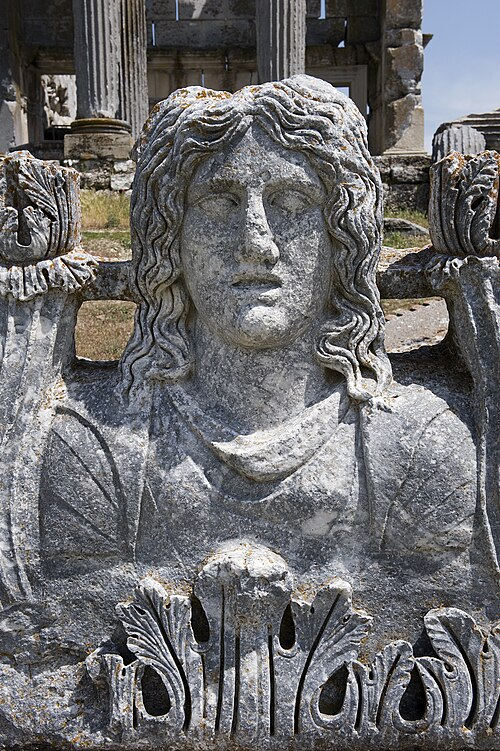
Statue in the Temple of Zeus at Aizanoi, believed to depict a sibyl
"Sibyls" redirects here. For the 1514 Italian painting, see Sibyls (Raphael).
For other uses, see Sibyl (disambiguation).
The sibyls[n ^1] were prophetesses or oracles in Ancient Greece.[1][2]
The sibyls prophesied at holy sites.[3] A sibyl at Delphi has been dated to as early as the eleventh century BC by Pausanias[4] when he described local traditions in his writings from the second century AD. At first, there appears to have been only a single sibyl. By the fourth century BC, there appear to have been at least three more, Phrygian, Erythraean, and Hellespontine. By the first century BC, there were at least ten sibyls, located in Greece, Italy, the Levant, and Asia Minor.
The English word sibyl (/ˈsɪbəl/) is from Middle English, via the Old French sibile and the Latin sibylla from the ancient Greek Σίβυλλα (Sibylla).[5] Varro derived the name from an Aeolic sioboulla, the equivalent of Attic theobule ("divine counsel").[6] This etymology is not accepted in modern handbooks, which list the origin as unknown.[7] There have been alternative proposals in nineteenth-century philology suggesting Old Italic[8][failed ^verification] or Semitic derivation.[9]
The first known Greek writer to mention a sibyl is (based on the testimony of Plutarch) Heraclitus (fl. 500 BC):
The Sibyl, with frenzied mouth uttering things not to be laughed at, unadorned and unperfumed, yet reaches to a thousand years with her voice by aid of the god.[10]
Walter Burkert observes that "frenzied women from whose lips the god speaks" are recorded very much earlier in the Near East, as in Mari in the second millennium and in Assyria in the first millennium".[11]
Until the literary elaborations of Roman writers, sibyls were not identified by a personal name, but by names that refer to the location of their temenos, or shrine.
In Pausanias, Description of Greece, the first sibyl at Delphi mentioned ("the former" [earlier]) was of great antiquity, and was thought, according to Pausanias, to have been given the name "sibyl" by the Libyans.[12] Sir James Frazer calls the text defective.
The second sibyl referred to by Pausanias, and named "Herophile", seems to have been based ultimately in Samos, but visited other shrines, at Clarus, Delos, and Delphi and sang there, but that at the same time, Delphi had its own sibyl.[12]
James Frazer writes, in his translation and commentary on Pausanias,[13] that only two of the Greek sibyls were historical: Herophile of Erythrae, who is thought to have lived in the eighth century BC, and Phyto of Samos who lived somewhat later. He observes that the Greeks at first seemed to have known only one sibyl, and instances Heraclides Ponticus[14] as the first ancient writer to distinguish several sibyls: Heraclides names at least three sibyls, the Phrygian, the Erythraean, and the Hellespontine.[15] The scholar David S. Potter writes, "In the late fifth century BC it does appear that 'Sibylla' was the name given to a single inspired prophetess".[16]
Like Heraclitus, Plato speaks of only one sibyl, but in course of time the number increased to nine, with a tenth, the Tiburtine Sibyl, probably Etruscan in origin, added by the Romans. According to Lactantius' Divine Institutions (Book 1, Ch. 6), Varro (first century BC) lists these ten: the Persian, the Libyan, the Delphic, the Cimmerian, the Erythræan, the Samian, the Cumæan, the Hellespontine (in Trojan territory), the Phrygian (at Ancyra), and the Tiburtine (named Albunea).
Specific sibyls
Cimmerian Sibyl
Naevius names the Cimmerian Sibyl in his books of the Punic War and Piso in his annals.
Evander, the son of Sibyl, founded in Rome the shrine of Pan that is called the Lupercal.
Cumaean Sibyl
The sibyl who most concerned the Romans was the Cumaean Sibyl, located near the Greek city of Naples, whom Virgil's Aeneas consults before his descent to the lower world (Aeneid book VI: 10). Burkert notes (1985, p. 117) that the conquest of Cumae by the Oscans in the fifth century destroyed the tradition, but provides a terminus ante quem for a Cumaean sibyl. She is said to have sold the original Sibylline books to Tarquinius Superbus, the last king of Rome. In Virgil's Fourth Eclogue, the Cumaean sibyl foretells the coming of a savior—possibly a flattering reference to the poet's patron, Augustus. Christians later identified this saviour as Jesus.[17][18][19]
Delphic Sibyl
Main article: Delphic Sibyl
The Delphic Sibyl was a woman who prophesied before the Trojan Wars (c. eleventh century BC). She was noted by Pausanias[4] in his writing during the second century AD about local traditions in Greece. This earliest documented Delphic Sibyl would have predated by hundreds of years the priestess of Apollo active at the oracle from around the eighth century BC who was known as Pythia.[20] As Greek religion passed through transitions to the pantheon of the Classical Greeks that is most familiar to modern readers, Apollo had become the deity represented by Pythia and those who then officiated at the already ancient oracle.
Erythraean Sibyl
The Erythraean Sibyl was sited at Erythrae, a town in Ionia opposite Chios.
Apollodorus of Erythrae affirms the Erythraean Sibyl to have been his own countrywoman and to have predicted the Trojan War and prophesied to the Greeks who were moving against Ilium both that Troy would be destroyed and that Homer would write falsehoods.
The word acrostic was first applied to the prophecies of the Erythraean Sibyl, which were written on leaves and arranged so that the initial letters of the leaves always formed a word.
Hellespontine Sibyl
The Hellespontine, or Trojan Sibyl, presided over the Apollonian oracle at Dardania.
The Hellespontian Sibyl was born in the village of Marpessus near the small town of Gergitha, during the lifetimes of Solon and Cyrus the Great. Marpessus, according to Heraclides of Pontus, was formerly within the boundaries of the Troad. The sibylline collection at Gergis was attributed to the Hellespontine Sibyl and was preserved in the temple of Apollo at Gergis. Thence it passed to Erythrae, where it became famous.
Libyan Sibyl
The Libyan Sibyl was identified with prophetic priestesses presiding over the ancient Zeus-Amon (Zeus represented with the horns of Amon) oracle at the Siwa Oasis in the Western Desert of Egypt. The oracle here was consulted by Alexander after his conquest of Egypt. The mother of the Libyan Sibyl was Lamia, the daughter of Poseidon. Euripides mentions the Libyan Sibyl in the prologue to his tragedy Lamia.
Persian Sibyl
The Persian Sibyl was said to be a prophetic priestess presiding over the Apollonian Oracle; although her location remained vague enough so that she might be called the "Babylonian Sibyl", the Persian Sibyl is said to have foretold the exploits of Alexander the Great.[21] Also named Sambethe, she was reported to be of the family of Noah.[21] The second-century AD traveller Pausanias, pausing at Delphi to enumerate four sibyls, mentions the "Hebrew Sibyl" who was
brought up in Palestine named Sabbe, whose father was Berosus and her mother Erymanthe. Some say she was a Babylonian, while others call her an Egyptian Sibyl.[22][23][24]
The medieval Byzantine encyclopedia, the Suda, credits the Hebrew Sibyl as author of the Sibylline oracles.
Phrygian Sibyl
The Phrygian Sibyl is most well known for being conflated with Cassandra, Priam's daughter in Homer's Iliad.[25] The Phrygian Sibyl appears to be a doublet of the Hellespontine Sibyl.
Samian Sibyl
The Samian sibyl's oracular site was at Samos.
Sibyl of the Rhine
Hildegard of Bingen, also known as the Sibyl of the Rhine, was a German Benedictine abbess and polymath. She was active as a writer, composer, philosopher, mystic, visionary, and as a medical writer and practitioner during the 12th. century. Hildegard regularly experienced visions and said that she saw all things in the light of God through the five senses.
Tiburtine Sibyl
Main article: Tiburtine Sibyl
To the classical sibyls of the Greeks, the Romans added a tenth, the Tiburtine Sibyl, whose seat was the ancient Sabino–Latin town of Tibur (modern Tivoli). The mythic meeting of Augustus with the Sibyl, of whom he inquired whether he should be worshiped as a god, was a favored motif of Christian artists. Whether the sibyl in question was the Etruscan Sibyl of Tibur or the Greek Sibyl of Cumae is not always clear. The Christian author Lactantius had no hesitation in identifying the sibyl in question as the Tiburtine Sibyl, nevertheless. He gave a circumstantial account of the pagan sibyls that is useful mostly as a guide to their identifications, as seen by fourth-century Christians:
The Tiburtine Sibyl, by name Albunea, is worshiped at Tibur as a goddess, near the banks of the Anio, in which stream her image is said to have been found, holding a book in her hand. Her oracular responses the Senate transferred into the capitol. (Divine Institutes I.vi)
An apocalyptic pseudo-prophecy exists, attributed to the Tiburtine Sibyl, written c. AD 380, but with revisions and interpolations added at later dates.[26] It purports to prophesy the advent of a final emperor named Constans, vanquishing the foes of Christianity, bringing about a period of great wealth and peace, ending paganism, and converting the Jews. After vanquishing Gog and Magog, the emperor is said to resign his crown to God. This would give way to the Antichrist. Ippolito d'Este rebuilt the Villa d'Este at Tibur, the modern Tivoli, from 1550 onward, and commissioned elaborate fresco murals in the Villa that celebrate the Tiburtine Sibyl, as prophesying the birth of Christ to the classical world.
In Renaissance art and literature
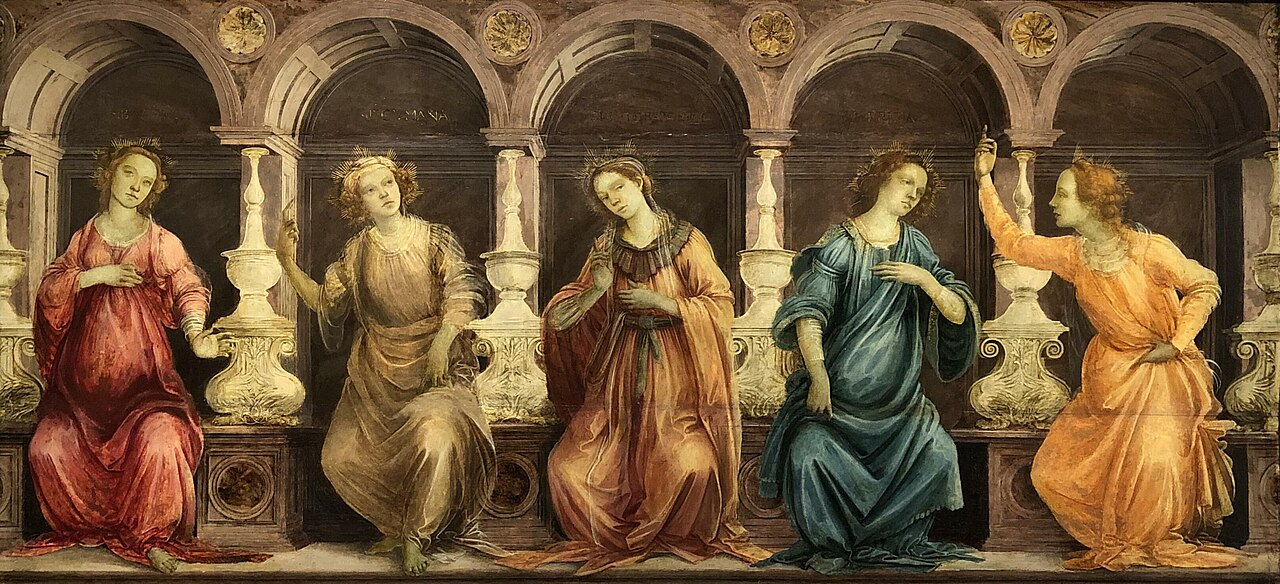
English:Filippino Lippi (1457-1504), Five Sibyls Seated in Niches: the Samian, Cumean, Hellespontic, Phrygian and Tiburtine, ca. 1465-1470, oil on poplar panel; collection of Christ Church, Oxford, photographed on display at the Legion of Honor, San Francisco, by Steven Saylor, January 2024.
Prophetesses from Classical literature, the sibyls were considered by later Christian theologians to have foretold Christ's birth, death, and resurrection. Two paintings, each showing five sibyls, were executed by Botticelli and Filippino Lippi, the son of Fra Filippo Lippi, who from 1472 was Botticellis pupil and associate. While working in a uniform format, each artist approached his panel with his own individual style. As the senior artist, Botticelli was likely responsible for the overall design: a sequence of five draped, seated figures, each framed by a niche separated by a series of candelabra-shaped columns. Their names are inscribed behind them on the corresponding walls, and eleven of their prophecies ("dicta sibillarum") on the advent of Christ are strung together into two lengthy texts underneath the figures.