Phytophthora infestans
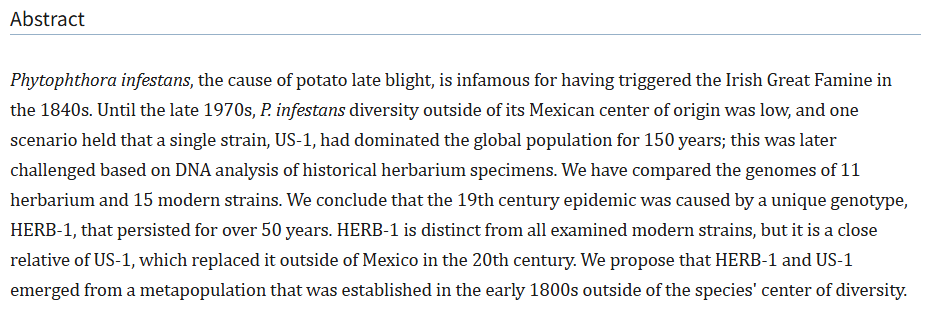
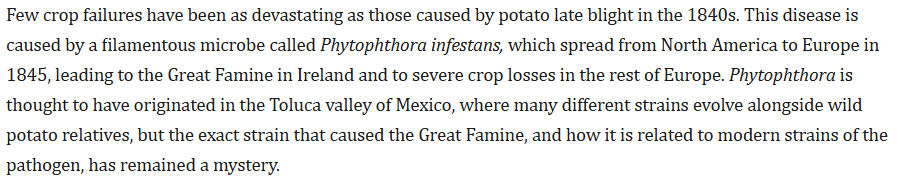
Phytophthora infestans is the oomycete pathogen responsible for potato late blight — the disease that triggered the Irish Potato Famine (1845–1852), the 1840s European potato blight, and the 1846 Highland potato famine. Originating in the Toluca Valley of central Mexico, a single clonal lineage (HERB-1) was transported to the Americas and then to Europe in infected potato cargo during the early 1840s, where it devastated a continent dependent on monoculture potato agriculture. Far from a historical relic, P. infestans remains the most economically destructive plant pathogen on Earth, costing global agriculture an estimated $3–10 billion annually and continuing to evolve new virulent lineages that outpace host resistance.
The rise and fall of the Phytophthora infestans lineage that triggered the Irish potato famine - PMC
2. Definitions
Phytophthora infestans: An oomycete (water mold) of the class Oomycetes, order Peronosporales, family Peronosporaceae. Despite its filamentous, fungus-like growth, it belongs to the stramenopiles — a lineage more closely related to brown algae and diatoms than to true fungi. The name translates from Greek and Latin as "plant destroyer that infests."
Oomycete: A class of filamentous, typically diploid microorganisms within the stramenopile kingdom. Oomycetes were historically classified as fungi due to similar growth patterns but are phylogenetically distinct.
Late Blight: The plant disease caused by P. infestans, characterized by dark lesions on leaves, stems, and tubers of potato and tomato plants. Under cool, moist conditions, the pathogen can destroy an entire field within days.
Sporangium (pl. Sporangia): A sac-like reproductive structure produced on aerial sporangiophores. Sporangia are the primary dispersal unit of P. infestans, carried by wind and rain to new host plants.
Zoospore: A motile, wall-less, biflagellated spore released from sporangia at temperatures below 15°C (59°F). Zoospores swim in free water to reach and penetrate host plant cells.
HERB-1: The designation given to the specific P. infestans genotype identified from 19th-century herbarium specimens, confirmed by genomic analysis as the strain responsible for the Irish Potato Famine. It is distinct from the later-dominant US-1 lineage.
FAM-1: An alternative designation used in some studies for the pandemic genotype that caused late blight outbreaks in the 1840s across the United States and Europe, overlapping with or closely related to the HERB-1 lineage.
Mating Types (A1 and A2): P. infestans is heterothallic, requiring two complementary mating types for sexual reproduction. Sexual reproduction produces durable oospores and promotes genetic recombination, generating offspring with novel virulence traits.
Solanaceae: The nightshade family of plants, which includes potato (Solanum tuberosum), tomato (Solanum lycopersicum), and other species susceptible to P. infestans infection.
Historical Timeline
Pre-1840s — P. infestans co-evolves with wild potato relatives in the Toluca Valley, central Mexico, its center of origin, where it undergoes frequent sexual reproduction alongside closely related species P. mirabilis and P. ipomoeae.
Source: Goodwin et al. (1994); Grünwald & Flier (2005), cited in Yoshida et al., "The rise and fall of the Phytophthora infestans lineage that triggered the Irish potato famine," eLife (2013) — https://pmc.ncbi.nlm.nih.gov/articles/PMC3667578/
Quote: "The species is thought to originate from Toluca Valley, Mexico, where it infects wild relatives of potato, frequently undergoes sexual reproduction and co-occurs with the two closely related species P. mirabilis and P. ipomoeae." — Yoshida et al. (2013), eLife, Introduction.
Summer 1843 — P. infestans strikes potato crops in the eastern United States for the first time, marking its first documented appearance outside its center of origin.
Source: Ireland's Great Hunger Museum, "The Potato Blight" — https://www.ighm.org/learn.html
Quote: "Phytophthora infestans, the fungus that invades the potato plant and causes its rapid decay, struck for the first time in the eastern United States in the summer of 1843." — IGHM, "The Potato Blight."
Summer 1845 — Blight spores, transported in apparently healthy potato cargo, revive in Belgium and devastate crops across Flanders, Normandy, Holland, and southern England.
Source: Ireland's Great Hunger Museum, "The Potato Blight" — https://www.ighm.org/learn.html
Quote: "The invisible fungus spores were transported to Belgium in a cargo of apparently healthy potatoes, and in the summer of 1845 the fungus revived and reproduced, devastating the potato crop in Flanders, Normandy, Holland and southern England." — IGHM, "The Potato Blight."
August 1845 — Blight recorded at the Dublin Botanical Gardens; total crop failure reported in County Fermanagh within one week. By October, panic in western Ireland.
Source: Ireland's Great Hunger Museum, "The Potato Blight" — https://www.ighm.org/learn.html
Quote: "By August of 1845 the blight was recorded at the Dublin Botanical Gardens, and a week later, a total failure of the crop was reported in County Fermanagh." — IGHM, "The Potato Blight."
1845–1852 — The Irish Potato Famine (An Gorta Mór). Approximately one million die, over two million emigrate. Ireland's population falls from ~8.5 million to 6.6 million by 1851 and continues declining to 4.4 million by 1901.
Source: Nature Communications, "Evolution of Phytophthora infestans on its potato host since the Irish potato famine" (2024) — https://www.nature.com/articles/s41467-024-50749-4
Quote: "This epidemic (1845–1852) had profound consequences in Ireland, leading to the Irish Famine which resulted in the death of about 1 million people and the emigration of another 1 million people, as potatoes were a staple food." — Nature Communications (2024), Introduction.
1846 — The pathogen is first identified by M. J. Berkeley, who describes the organism causing potato blight. The 1846 Highland potato famine devastates Scotland.
Source: Nature Communications (2024), Introduction — https://www.nature.com/articles/s41467-024-50749-4
Quote: "The responsible plant pathogen was identified in 1846 by M. J. Berkeley." — Nature Communications (2024), Introduction.
1876 — Anton de Bary formally renames the pathogen Phytophthora infestans, establishing the modern nomenclature. De Bary's work is foundational to the discipline of plant pathology itself.
Source: Nature Communications (2024), Introduction — https://www.nature.com/articles/s41467-024-50749-4
Quote: "Subsequently renamed Phytophthora infestans in 1876 by Anton de Bary." — Nature Communications (2024), Introduction.
1866–1915 — Herbarium specimens from this period document the continued prevalence of the HERB-1 mitochondrial haplotype (type Ia) in global P. infestans populations.
Source: Martin et al., "Historic Late Blight Outbreaks Caused by a Widespread Dominant Lineage of Phytophthora infestans," PLOS ONE (2016) — https://journals.plos.org/plosone/article?id=10.1371/journal.pone.0168381
Quote: "A survey of mitochondrial haplotypes in a larger set of global herbarium specimens documented the more frequent occurrence of the HERB-1 (type Ia) mitochondrial haplotype in archival collections from 1866–75 and 1906–1915." — Martin et al. (2016), Abstract.
Mid-20th century — The US-1 lineage (Ib mitochondrial haplotype) displaces HERB-1 globally, becoming the dominant clonal lineage worldwide for decades.
Source: Martin et al. (2016), PLOS ONE — https://journals.plos.org/plosone/article?id=10.1371/journal.pone.0168381
Quote: "The FAM-1 SSR lineage survived for almost 100 years in the US, was geographically widespread, and was displaced first in the mid-20th century by the US-1 lineage and then by distinct new aggressive lineages that migrated from Mexico." — Martin et al. (2016), Abstract.
2009 — The genome of *P. infestans* is fully sequenced, revealing a 240 Mb genome — one of the largest among oomycetes — with rapidly evolving effector gene families that explain its extraordinary adaptability.
Source: Haas et al., "Genome sequence and analysis of the Irish potato famine pathogen Phytophthora infestans," Nature (2009) — https://www.nature.com/articles/nature08358
Quote: "Comparison with two other Phytophthora genomes shows rapid turnover and extensive expansion of specific families of secreted disease effector proteins, including many genes induced during infection that have activities thought to alter host physiology." — Haas et al. (2009), Abstract.
2013 — Yoshida et al. extract and sequence DNA from 19th-century herbarium specimens, confirming that the HERB-1 lineage — distinct from modern strains — was the specific genotype that triggered the Irish Potato Famine.
Source: Yoshida et al., "The rise and fall of the Phytophthora infestans lineage that triggered the Irish potato famine," eLife (2013) — https://pmc.ncbi.nlm.nih.gov/articles/PMC3667578/
2024 — Ongoing research documents the continued evolution of P. infestans on its potato host, with new aggressive lineages surfacing globally. Late blight remains the most important biotic constraint to potato production worldwide, costing $3–10 billion USD annually.
Source: Savary et al. and Kamoun et al., cited in Li et al., "Potato late blight caused by Phytophthora infestans: From molecular interactions to integrated management strategies," Journal of Integrative Agriculture (2022) — https://www.sciencedirect.com/science/article/pii/S2095311922001381
Quote: "Globally, yield loss and management cost for PLB can add up to 3–10 billion USD per annum." — Li et al. (2022), Introduction.