Owl
DOWNLOADED: 8/31/2025, 9:04:39 PM
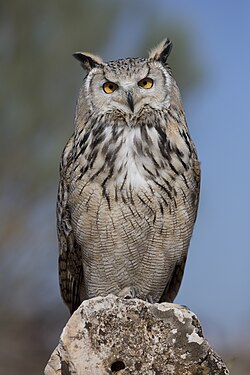
Owls are birds from the order Strigiformes[1] (/ˈstrɪdʒəfɔːrmiːz/), which includes over 200 species of mostly solitary and nocturnal birds of prey typified by an upright stance, a large, broad head, binocular vision, binaural hearing, sharp talons, and feathers adapted for silent flight. Exceptions include the diurnal northern hawk-owl and the gregarious burrowing owl.
Owls are divided into two families: the true (or typical) owl family, Strigidae, and the barn owl and bay owl family, Tytonidae.[2] Owls hunt mostly small mammals, insects, and other birds, although a few species specialize in hunting fish. They are found in all regions of the Earth except the polar ice caps and some remote islands.
A group of owls is called a "parliament".[3]
Sexual dimorphism

A stamp from the Soviet Union, 1979
Sexual dimorphism is a physical difference between males and females of a species. Female owls are typically larger than the males.[12] The degree of size dimorphism varies across multiple populations and species, and is measured through various traits, such as wing span and body mass.[12]
One theory suggests that selection has led males to be smaller because it allows them to be efficient foragers. The ability to obtain more food is advantageous during breeding season. In some species, female owls stay at their nest with their eggs while it is the responsibility of the male to bring back food to the nest.[13] If food is scarce, the male first feeds himself before feeding the female.[14] Small birds, which are agile, are an important source of food for owls. Male burrowing owls have been observed to have longer wing chords than females, despite being smaller than females.[14] Furthermore, owls have been observed to be roughly the same size as their prey.[14] This has also been observed in other predatory birds,[13] which suggests that owls with smaller bodies and long wing chords have been selected for because of the increased agility and speed that allows them to catch their prey.[citation needed]
Another popular theory suggests that females have not been selected to be smaller like male owls because of their sexual roles. In many species, female owls may not leave the nest. Therefore, females may have a larger mass to allow them to go for a longer period of time without starving. For example, one hypothesized sexual role is that larger females are more capable of dismembering prey and feeding it to their young, hence female owls are larger than their male counterparts.[12]
A different theory suggests that the size difference between male and females is due to sexual selection: since large females can choose their mate and may violently reject a male's sexual advances, smaller male owls that have the ability to escape unreceptive females are more likely to have been selected.[14]
If the character is stable, there can be different optimums for both sexes. Selection operates on both sexes at the same time; therefore it is necessary to explain not only why one of the sexes is relatively bigger, but also why the other sex is smaller.[15] If owls are still evolving toward smaller bodies and longer wing chords, according to V. Geodakyan's Evolutionary Theory of Sex, males should be more advanced on these characters. Males are viewed as an evolutionary vanguard of a population, and sexual dimorphism on the character, as an evolutionary "distance" between the sexes. "Phylogenetic rule of sexual dimorphism" states that if there exists a sexual dimorphism on any character, then the evolution of this trait goes from the female form toward the male one.[16]
Behavior

Comparison of an owl (left) and hawk (right) remex.

The serrations on the leading edge of an owl's flight feathers reduce noise

Owl eyes each have nictitating membranes that can move independently of each other, as seen on this spotted eagle-owl in Johannesburg, South Africa.
Most owls are nocturnal, actively hunting their prey in darkness. Several types of owls are crepuscular—active during the twilight hours of dawn and dusk; one example is the pygmy owl (Glaucidium). A few owls are active during the day, also; examples are the burrowing owl (Speotyto cunicularia) and the short-eared owl (Asio flammeus).
Much of the owls' hunting strategy depends on stealth and surprise. Owls have at least two adaptations that aid them in achieving stealth. First, the dull coloration of their feathers can render them almost invisible under certain conditions. Secondly, serrated edges on the leading edge of owls' remiges muffle an owl's wing beats, allowing an owl's flight to be practically silent. Some fish-eating owls, for which silence has no evolutionary advantage, lack this adaptation.
An owl's sharp beak and powerful talons allow it to kill its prey before swallowing it whole (if it is not too big). Scientists studying the diets of owls are helped by their habit of regurgitating the indigestible parts of their prey (such as bones, scales, and fur) in the form of pellets. These "owl pellets" are plentiful and easy to interpret, and are often sold by companies to schools for dissection by students as a lesson in biology and ecology.[37]
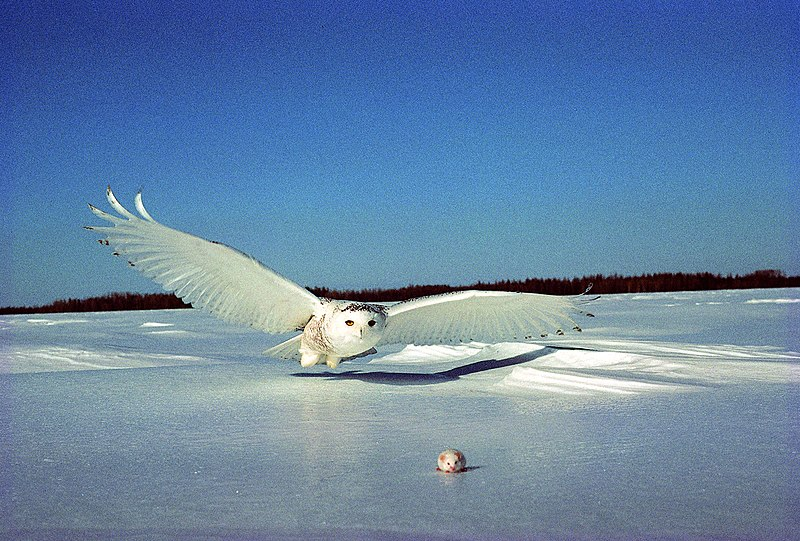
Copyrighted free use, https://commons.wikimedia.org/w/index.php?curid=1917098