Hermeneutics
Wednesday, September 03, 2025 08:27AM
downloaeded: Wednesday, September 03, 2025 09:20AM
| Part of a series on |
|---|
| Research |
Hermeneutics (/hɛrməˈnuːtɪks/ or /hɛrməˈnjuːtɪks/)[1] is the theory and methodology of interpretation,[2][3] especially the interpretation of biblical texts, wisdom literature, and philosophical texts.[4][5] It started out as a theory of text interpretation but has been later broadened to questions of general interpretation.[6]
Hermeneutics was initially applied to the interpretation, or exegesis, of scripture. The terms "hermeneutics" and "exegesis" are sometimes used interchangeably. Hermeneutics is a wider discipline which includes written, verbal, and non-verbal[7][8] communication. Exegesis focuses primarily upon texts.
7) Zimmermann, Jens (2015). Hermeneutics: A Very Short Introduction. Oxford University Press. p. 2. ISBN 9780199685356.
8) The Routledge Companion to Philosophy in Organization Studies, Routledge, 2015, p. 113.
Modern hermeneutics includes both verbal and non-verbal communication[7][8] as well as semiotics, presuppositions, and pre-understandings. Hermeneutics has been broadly applied in the humanities, especially in law, history and theology.
Hermeneutic, as a singular noun, refers to some particular method of interpretation (see, in contrast, double hermeneutic).
Etymology
Hermeneutics is derived from the Greek word ἑρμηνεύω (hermēneuō, "translate, interpret"),[11] from ἑρμηνεύς (hermeneus, "translator, interpreter"). While the etymology is uncertain, both R. S. P. Beekes (2009)[12] and Zsolt Simon (2019)[13] suggest an Anatolian (Carian) origin.
The technical term ἑρμηνεία (hermeneia, "interpretation, explanation") was introduced into philosophy mainly through the title of Aristotle's work Περὶ Ἑρμηνείας (Peri Hermeneias), commonly referred to by its Latin title De Interpretatione and translated in English as On Interpretation. It is one of the earliest (c. 360 BCE) extant philosophical works in the Western tradition to deal with the relationship between language and logic in a comprehensive, explicit and formal way.
The early usage of "hermeneutics" places it within the boundaries of the sacred.[14]: 21 A divine message must be received with implicit uncertainty regarding its truth. This ambiguity is an irrationality; it is a sort of madness that is inflicted upon the receiver of the message. Only one who possesses a rational method of interpretation (i.e., a hermeneutic) could determine the truth or falsity of the message.[14]: 21–22
Hermeneutics (/hɜːrməˈnjuːtɪks/)[1] is the theory and methodology of interpretation,[2][3][4] especially the interpretation of biblical texts, wisdom literature, and philosophical texts.[5][6] As necessary, hermeneutics may include the art of understanding and communication.[7]
Modern hermeneutics includes both verbal and non-verbal communication,[8][9] as well as semiotics, presuppositions, and pre-understandings. Hermeneutics has been broadly applied in the humanities, especially in law, history and theology.
Hermeneutics was initially applied to the interpretation, or exegesis, of scripture, and has been later broadened to questions of general interpretation.[10] The terms hermeneutics and exegesis are sometimes used interchangeably. Hermeneutics is a wider discipline which includes written, verbal, and nonverbal[8][9] communication. Exegesis focuses primarily upon the word and grammar of texts.
Hermeneutic, as a count noun in the singular, refers to some particular method of interpretation (see, in contrast, double hermeneutic).
Etymology
Hermeneutics is derived from the Greek word ἑρμηνεύω (hermēneuō, "translate, interpret"),[11] from ἑρμηνεύς (hermeneus, "translator, interpreter"). While the etymology is uncertain, both R. S. P. Beekes (2009)[12] and Zsolt Simon (2019)[13] suggest an Anatolian (Carian) origin.
The technical term ἑρμηνεία (hermeneia, "interpretation, explanation") was introduced into philosophy mainly through the title of Aristotle's work Περὶ Ἑρμηνείας (Peri Hermeneias), commonly referred to by its Latin title De Interpretatione and translated in English as On Interpretation. It is one of the earliest (c. 360 BCE) extant philosophical works in the Western tradition to deal with the relationship between language and logic in a comprehensive, explicit and formal way.
The early usage of "hermeneutics" places it within the boundaries of the sacred.[14]: 21 A divine message must be received with implicit uncertainty regarding its truth. This ambiguity is an irrationality; it is a sort of madness that is inflicted upon the receiver of the message. Only one who possesses a rational method of interpretation (i.e., a hermeneutic) could determine the truth or falsity of the message.[14]: 21–22
Folk etymology
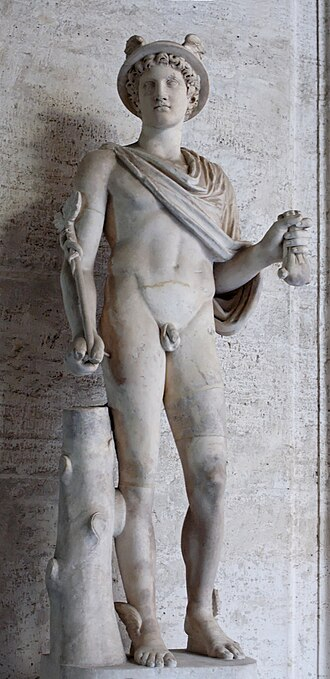
 Hermes, messenger of the gods
Folk etymology places its origin with Hermes, the mythological Greek deity who was the 'messenger of the gods'.[15] Aside from being a mediator among the gods and between the gods and men, he led souls to the underworld upon death.
Moreover, Hermes was considered the inventor of language and speech, an interpreter, a liar, a thief, and a trickster.[15] These multiple roles made Hermes an ideal representative figure for hermeneutics. As Socrates noted, words have the power to reveal or conceal and can deliver messages in an ambiguous way.[15] The Greek view of language as consisting of signs that could lead to truth or to falsehood was the essence of Hermes, who was said to relish the uneasiness of those who received the messages he delivered.[16]: 63