Altered state of consciousness
This article is about the psychological concept. For the medical concept, see Altered level of consciousness.
An altered state of consciousness (ASC)[1], also called an altered state of mind, altered mental status (AMS), mind alteration, or an altered state of awareness, is a condition significantly different from ordinary waking consciousness, in which normal consciousness is suspended, replaced, or otherwise altered.[2]
Such alterations in mental state are generally temporary and
are commonly induced, although
in the broadest sense
sleep itself
constitutes
an altered state of consciousness.[1][2]
The term is
- more commonly applied to
- induced states,
- ranging from those produced by
- drugs
- to those arising through meditation practices.[2]
Debate has concerned
- whether the various induced states are
- fundamentally identical or
- whether states occurring in religious contexts
- differ in kind.
This discussion has also raised the possibility that "altered states of consciousness" may itself constitute a category error by suggesting that a number of discrete neurophysiological or brain states can appropriately be subsumed under a single heading.[2]
History of the term
By 1892,
- the expression was in use in relation to hypnosis,[3]
- though there is an ongoing debate
- as to whether hypnosis
- is to be identified as an ASC
- according to its modern definition.
- The next retrievable instance,
- by Max Mailhouse
- from his 1904 presentation to conference,[4]
- however, is
- unequivocally identified as such,
- as it was in relation to epilepsy, and
- is still used today.
- In academia,
- the expression was used
- as early as 1966
- by Arnold M. Ludwig[5] and
- brought into common usage
- from 1969
- by Charles Tart.[6][7]
Definitions
There is no general definition of an altered state of consciousness,
as any definitional attempt would
first have to rely on a definition
of a normal state of consciousness.[8]
Attempts to define the term can however be found in philosophy, psychology and neuroscience.
There is no final consensus on what the most accurate definition is.[9]
The best-established and latest definitions are provided below.
Arnold M. Ludwig attempted a first definition in 1966.
An altered state is any mental state(s), induced by various physiological, psychological, or pharmacological maneuvers or agents, which can be recognized subjectively by the individual himself (or by an objective observer of the individual) as representing a sufficient deviation in subjective experience of psychological functioning from certain general norms for that individual during alert, waking consciousness.[10]
rk NOTE: Article just finished saying that it would be inappropriate to declare what is a "NORMAL" state of consciousness. Who has the right to DECIDE what is "normal" for anybody EVER? It is no secret any more that the pathogenic forces (which may include BIG PHARMA and FAUCI-like clinicians in medicine and psychology and psychiatry) are trying to make those of us who are "awakened" to their bullshit appear CRAZY. It is also being researched that many of the diagnoses in the DSM5 have been CREATED in that effort (particularly: Dementia, Alzheimers, Autism, Schizophrenia, SchizoAffective disorder and others). This article appears to be written from that perspecetive with the added suggestion that certain religious practices (mostly of the indigenous populations around the world) are symptoms of any number of disorders rather than as a prayer with their Creator (GOD) or a
GIFT from GOD and GODDESS such as
being an Empath or a Mystic or a Shaman/Shamanka, that have been acknowledged as legitimate all over the Earth, from the beginning of Humanity.
Starting from this, Charles Tart focuses his definition on the subjective experience of a state of consciousness and its deviation from a normal waking state.
Altered states of consciousness are alternate patterns or configurations of experience, which differ qualitatively from a baseline state.[note ^1][11]
rk NOTE: Who determines the "baseline state"? Is it the same thugs that compose the DSM5? Do they work in conjunction with BIG PHARMA? Do they get "kickbacks" for all the psych meds they throw at people who are most likely being stalked and haunted by some DEMON? This is "spiritual warfare" we are experiencing and this is a KNOWN TACTIC. It is a "crime against humanity. It was only today that I read online that Michael Robinson (alias Michelle Obama) was HUNG FOR TREASON and that there will be a public execution for someone this November (2026) broadcasted on local television. It was noted that this is an "event driven war" and that the timeline may change for this public execution. I am confident that the BABY-EATERS are on the run because the site on rumble.com (WeThePeopleNEWS/Situation Update) has a very good reputation for reporting the TRUTH.
Farthing's definition of an altered state of consciousness (ASC) is based on Charles Tart's terminology.
Charles Tart described an altered state of consciousness as a profound change in the "overall pattern of subjective experiences".[12]
rk NOTE: I have the same comments here also. I would also say, who gives anyone the right to define what an "overall pattern of subjective experience" is?
In order to define an ASC, Tart focuses on the importance of subjective experience.
Farthing adds to his definition that an ASC is short-termed or at least reversible and that it might not even be recognized as an ASC at that moment.
His definition relies only on subjective experience, leaving aside behavioral changes and physiological response.
An altered state of consciousness (ASC) may be defined as a temporary change in the overall pattern of subjective experience, such that the individual believes that his or her mental functioning is distinctly different from certain general norms for his or her normal waking state of consciousness. (Farthing, 1992, p. 205)
rk NOTE: For instance:
- spirituality
- flow
- sleep
- daydreaming
- nightmares
- haunting
- trauma
- prayer
- meditation
- creative expression
- music
- journaling
- concentration
- movie viewing
- sports viewing
- boxing viewing
- war viewing
- abuse
- being lied to (this medicine will help you feel better)
- should I go on?
He lists fourteen dimensions of changed subjective experience. To account for an ASC, multiple dimensions need to be altered.[13]
A working definition for empirical research based on these previous definitions was by Schmidt in 2016:[8]
rk NOTE: Were "THEY" getting ready for Agenda 2030?
#426). What is AGENDA 2030?:
https://bra.in/3jb3ak
[Translated from German]: As a working definition for neuroscientific research, it might suffice to presume that most people have a strong intuition concerning which variability in their everyday wakeful state feels normal to them. This variability of experience is considered as normal fluctuation, while any state that is experienced to diverge significantly from it can be called an ASC. From an experimental perspective, it is also reasonable to compare ASC conditions to a baseline state – a state subjectively judged as average, or normal. The comparison with a 'normal' baseline requires that the ASC under investigation is of relatively short duration (minutes to hours), which differentiates ASCs from most pathological conditions. Importantly, it has been emphasized that an ASC is not a mere quantitative change in a single cognitive function (e.g. elevated arousal). Instead, it is a multidimensional phenomenon. Thereby, the relative intensity of multiple consciousness aspects constitutes a 'phenomenological pattern' characterizing a particular state. Such 'patterns' have also been referred to as relative changes in the '(basic) dimensions of consciousness'. For empirical research, such patterns correspond to a multivariate combination of independent 'consciousness factors', which can be quantified via questionnaires. The 'phenomenological pattern' results from the factor structure of the applied psychometric assessment, i.e. the individual ratings, or factor scores, of a questionnaire.
History
History of utilization of ASCs
Altered states of consciousness might have been employed by humans as early as 30,000 years ago.[11]
Mind-altering plants and/or excessive dancing were used to attain an ecstatic or mystic state.[14]
Examples of early religious use of altered states of consciousness are the rites of Dionysus and the Eleusinian Mysteries,[15] as well as yoga and meditation.[11]
Followers of various shamanic traditions "enter altered states of consciousness in order to serve their community."[15]
Terence McKenna has suggested that the use of psychedelic mushrooms in prehistoric times has led to the "evolution of human language and symbol use".[16] '
Some theorists propose that mind-altering substances, such as soma, might have pushed the formation of some of the world's main religions.[15][17]
Meditation in its various forms is being rediscovered by modern psychology because of its therapeutic potential and its ability to "enable the activity of the mind to settle down".[18] In psychotherapy, techniques like hypnosis and meditation support psychological processes.[19]
History of scientific study
See also: Scholarly approaches to mysticism
Due to the behaviourist paradigm in psychology altered states of consciousness were dismissed as a field of scientific inquiry during the early 20th century.[20] They were pathologized and merely seen as symptoms of intoxication or demonic possession.[21]
Their return into psychology began with William James's interest into a variety of altered states, such as "mystical experiences and drug-induced states".[9] James' investigations into first-person-subjective-experience contributed to the reconsideration of introspection as a valuable research method in the academic community.[9]
The social change of the turbulent 1960s has decisively led to a change of the scientific perspective to the point that introspection as a scientific method and ASCs as valid realms of experience became more widely accepted.[22]
Foundations for the research have been laid out by various scientists such as Abraham Maslow, Walter N. Pahnke, Stanislav Grof, and Charles Tart.[23] They focused on seemingly beneficial aspects of ASCs such as their potential to "promote creativity or treat addiction".[10]
rk NOTE: Be advised that one of the goals of the pathogenic forces is to increase addictions in populations all over the world in an effort to "cull the herd" as in Transhumanism.
See #706). LINK to: JOE ROGAN INTERVIEWS ELON MUSK:
https://rumble.com/v7hgezk-heydonmusicpage-latest-videos-and-breaking-news-10.27.26.html?e9s=src_v1_clr%2Csrc_v1_ucp_a
Rather oppressive states such as dissociation from trauma were neglected.
The findings of the famous Good Friday Experiment by Pahnke suggest that mystical experiences can be triggered by psilocybin.
Later investigations by Rick Doblin found that participants valued those experiences as "spiritual high points of their lives".[11]
In the midst of the rise of new-age subculture Stanislav Grof and others formed the new field of transpersonal psychology, which emphasized "the importance of individual human experience, validity of mystical and spiritual experience, interconnectedness of self with others and the world and potential of self-transformation".[24]
Abraham Maslow's research on peak experiences, as moments of "highest happiness and fulfillment",[24] further contributed to the depathologization of altered states.
A first summary of the existing literature was carried out by Charles T. Tart in his book Altered States of Consciousness, which led to a more common use of the term.[24]
Tart coined the key terms discrete[note ^2] and baseline states of consciousness, and thought about a general classification system for ASCs.[25]
He also called for "state specific sciences"[11] in which researchers should do science on ASCs from within such states.
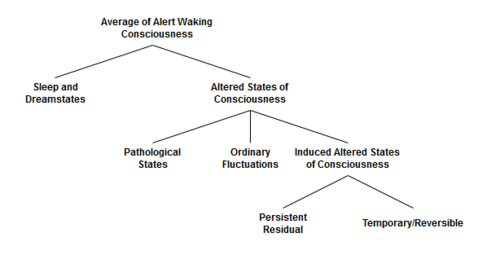
A simple classification scheme for ASC. Sleep and dream states are distinguished from waking consciousness since they account for substantially different ways of the ability of memory formation and retrieval.
Psychiatric diseases that go along with persistent changes of consciousness, like schizophrenia, are covered with the term "pathological conditions".
In contrast, the classification scheme includes intended and induced ASCs as well as general fluctuations of neurotransmission, which are reversible and short-termed.
rk NOTE: Is the author using the term "neurotransmission" as a synonym for hypnosis?
One step further, the graph suggests splitting induced ASCs in persistent and reversible states. Translated from German Schmidt & Majic.[8]
See PDF for complete Wikipedia article downloaded:
Friday, October 30, 2026 09:36AM
Highlights, questions, and comments are mine:
#614). MindMap:
I AM SINCERELY:
https://bra.in/9vAeW3