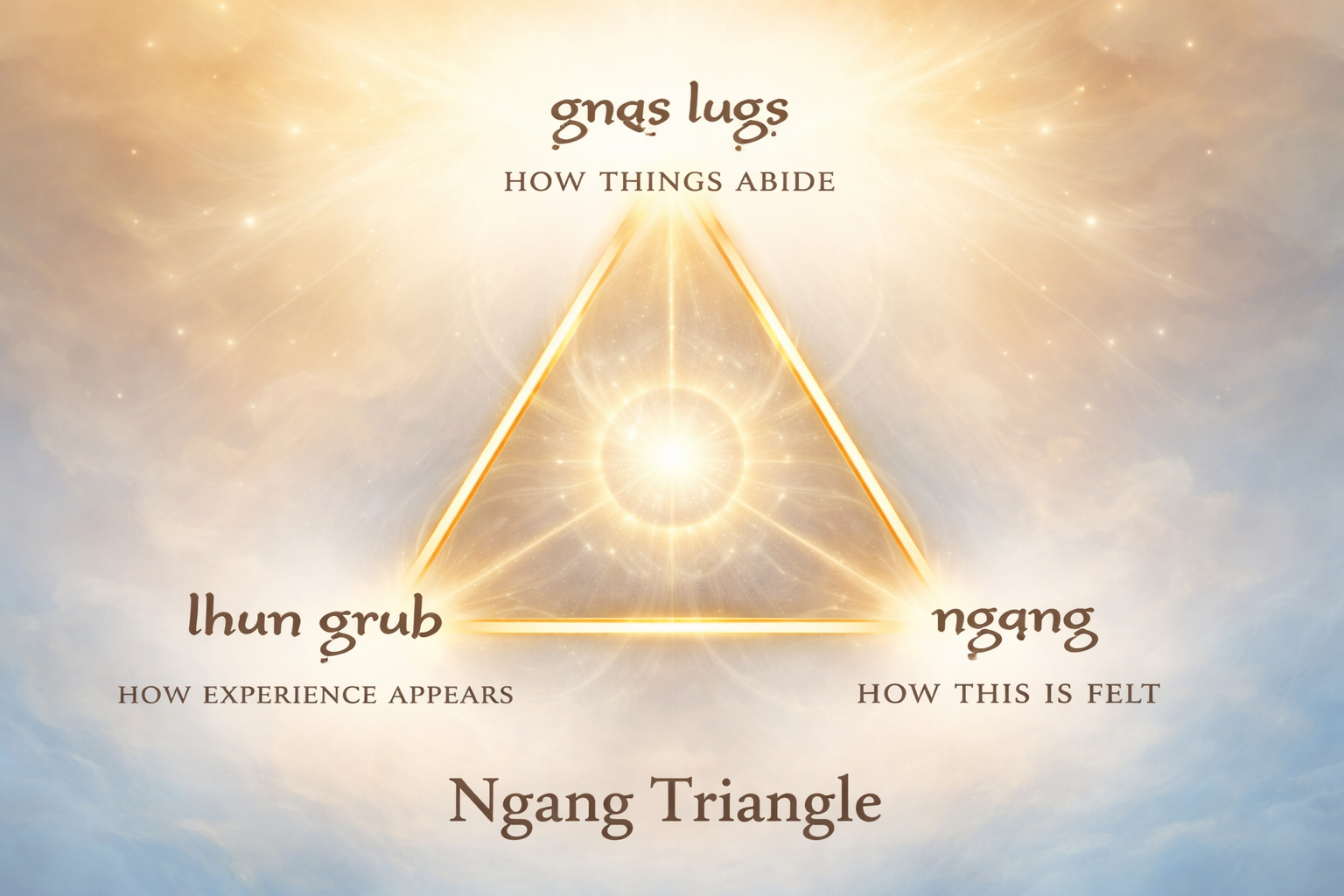
The Ngang Triangle
Adapted and enlarged from ngang.
Prior to Conceptualization
The ngang triangle names three inseparable aspects of lived reality in Dzogchen: gnas lugs points to how things abide—namely, that nothing, not even awareness, exists inherently or as a stable ground; lhun grub points to how experience nonetheless appears—vividly, dynamically, and effortlessly, without a doer or controller; and ngang points to how this inseparability is actually lived and felt in the immediacy of the present moment, prior to conceptualization.
Together they show how emptiness and appearance are not opposing truths but a single lived event: nothing improves or degrades at the level of essence, yet patterns shift and responsiveness deepens in experience, without positing a self that changes.
The triangle functions less as a doctrine than as a safeguard—preventing emptiness from collapsing into nihilism, appearance into reification, and awareness into a subtle metaphysical ground—by continuously returning understanding to the felt mode of being itself.
Gnas lugs – mode of abiding or how things actually are. What can be said for how things exist. Nothing ever improves (or degrades).
Ihun grub – spontaneous presence, effortless unfolding. This is the appearance side. Despite not being a thing, experience keeps happening without anyone manufacturing it. No controller.
Ngang – the lived mode, the felt immediacy of experiencing.
This is where the other two are not philosophical claims but directly tasted. It’s the way emptiness and appearance are known as they are happening, before commentary. Not “I am resting in emptiness,” not “phenomena are spontaneously present,” but simply this: how this moment is being lived right now.
• gnas lugs → what can be said about how things exist (they don’t, inherently)
• lhun grub → what can be said about how things appear (they do, vividly and effortlessly)
• ngang → how that inseparability is actually experienced
And ngang is where these two are not contradictory.
Because in lived experience, there can be less contraction, more openness, more responsiveness, without there ever being a metaphysical self that “got better.”
This triangle is also how Dzogchen avoids turning rigpa into an absolute. Rigpa is not a thing with gnas lugs, not a substance that produces lhun grub, and not an experience that can be grasped in ngang. It’s just another name for this inseparable reality when recognized.
Yes… and this is a beautiful request. Integration happens through story far more easily than through structure 😊 Let me offer you a simple, lived narrative you can return to, not as a doctrine, but as a way of feeling the triangle in motion.
A Tale of the Ngang Triangle
You’re sitting somewhere ordinary — maybe with a cup of tea, maybe just standing still for a moment. A sound arises: a car passes, a machine hums, a bird calls. Instantly, without effort, the sound appears. You didn’t summon it, you didn’t choose it, and you don’t need to hold it in place. This is lhun grub — the spontaneous, self-arising display of experience. Life is already happening, unasked.
At the same time, if you look closely, you can’t find the sound as a thing. It has no edge, no core, no place it abides. As soon as it appears, it’s already dissolving. There is no sound you can grasp, no awareness behind it that stands apart. This is gnas lugs — the way things abide: empty, unfixed, unfindable, including the hearing itself.
Now notice something subtler. You don’t need to think about the sound for it to be known. Before the word “car,” before “hearing,” before “me,” there is simply the lived fact of sound-being-heard. The immediacy of that moment — its texture, openness, vividness — is ngang. It’s not a state you enter, and it’s not something you maintain. It’s how this moment is already being lived, before you say anything about it.
Then, almost inevitably, thought arrives: “That was loud,” “I like that,” “I should be more present.” That’s namtok. Nothing has gone wrong. The triangle hasn’t collapsed. Conceptualization is just another appearance within the same field. But now the felt immediacy tightens slightly, contracts into commentary. 👮♀️👮 If that commentary is believed, a self and a world congeal. If it’s not, it dissolves on its own.
Integration is not about choosing one corner of the triangle. It’s about recognizing that emptiness (gnas lugs) is not elsewhere, appearance (lhun grub) is not a problem, and lived immediacy (ngang) is always already functioning. You don’t have to switch modes. You just stop privileging the commentary.
Over time — not through effort, but through familiarity — life feels less like something you manage and more like something you participate in. Responsiveness becomes easier. Compassion happens without rehearsal. Suffering still arises, but it doesn’t harden into identity. Nothing has improved in essence, yet everything functions more freely.
That’s the triangle not as a map, but as a way of walking. 🌿
If you’d like, next we can turn this into a one-minute “recollection narrative” you can drop into during a USPS shift, stress spike, or moment of contraction — something very practical and very ordinary.