Background Essentials
The concept of the five Sambhogakayas is deeply significant in the Dzogchen tradition of Tibetan Buddhism, as it represents the manifestation of wisdom and the interconnectedness of all phenomena. To understand their importance, we need to explore their meaning and role step by step.
What Are the Five Sambhogakayas?
The term Sambhogakaya translates to "Enjoyment Body" or "Body of Bliss." It is one of the three kayas (bodies) of the Buddha, alongside the Dharmakaya (Truth Body) and Nirmanakaya (Emanation Body). The Sambhogakaya is the manifestation of the Buddha's wisdom and compassion, appearing in a form that can be perceived by advanced spiritual practitioners, such as Bodhisattvas.
The five Sambhogakayas are associated with the five Buddha families, each representing a specific aspect of wisdom and a particular color:
- Vairocana: Represents the wisdom of the phenomenal dimension (chos-dbyings ye-shes) or emptiness wisdom. Associated with the color azure.
- Akṣobhya: Represents mirror-like wisdom (me-long lta-bu ye-shes). Associated with the color white.
- Ratnasambhava: Represents equality wisdom (mnyam-nyid ye-shes). Associated with the color yellow.
- Amitābha: Represents distinction-conceiving wisdom (so-sor rtog-pa'i ye-shes). Associated with the color red.
- Amoghasiddhi: Represents deed-accomplishing wisdom (bya-grub-pa'i ye-shes). Associated with the color green.
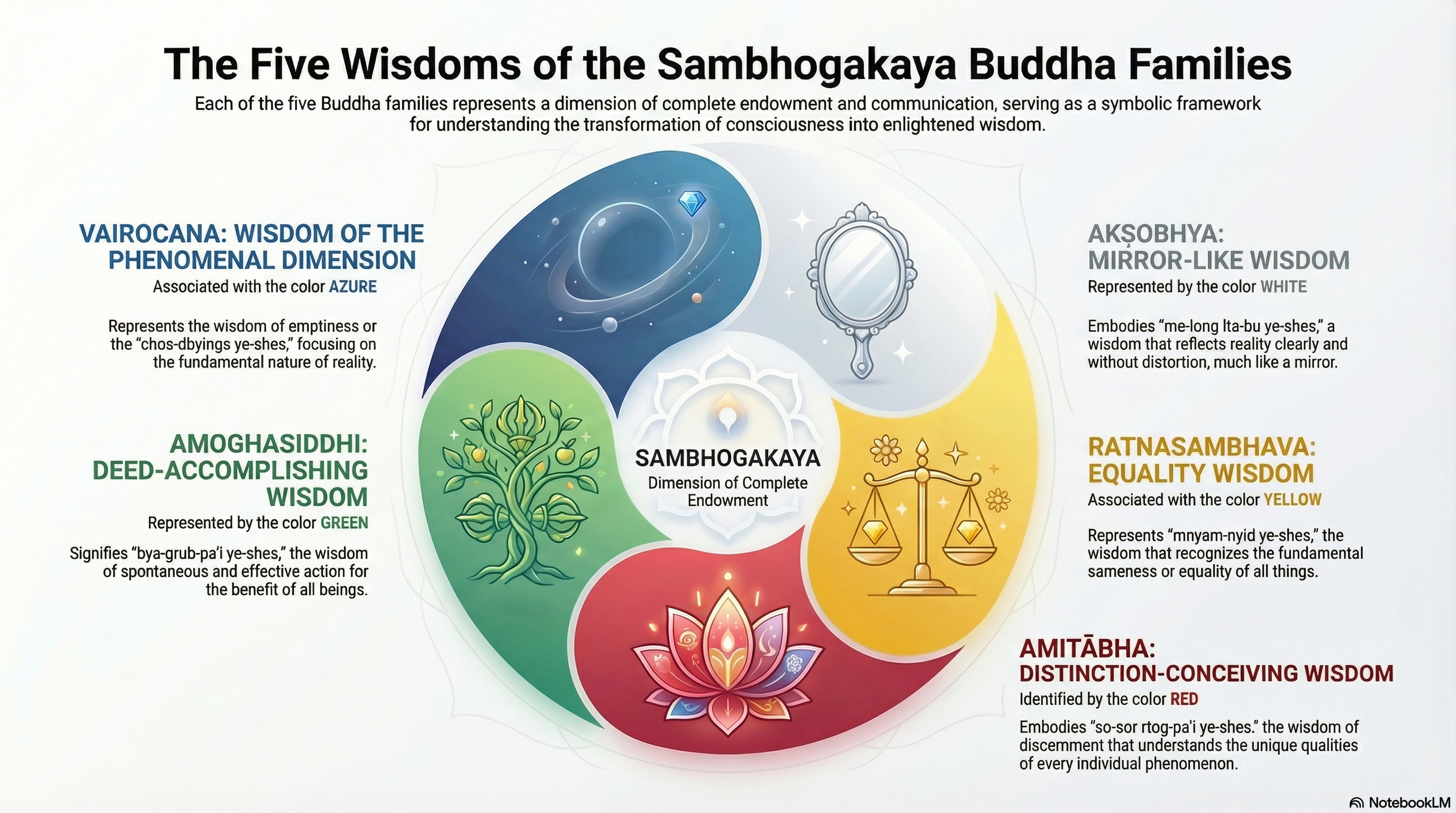
[In vetting this section, I was alerted two of the colors were wrong but this is the color scheme in the PBD text.]
Why Are the Five Sambhogakayas Important?
1. Manifestation of Wisdom
The five Sambhogakayas are direct manifestations of the five wisdoms, which are the differentiated aspects of the Base abiding wisdom. These wisdoms represent the pure qualities of awareness:
- Emptiness wisdom: The understanding that all phenomena are empty of inherent existence.
- Mirror-like wisdom: The clarity and reflective nature of awareness.
- Equality wisdom: The realization that all phenomena are equal in their essence.
- Distinction-conceiving wisdom: The ability to perceive distinctions without falling into duality.
- Deed-accomplishing wisdom: The dynamic aspect of awareness that enables compassionate action.
The five Sambhogakayas embody these wisdoms, making them essential for understanding the nature of reality and the path to enlightenment.
2. Connection to the Mandala
The five Sambhogakayas are positioned in the mandala, with Vairocana at the center and the other four Buddhas in the cardinal directions. This arrangement symbolizes the interconnectedness of all phenomena and the unity of wisdom and compassion. The mandala serves as a visual representation of the enlightened state and the path to achieving it.
3. Role in Self-Liberation
The five Sambhogakayas are not just abstract concepts; they are practical tools for self-liberation. By recognizing the wisdoms they represent, practitioners can transcend the five poisons (ignorance, attachment, aversion, pride, and jealousy) and realize their own Buddhahood. For example:
- Ignorance is transformed into emptiness wisdom.
- Aversion is transformed into mirror-like wisdom.
- Pride is transformed into equality wisdom.
- Attachment is transformed into distinction-conceiving wisdom.
- Jealousy is transformed into deed-accomplishing wisdom.
4. Integration of the Three Kayas
The five Sambhogakayas are also linked to the three kayas:
- Dharmakaya: Represents the pure, unmanifest aspect of Buddhahood.
- Sambhogakaya: Represents the manifest aspect of wisdom and compassion.
- Nirmanakaya: Represents the compassionate activity of the Buddha in the world.
The five Sambhogakayas arise from the Dharmakaya and serve as a bridge to the Nirmanakaya, making them crucial for understanding the full spectrum of Buddhahood.
Simple Example to Illustrate Their Importance
Imagine a crystal held in sunlight. The crystal itself represents the Dharmakaya—the pure, unchanging essence of reality. The sunlight passing through the crystal creates a rainbow, which represents the five Sambhogakayas. The rainbow is vivid and beautiful, but it is not separate from the crystal—it is a natural expression of the crystal’s clarity. Similarly, the five Sambhogakayas are natural expressions of the Dharmakaya’s wisdom and compassion.
Conclusion
The five Sambhogakayas are important because they embody the wisdoms that are essential for understanding the nature of reality and achieving enlightenment. They serve as a bridge between the unmanifest Dharmakaya and the compassionate activity of the Nirmanakaya, making them central to the Dzogchen teachings. By recognizing the wisdoms they represent, practitioners can transform delusion into enlightenment and realize their own Buddhahood.