Ancient Greek Alphabet
Archaic Greek alphabets - Wikipedia
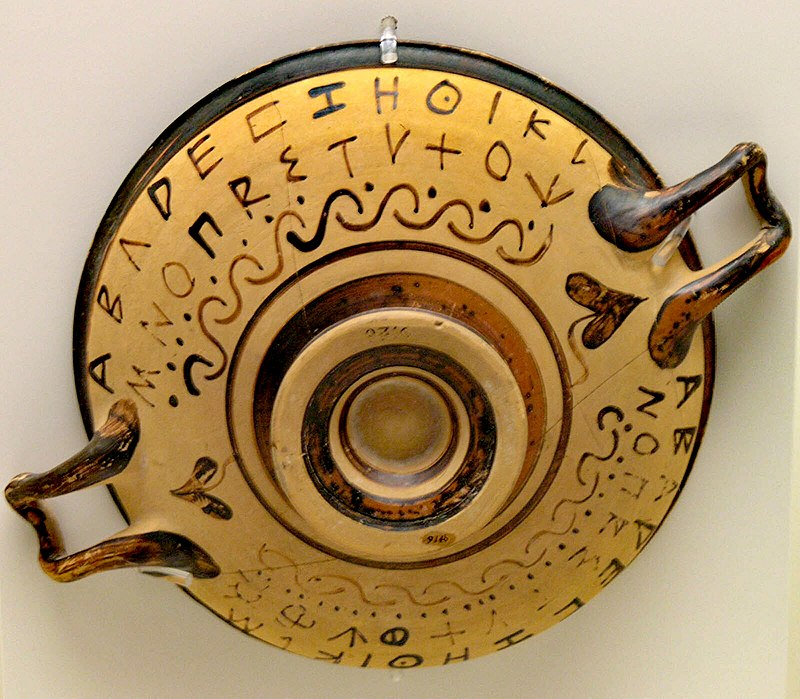
Early Greek alphabet painted on the body of an Attic black-figure cup. (note resemblance to “point in a circle”).
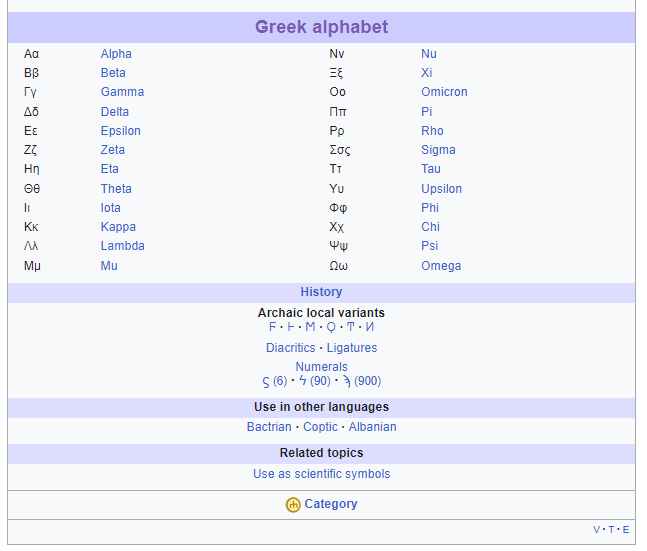
Many local variants of the Greek alphabet were employed in ancient Greece during the archaic and early classical periods, until around 400 BC, when they were replaced by the classical 24-letter alphabet that is the standard today.
All forms of the Greek alphabet were originally based on the shared inventory of the 22 symbols of the Phoenician alphabet,
with the exception of the letter Samekh,
whose Greek counterpart Xi (Ξ)
was used only in a sub-group of Greek alphabets, and
with the common addition of Upsilon (Υ)
for the vowel /u, ū/.[1][2]
The local, so-called epichoric, alphabets differed in many ways:
in the use of the consonant symbols Χ, (a value of 600), Φ and Ψ;
in the use of the innovative long vowel letters (Ω and Η),
in the absence or presence of Η in its original consonant function (/h/);
in the use or non-use of certain archaic letters (Ϝ = /w/, Ϙ = /k/, Ϻ = /s/); and
in many details of the individual shapes of each letter.
The system now familiar as the standard 24-letter Greek alphabet was originally the regional variant of the Ionian cities in Anatolia.
It was officially adopted in Athens in 403 BC and in most of the rest of the Greek world by the middle of the 4th century BC.