Conjugate Acid
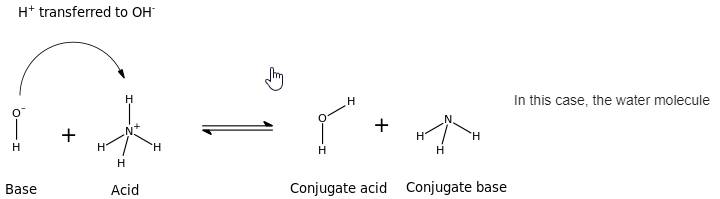
A conjugate acid is a chemical compound formed when an acid gives a proton to a base, while a conjugate base is the ion or molecule remaining after the acid has lost its proton.01 The formation of conjugate acids and bases is central to the Brnsted-Lowry definition of acids and bases.0
A conjugate acid can release or donate a proton, while a conjugate base can accept a proton.2 The simplest anion that can be a conjugate base is the free electron in a solution whose conjugate acid is the atomic hydrogen.1 When a base dissolves in water, the species that gains a hydrogen is the base's conjugate acid.2
^
from Wikipedia: index
A conjugate acid, within the Brønsted–Lowry acid–base theory, is a chemical compound formed when an acid gives a proton (H^+) to a base—in other words, it is a base with a hydrogen ion added to it, as it loses a hydrogen ion in the reverse reaction. On the other hand, a conjugate base is what remains after an acid has donated a proton during a chemical reaction. Hence, a conjugate base is a substance formed by the removal of a proton from an acid, as it can gain a hydrogen ion in the reverse reaction. ^[1] Because some acids can give multiple protons, the conjugate base of an acid may itself be acidic.
In summary, this can be represented as the following chemical reaction:
acid+base↽−−⇀conjugate base+conjugate acid


Johannes Nicolaus Brønsted (left) and Martin Lowry (right).
Johannes Nicolaus Brønsted and Martin Lowry introduced the Brønsted–Lowry theory, which said that any compound that can give a proton to another compound is an acid, and the compound that receives the proton is a base. A proton is a subatomic particle in the nucleus with a unit positive electrical charge. It is represented by the symbol H+ because it has the nucleus of a hydrogen atom,[2] that is, a hydrogen cation.
A cation can be a conjugate acid, and an anion can be a conjugate base, depending on which substance is involved and which acid–base theory is used. The simplest anion which can be a conjugate base is the free electron in a solution whose conjugate acid is the atomic hydrogen.
Downloaded: December 13, 2023, 6:52 PM