Ground effect
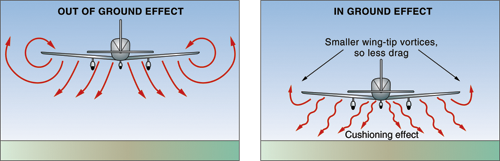
For fixed-wing aircraft, ground effect is the reduced aerodynamic drag that an aircraft's wings generate when they are close to a fixed surface. Reduced drag when in ground effect during takeoff can cause the aircraft to "float" whilst below the recommended climb speed. The pilot can then fly just above the runway while the aircraft accelerates in ground effect until a safe climb speed is reached.
For rotorcraft, ground effect results in less drag on the rotor during hovering close to the ground. At high weights this sometimes allows the rotorcraft to lift off while stationary in ground effect but does not allow it to transition to flight out of ground effect. Helicopter pilots are provided with performance charts which show the limitations for hovering their helicopter in ground effect (IGE) and out of ground effect (OGE). The charts show the added lift benefit produced by ground effect.
For fan- and jet-powered VTOL aircraft, ground effect when hovering can cause suckdown and fountain lift on the airframe and loss in hovering thrust if the engine sucks in its own exhaust gas, which is known as hot gas ingestion (HGI).
Fixed wing aircraft
When an aircraft flies at or below approximately half the length of the aircraft's wingspan above the ground or water there occurs an often-noticeable ground effect. The result is lower induced drag on the aircraft. This is caused primarily by the ground or water obstructing the creation of wingtip vortices and interrupting downwash behind the wing.
A wing generates lift by deflecting the oncoming airmass (relative wind) downward. The deflected or "turned" flow of air creates a resultant force on the wing in the opposite direction (Newton's 3rd law). The resultant force is identified as lift. Flying close to a surface increases air pressure on the lower wing surface, nicknamed the "ram" or "cushion" effect, and thereby improves the aircraft lift-to-drag ratio. The lower/nearer the wing is with regards to the ground, the more pronounced the ground effect becomes. While in the ground effect, the wing requires a lower angle of attack to produce the same amount of lift. In wind tunnel tests in which the angle of attack and airspeed remain constant, an increase in the lift coefficient ensues, which accounts for the "floating" effect. Ground effect also alters thrust versus velocity, where reduced induced drag requires less thrust in order to maintain the same velocity.
Low winged aircraft are more affected by ground effect than high wing aircraft. Due to the change in up-wash, down-wash, and wingtip vortices there may be errors in the airspeed system while in ground effect due to changes in the local pressure at the static source.
Rotorcraft
When a hovering rotor is near the ground the downward flow of air through the rotor is reduced to zero at the ground. This condition is transferred up to the disc through pressure changes in the wake which decreases the inflow to the rotor for a given disk loading, which is rotor thrust for each square foot of its area. This gives a thrust increase for a particular blade pitch angle. Or, alternatively, the power required for a thrust is reduced. For an overloaded helicopter that can only hover IGE it may be possible to climb away from the ground by translating to forward flight first while in ground effect. The ground effect benefit disappears rapidly with speed but the induced power decreases rapidly as well to allow a safe climb. Some early underpowered helicopters could only hover close to the ground. Ground effect is at its maximum over a firm, smooth surface.