TWA Flight 800
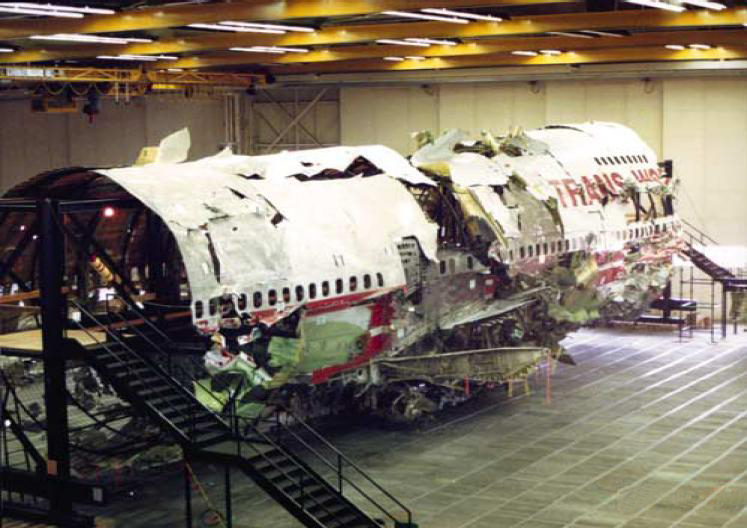
The reconstructed wreckage of TWA 800, stored at Calverton Executive Airpark by the NTSB, May 1997
Trans World Airlines Flight 800 (TWA 800) was a Boeing 747-100 that exploded and crashed into the Atlantic Ocean near East Moriches, New York, on July 17, 1996, at about 8:31 p.m. EDT, 12 minutes after takeoff from John F. Kennedy International Airport on a scheduled international passenger flight to Rome, with a stopover in Paris. All 230 people on board died in the crash; it is the third-deadliest aviation accident in U.S. history. Accident investigators from the National Transportation Safety Board (NTSB) traveled to the scene, arriving the following morning amid speculation that a terrorist attack was the cause of the crash. Consequently, the Federal Bureau of Investigation (FBI) and New York Police Department Joint Terrorism Task Force (JTTF) initiated a parallel criminal investigation. Sixteen months later, the JTTF announced that no evidence of a criminal act had been found and closed its active investigation.
The four-year NTSB investigation concluded with the approval of the Aircraft Accident Report on August 23, 2000, ending the most extensive, complex and costly air disaster investigation in U.S. history at that time. The report's conclusion was that the probable cause of the accident was explosion of flammable fuel vapors in the center fuel tank. Although it could not be determined with certainty, the likely ignition source was a short circuit. Problems with the aircraft's wiring were found, including evidence of arcing in the Fuel Quantity Indication System (FQIS) wiring that enters the tank. The FQIS on Flight 800 is known to have been malfunctioning; the captain remarked on "crazy" readings from the system approximately two minutes and thirty seconds before the aircraft exploded. As a result of the investigation, new requirements were developed for aircraft to prevent future fuel tank explosions.
The accident airplane, registration N93119, (Boeing 747-131) was manufactured by Boeing in July 1971; it had been ordered by Eastern Air Lines, but after Eastern canceled its 747 orders, the plane was purchased new by Trans World Airlines. The aircraft had completed 16,869 flights with 93,303 hours of operation and was powered by four Pratt & Whitney JT9D-7AH turbofan engines. On the day of the accident, the airplane departed from Ellinikon International Airport in Athens, Greece as TWA Flight 881 and arrived at John F. Kennedy International Airport (JFK) about 4:38pm. The aircraft was refueled, and there was a crew change; the new flight crew consisted of 58-year-old Captain Ralph G. Kevorkian, 57-year-old Captain/Check Airman Steven E. Snyder, and 63-year-old Flight Engineer/Check Airman Richard G. Campbell (all of whom were highly experienced veterans flying with TWA), as well as 25-year-old flight engineer trainee Oliver Krick, who was starting the sixth leg of his initial operating experience training.
The ground-maintenance crew locked out the thrust reverser for engine #3 (treated as a minimum equipment list item) because of technical problems with the thrust reverser sensors during the landing of TWA 881 at JFK, prior to Flight 800's departure. Additionally, severed cables for the engine #3 thrust reverser were replaced. During refueling of the aircraft, the volumetric shutoff (VSO) control was believed to have been triggered before the tanks were full. To continue the pressure fueling, a TWA mechanic overrode the automatic VSO by pulling the volumetric fuse and an overflow circuit breaker. Maintenance records indicate that the airplane had numerous VSO-related maintenance writeups in the weeks before the accident.
TWA 800 was scheduled to depart JFK for Charles DeGaulle International Airport around 7:00 p.m., but the flight was delayed until 8:02 p.m. by a disabled piece of ground equipment and a passenger/baggage mismatch. After the owner of the baggage in question was confirmed to be on board, the flight crew prepared for departure and the aircraft pushed back from Gate 27 at the TWA Flight Center. The flight crew started the engines at 8:04 pm. However, because of the previous maintenance undertaken on engine #3, the flight crew only started engines #1, #2, and #4. Engine #3 was started ten minutes later at 8:14 pm. Taxi and takeoff proceeded uneventfully.
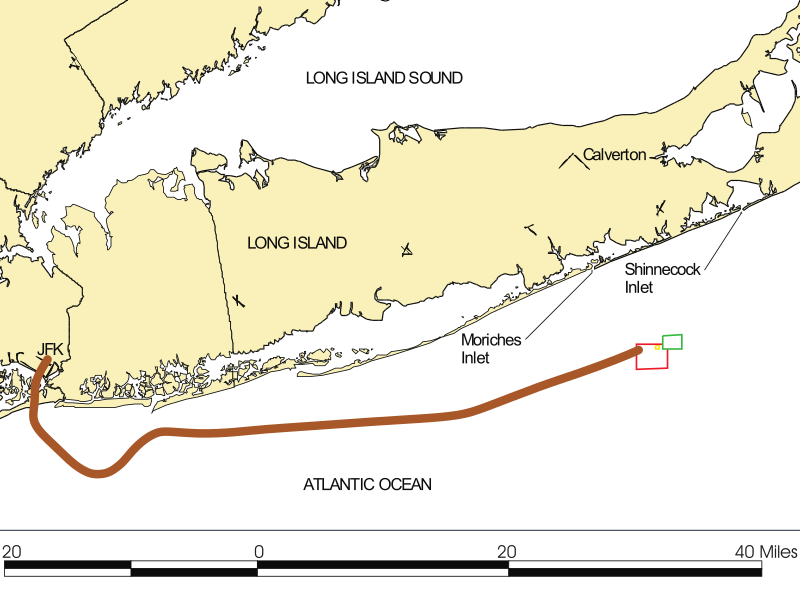
Flight path of TWA 800. The colored rectangles are areas from which wreckage was recovered.
TWA 800 then received a series of heading changes and generally increasing altitude assignments as it climbed to its intended cruising altitude. Weather in the area was light winds with scattered clouds, and there were dusk lighting conditions. The last radio transmission from the airplane occurred at 8:30 p.m. when the flight crew received and then acknowledged instructions from Boston Center to climb to 15,000 feet (4,600 m). The last recorded radar transponder return from the airplane was recorded by the Federal Aviation Administration (FAA) radar site at Trevose, Pennsylvania at 8:31:12 p.m.
Thirty-eight seconds later, the captain of an Eastwind Airlines Boeing 737 reported to Boston ARTCC that he "just saw an explosion out here", adding, "we just saw an explosion up ahead of us here ... about 16,000 feet [4,900 m] or something like that, it just went down into the water." Subsequently, many air traffic control facilities in the New York/Long Island area received reports of an explosion from other pilots operating in the area. Many witnesses in the vicinity of the crash stated that they saw or heard explosions, accompanied by a large fireball or fireballs over the ocean, and observed debris, some of which was burning while falling into the water.
Various civilian, military, and police vessels reached the crash site and searched for survivors within minutes of the initial water impact, but found none, making TWA 800 the second-deadliest aircraft accident in United States history at that time.