Speculation on disappearance
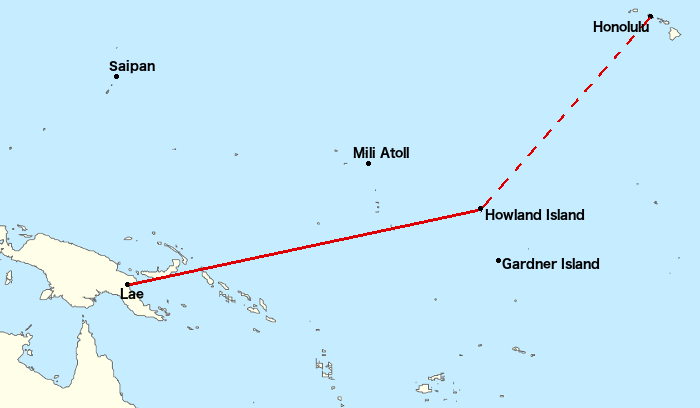
Earhart's flight was intended to be from Lae Airfield to Howland Island, a trip of 2,556 miles (2,200 nmi; 4,100 km). This leg was the longest of the planned flight, the length was close to the maximum range of the plane, and the destination was a small island in a large ocean.
There has been considerable speculation on what happened to Earhart and Noonan. Most historians hold to the simple "crash and sink" theory, but a number of other possibilities have been proposed, including several conspiracy theories.
Some have suggested that Earhart and Noonan survived and landed elsewhere, but were either never found or killed, making en-route locations like Tarawa unlikely. Proposals have included the uninhabited Gardner Island (400 miles (640 km) from the vicinity of Howland), the Japanese-controlled Marshall Islands (870 miles (1,400 km) at the closest point of Mili Atoll), and the Japanese-controlled Northern Mariana Islands (2,700 miles (4,300 km) from Howland).
Crash and sink theory
Many researchers believe that Earhart and Noonan ran out of fuel while searching for Howland Island, ditched at sea, and died. The plane would have carried enough fuel to reach Howland with some extra to spare. The extra fuel would cover some contingencies such as headwinds and searching for Howland. The plane could fly a compass course toward Howland through the night. In the morning, the time of apparent sunrise would allow the plane to determine its line of position (a "sun line" that ran 157°–337°). From that line, the plane could determine how much further it must travel before reaching a parallel sun line that ran through Howland. At 6:14 AM Itasca time, Earhart estimated they were 200 miles away from Howland. As the plane closed with Howland, it expected to be in radio contact with Itasca. With the radio contact, the plane should be able to use radio direction finding (RDF) to head directly for the Itasca and Howland. Unfortunately, the plane was not receiving a radio signal from Itasca, so it would be unable to determine an RDF bearing to the ship. Although Itasca was receiving HF radio signals from the plane, it did not have HF RDF equipment, so it could not determine a bearing to the plane. The communications going to the plane were almost non-existent. Consequently, the plane was not directed to Howland; it was left on its own with little fuel. Presumably, the plane reached the parallel sun line and started searching for Howland on that line of position. At 7:42 AM, Earhart reported, "We must be on you, but cannot see you – but gas is running low. Have been unable to reach you by radio. We are flying at 1,000 feet." At 8:43 AM, Earhart reported, "We are on the line 157 337. We will repeat this message. We will repeat this on 6210 kilocycles. Wait." Between Earhart's low on fuel message at 7:42 AM and her last confirmed message at 8:43, her signal strength remained consistent indicating that she never left the Howland Island immediate area or that she had the fuel to do so. The U.S. Coast Guard made this determination by tracking her signal strength as she approached the island noting signal levels from her reports of 200 and 100 miles out. These reports were roughly 30 minutes apart providing vital ground speed clues. Based on these facts, and the lack of additional signals from Earhart, the Coast Guard first responders initiating the search concluded that she ran out of fuel somewhere very close to and north of Howland.
Capt. Laurance Safford, USN, (Ret.) who was responsible for the interwar Mid-Pacific Strategic Direction Finding Net, and the decoding of the Japanese Purple cipher messages for the attack on Pearl Harbor, began a lengthy analysis of the Earhart flight during the 1970s. His research included the intricate radio transmission documentation. Safford came to the conclusion, "poor planning, worse execution". Rear Admiral Richard R. Black, USN (Ret.), who was in administrative charge of the Howland Island airstrip and was present in the radio room on the Itasca, asserted in 1982 that "the Electra went into the sea about 10 am, July 2, 1937, not far from Howland". British aviation historian Roy Nesbit interpreted evidence in contemporary accounts and Putnam's correspondence and concluded Earhart's Electra was not fully fueled at Lae. William L. Polhemous, the navigator on Ann Pellegreno's 1967 flight that followed Earhart and Noonan's original flight path, studied navigational tables for July 2, 1937, and thought Noonan may have miscalculated the "single line approach" intended to "hit" Howland.
David Jourdan, a former Navy submariner and ocean engineer specializing in deep-sea recoveries, has claimed any transmissions attributed to Gardner Island were false. Through his company Nauticos he extensively searched a 1,200-square-mile (3,100 km) quadrant north and west of Howland Island during two deep-sea sonar expeditions (2002 and 2006, total cost $4.5 million) and found nothing. The search locations were derived from the line of position (157–337) broadcast by Earhart on July 2, 1937. Nevertheless, Elgen Long's interpretations have led Jourdan to conclude, "The analysis of all the data we have – the fuel analysis, the radio calls, other things – tells me she went into the water off Howland." Earhart's stepson George Palmer Putnam Jr. has been quoted as saying he believes "the plane just ran out of gas". Susan Butler, author of the Earhart biography East to the Dawn, says she thinks the aircraft went into the ocean out of sight of Howland Island and rests on the seafloor at a depth of 17,000 feet (5 km). Tom D. Crouch, Senior Curator of the National Air and Space Museum, has said the Earhart/Noonan Electra is "18,000 ft. down" and may even yield a range of artifacts that could rival the finds of the Titanic, adding that "the mystery is part of what keeps us interested. In part, we remember her because she's our favorite missing person."
Gardner Island hypothesis
Gardner (Nikumaroro) Island in 2014. "Seven Site" is a focus of the search for Amelia Earhart's remains.
The Gardner Island (Nikumaroro) hypothesis assumes that Earhart and Noonan, having not found Howland Island, would not waste time searching for Howland. Instead, they would turn to the south and look for other islands. The 157/337 radio transmission suggests they flew a course of 157° that would take them past Baker Island; if they missed Baker Island, then sometime later they would fly over the Phoenix Islands, now part of the Republic of Kiribati, about 350 nautical miles (650 km) south-southeast of Howland Island. The Gardner Island hypothesis has the plane making it to Gardner Island (now Nikumaroro), one of the Phoenix Islands.
A week after Earhart disappeared, Navy planes from USS Colorado (which had sailed from Pearl Harbor) searched Gardner Island. The planes saw signs of recent habitation and the November 1929 wreck of the SS Norwich City, but did not see any signs of Earhart's plane or people. After the Navy ended its search, G. P. Putnam undertook a search in the Phoenix Group and other islands, but nothing was found.
In October 1937, Eric Bevington and Henry E. Maude visited Gardner with some potential settlers. A group walked all the way around the island, but did not find a plane or other evidence. During this visit, Bevington took a picture of the SS Norwich City wreck. In 2010, Jeff Glickman an expert in image processing claimed that a small portion of a 75-year-old picture showed what looked like landing gear sticking out of the water. A 2019 search of the island suggests that the object in the photo resembles local rocks.
In December 1938, laborers landed on the island and started constructing a settlement. In late 1939, USS Bushnell did a survey of the island.
Around April 1940, a skull was discovered and buried, but British colonial officer Gerald Gallagher did not learn of it until September. Gallagher did a more thorough search of the discovery area, including looking for artifacts such as rings. The search found more bones, a bottle, a shoe, and a sextant box. On September 23, 1940, Gallagher radioed his superiors that he had found a "skeleton ... possibly that of a woman", along with an old-fashioned sextant box, under a tree on the island's southeast corner. Gallagher stated the "Bones look more than four years old to me but there seems to be very slight chance that this may be remains of Amelia Earhart." He was ordered to send the remains to Fiji. On 4 April 1941, Dr. D. W. Hoodless of the Central Medical School examined the bones, took measurements, and wrote a report. Using Karl Pearson's formulas for stature and the lengths of the femur, tibia, and humerus, Hoodless concluded that the person was about 5 feet 5.5 inches (166.4 cm) tall. Hoodless wrote that the skeleton "could be that of a short, stocky, muscular European, or even a half-caste, or person of mixed European descent." However, Earhart's 1930 pilot's license states she was 5 feet 8 inches (173 cm) and 118 pounds (54 kg). Hoodless also wrote "it may be definitely stated that the skeleton is that of a MALE. Owing to the weather-beaten condition of all the bones it is impossible to be dogmatic in regard to the age of the person at the time of death, but I am of the opinion that he was not less than 45 years of age and that probably he was older: say between 45 and 55 years." (Earhart was 39 years and 11 months when she disappeared.) Hoodless offered to make more detailed measurements if needed, but suggested any further examination be done by the Anthropological Department at Sydney University. These bones were apparently misplaced in Fiji and presumed lost. Around the turn of the 21st century, researchers used Hoodless's measurements to argue against his conclusions that the bones were that of a male.
Authorities also investigated the sextant box. Sir Harry Charles Luke, High Commissioner of the Western Pacific, provided the box to an expert aviation navigator, Harold Gatty. On August 8, 1941, Luke summarized Gatty's conclusions as the box is English, "is of some age" and "does not consider that it could in any circumstance have been a sextant box used in modern trans-Pacific aviation".
During World War II, US Coast Guard LORAN Unit 92, a radio navigation station built in the summer and fall of 1944, and operational from mid-November 1944 until mid-May 1945, was located on Gardner Island's southeast end. Dozens of U.S. Coast Guard personnel were involved in its construction and operation, but were mostly forbidden from leaving the small base or having contact with the Gilbertese colonists then on the island, and found no artifacts known to relate to Earhart.
In 1988, The International Group for Historic Aircraft Recovery (TIGHAR) began an investigation of the Earhart/Noonan disappearance and since then has sent ten research expeditions to Gardner Island/Nikumaroro. They have suggested Earhart and Noonan may have flown without further radio transmissions for two and a half hours along the line of position Earhart noted in her last transmission received at Howland, then found the then-uninhabited Gardner Island, landed the Electra on an extensive reef flat near the wreck of a large freighter (the SS Norwich City) on the northwest side of the atoll, and ultimately perished. In 2012, a photograph, taken in October 1937 of the reef at Nikumaroro after her disappearance, was enhanced. According to the analysts who viewed it, "a blurry object sticking out of the water in the lower left corner of the black-and-white photo is consistent with a strut and wheel of a Lockheed Electra landing gear."
TIGHAR's research has produced a range of archaeological and anecdotal evidence supporting this hypothesis. TIGHAR has sent a number of expeditions to Nikumaroro looking for evidence, although they have found nothing conclusive; expeditions include ones in 2007, 2010, 2012, and 2017. Artifacts discovered by TIGHAR on Nikumaroro have included improvised tools; an aluminum panel, possibly from an Electra, made using 1930s manufacturing specifications; an oddly cut piece of clear Plexiglas the same thickness and curvature of an Electra window; and a size 9 Cat's Paw heel dating from the 1930s, which resembles Earhart's footwear in world flight photos. Recently rediscovered photos of Earhart's Electra just before departure in Miami show an aluminum panel over a window on the right side. Ric Gillespie, head of TIGHAR, claimed the found aluminum panel artifact has the same dimensions and rivet pattern as the one shown in the photo "to a high degree of certainty". Based on this new evidence, Gillespie returned to the atoll in June 2015, but operations using a remotely operated underwater vehicle to investigate a sonar detection of a possible wreckage were hampered by technical problems. Further, a review of sonar data concluded it was most likely a coral ridge. The evidence remains circumstantial, but Earhart's surviving stepson, George Putnam Jr., has expressed support for TIGHAR's research.
In 1998, an analysis of the measurement data by forensic anthropologists found instead that the skeleton had belonged to a "tall white female of northern European ancestry". However, a 2015 review of both analyses concluded that "the most robust scientific analysis and conclusions are those of the original British finding indicating that the Nikumaroro bones belonged to a robust, middle-aged man, not Amelia Earhart."
In July 2017, staff from the New England Air Museum notified TIGHAR that the unique rivet pattern of the aluminum panel precisely matched the top of the wing of a C-47B in the museum inventory; particularly significant since a C-47B crashed on a nearby island during World War II and villagers acknowledged bringing aluminum from that wreck to Gardner Island. As of November 2018, TIGHAR has not published this new information.
The sextant box found near the bones on Nikumaroro and alleged to belong to Fred Noonan had two apparent serial numbers on it: 3500 and 1542. In October 2018, documents discovered at the National Archives and Records Administration showed USS Bushnell had a Brandis and Sons sextant with USNO serial number 1542 in 1938–1939, well after Earhart's disappearance. The USS Bushnell, a U.S. Navy submarine tender that was assigned to hydrographic surveys in December 1937, visited Nikumaroro and surveyed the island and its lagoon using sextants around November 1939, before the sextant box was discovered by Gallagher in September 1940. A Brandis and Sons sextant with serial number 3500 would have been made around the time of World War I.
A 2018 study by American anthropologist Richard Jantz (one of the authors of the 1998 TIGHAR report) estimated the size of Earhart's skeleton based on photographs and reanalyzed the earlier data using modern forensic techniques. Based on measurements of 2,700 Americans who died in the mid-20th century, the study concluded that Earhart's bone measurements more closely matched the Nikumaroro bones than 99% of the reference sample. However, others criticized the study for being based on little factual evidence (in particular seven measurements from the skeleton done in 1941, combined with estimates about Earhart's size based on photos) and doubted the accuracy of those measurements. The study did not attempt to dispute the original examiner's reinforced, expert conclusions regarding the age of the bones (at least six years older that Earhart's age at the time of her disappearance and possibly older) but acknowledges that Hoodless was qualified to make that assessment. Yet, despite the errors and speculative assumptions of Jantz's research, TIGHAR Executive Director Ric Gillespie appeared on BBC World News shortly after the findings were announced to state, "This is quantification of data. This is real science."
In 2019, National Geographic conducted an investigation of Earhart's disappearance, which focused on the Gardner Island hypothesis, and was the subject of an October 2019 TV special. A study conducted by renowned USF forensic anthropologist Erin Kimmerle revealed that a partial skull discovered in the Tarawa archives was likely too small to be Earhart's; the DNA results were inconclusive. Also depicted was an August 2019 search for Earhart's aircraft off Nikumaroro's reef conducted by ocean explorer Robert Ballard, who has found several ocean wrecks including RMS Titanic. Ballard considered that it was plausible that Bevington's 1937 photo shows landing gear. Ballard's expedition had more sophisticated search equipment than TIGHAR used on its expedition in 2012. He completed his expedition in October 2019. After days of searching the deep cliffs supporting the island and the nearby ocean, Ballard did not find any evidence of the plane or any associated wreckage of it. Allison Fundis, Ballard's chief operating officer of the expedition stated, "We felt like if her plane was there, we would have found it pretty early in the expedition." Julie Cohn, reporting for the New York Times, noted that the supposed landing gear in the Bevington photo had "become a joke" during the expedition, with many rocks resembling such an object.
A few news articles have considered TIGHAR's theory, and generally consider it the most plausible of the "Earhart survived" theories, although not proven and not accepted beyond crash-and-sink. Other news articles have criticized TIGHAR as seizing on unlikely possibilities as circumstantial evidence; for example, an article criticized the suggestion that a can of freckle ointment found on Nikumaroro might have been Earhart's, when the Electra was "virtually a flying gas station" with little room for amenities, as Earhart and Noonan carried extra gas tanks in every scrap of available space and absence of any corroborating evidence connecting the artifact to her.
Japanese capture theory
Another theory is that Earhart and Noonan were captured by Japanese forces, perhaps after somehow navigating to somewhere within the Japanese South Seas Mandate.
In 1966, CBS correspondent Fred Goerner published a book claiming that Earhart and Noonan were captured and executed when their aircraft crashed on the island of Saipan, part of the Northern Mariana Islands archipelago. Saipan is more than 2,700 miles away from Howland Island, however. Later proponents of the Japanese capture hypothesis have generally suggested the Marshall Islands instead, which while still distant from the intended location (800 miles), is slightly more possible.
In 1990, the NBC series Unsolved Mysteries broadcast an interview with a Saipanese woman who claimed to have witnessed Earhart and Noonan's execution by Japanese soldiers. No independent confirmation has ever emerged for any of these claims. Various purported photographs of Earhart during her captivity have been identified as either fraudulent or having been taken before her final flight.
A slightly different version of the Japanese capture hypothesis is not that the Japanese captured Earhart, but rather that they shot down her plane. Henri Keyzer-Andre, a former Pan Am pilot, propounded this view in his 1993 book Age Of Heroes: Incredible Adventures of a Pan Am Pilot and his Greatest Triumph, Unravelling the Mystery of Amelia Earhart.
Since the end of World War II, a location on Tinian, which is five miles (8 km) southwest of Saipan, had been rumored to be the grave of the two aviators. In 2004, an archaeological dig at the site failed to turn up any bones.
A recent proponent of this theory is Mike Campbell, who published the 2012 book Amelia Earhart: The Truth at Last in its favor. Campbell cites claims from Marshall Islanders to have witnessed a crash, as well as a U.S. Army Sergeant who found a suspicious gravesite near a former Japanese prison on Saipan.
A number of Earhart's relatives have been convinced that the Japanese were somehow involved in Amelia's disappearance, citing unnamed witnesses including Japanese troops and Saipan natives. According to one cousin, the Japanese cut the Lockheed Electra into scrap and threw the pieces into the ocean, to explain why the airplane was not found in the Marshall Islands.
In 2017, a History Channel documentary called Amelia Earhart: The Lost Evidence, proposed that a photograph in the National Archives of Jaluit Atoll in the Marshall Islands was actually a picture of a captured Earhart and Noonan. The picture showed a Caucasian male on a dock who appeared to look like Noonan and a woman sitting on the dock but facing away from the camera, who was judged to have a physique and haircut resembling Earhart's. The documentary theorizes that the photo was taken after Earhart and Noonan crashed at Mili Atoll. The documentary also said that physical evidence recovered from Mili matches pieces that could have fallen off an Electra during a crash or subsequent overland move to a barge. The Lost Evidence proposed that a Japanese ship seen in the photograph was the Koshu Maru, a Japanese military ship. The Lost Evidence was quickly discredited, however, after Japanese blogger Kota Yamano found the original source of the photograph in the Archives in the National Diet Library Digital Collection. The original source of the photo was a Japanese travel guide published in October 1935, implying that the photograph was taken in 1935 or before, and thus would be unrelated to Earhart and Noonan's 1937 disappearance. Additionally, the researcher who discovered the photo also identified the ship in the right of the photo as another ship called Koshu, seized by Allied Japanese forces during World War I, and not the Koshu Maru.
A common criticism of all versions of the Japanese capture hypothesis is that the Japanese-controlled Marshall Islands were considerably distant from Howland Island. To reach and land there would have required Earhart and Noonan, though low on fuel, to change her northeast course as she neared Howland Island and fly hundreds of miles northwest, a feat "not supported by the basic rules of geography and navigation." Additionally, had the Japanese found a crashed Earhart and Noonan, they would have had substantial motivation to rescue the famous aviators and be hailed as heroes.