P-factor
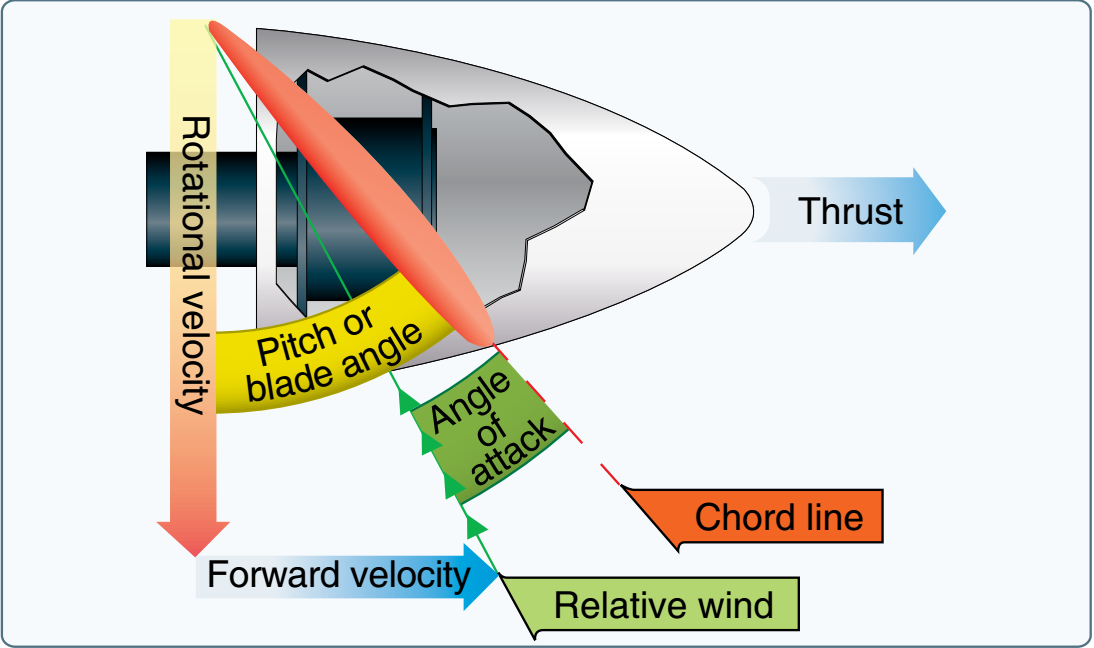
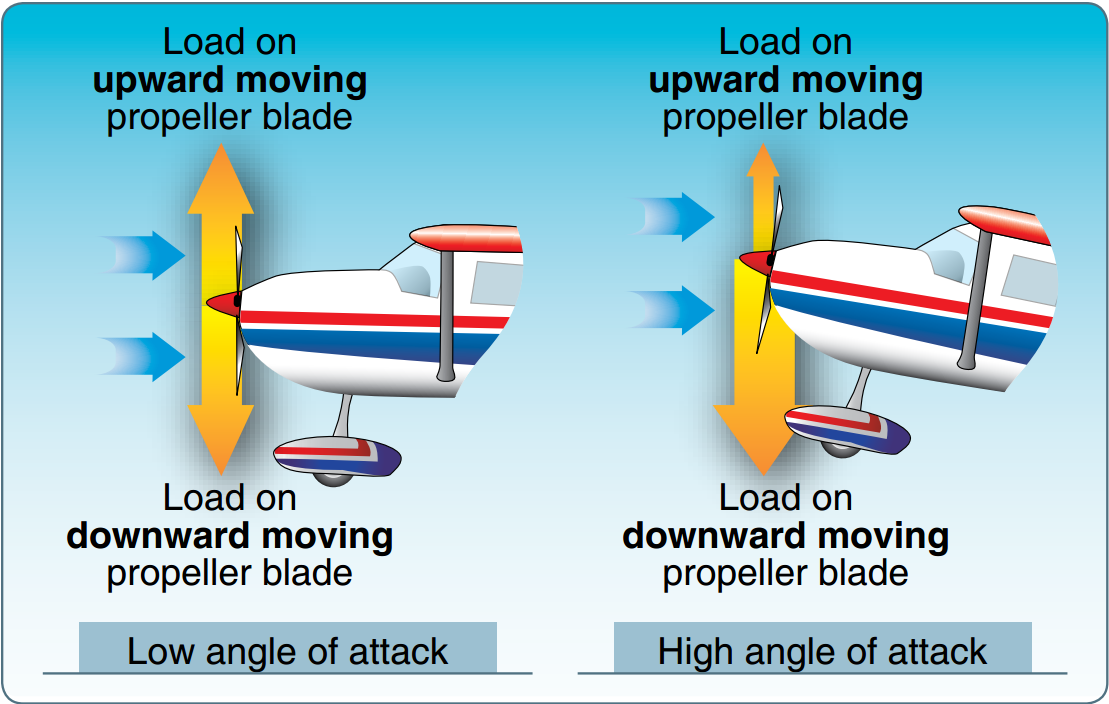
Propeller blade angle of attack (left) and propeller blade angle of attack change with aircraft pitch change, demonstrating asymmetrical load (right)
P-factor, also known as asymmetric blade effect and asymmetric disc effect, is an aerodynamic phenomenon experienced by a moving propeller, where the propeller's center of thrust moves off-center when the aircraft is at a high angle of attack. This shift in the location of the center of thrust will exert a yawing moment on the aircraft, causing it to yaw slightly to one side. A rudder input is required to counteract the yawing tendency.
When a propeller aircraft is flying at cruise speed in level flight, the propeller disc is perpendicular to the relative airflow through the propeller. Each of the propeller blades contacts the air at the same angle and speed, and thus the thrust produced is evenly distributed across the propeller.
However, at lower speeds the aircraft will typically be in a nose-high attitude, with the propeller disc rotated slightly toward the horizontal. This has two effects. Firstly, propeller blades will be more forward when in the down position, and more backwards when in the up position. The propeller blade moving down and forward (for clockwise rotation, from the one o'clock to the six o'clock position when viewed from the cockpit) will have a greater forward speed. This will increase the airspeed of the blade, so the down-going blade will produce more thrust. The propeller blade moving up and back (from the seven o'clock to the 12 o'clock position) will have a decreased forward speed, therefore a lower airspeed than the up-going blade and lower thrust. This asymmetry displaces the center of thrust of the propeller disc towards the blade with increased thrust.
Secondly, the angle of attack of the down-going blade will increase, and the angle of attack of the up-going blade will decrease, because of the tilt of the propeller disc. The greater angle of attack of the down-going blade will produce more thrust.
Note that the increased forward speed of the down-going blade actually reduces its angle of attack, but this is overcome by the increase in angle of attack caused by the tilt of the propeller disc. Overall, the down-going blade has a greater airspeed and a greater angle of attack.
P-factor is greatest at high angles of attack and high power, for example during take-off or in slow flight.