The Daevonian Religion
A priest arrives in an abbey and there's a standard for the Staff. The staff is called the 'Hierotyphe'. He is weary but he doesnt want to just slam it against a wall, so there's a Conglume, so he respecfully says the deposute (HUMMM) and places it in the receptacle. 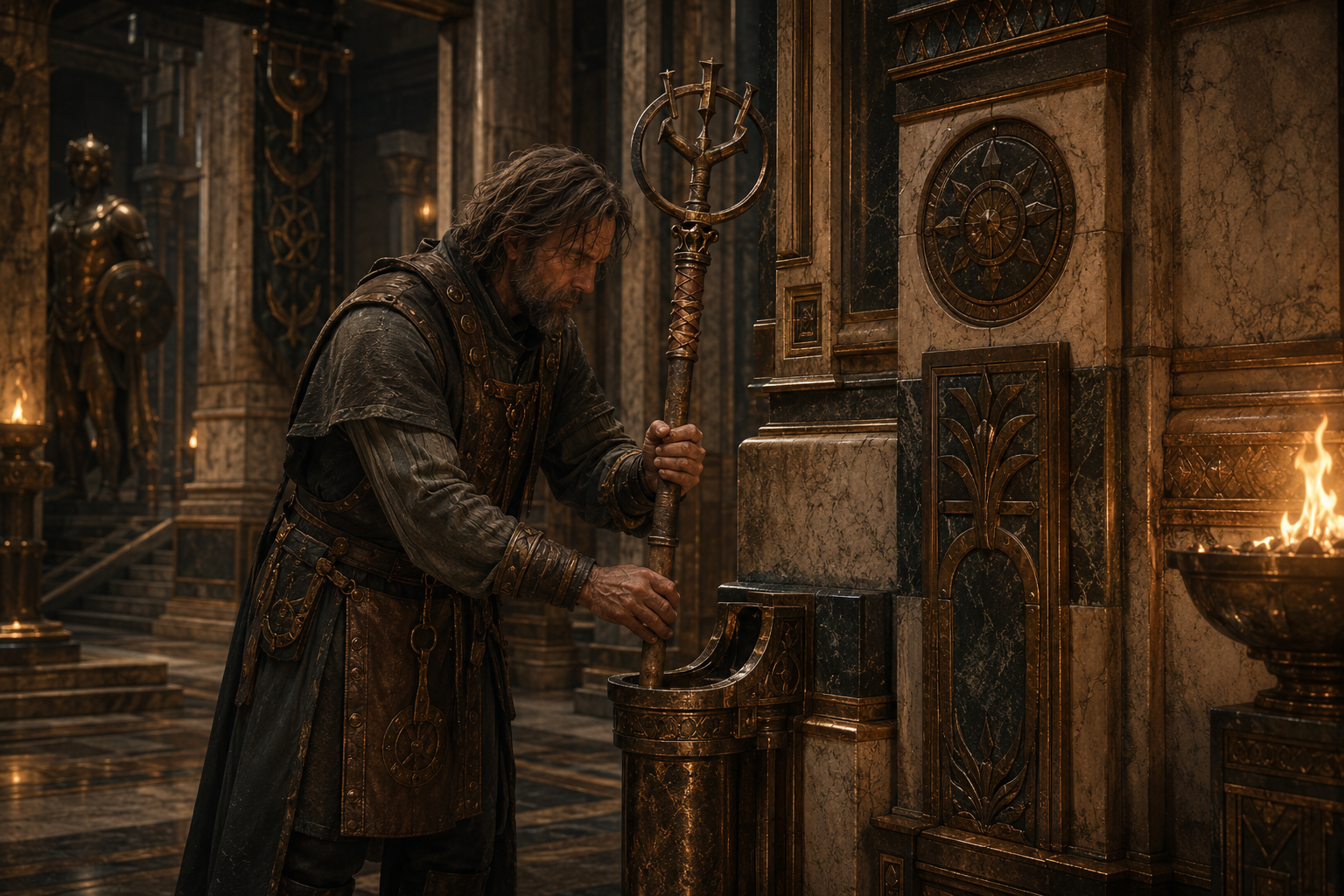
The God Daevon
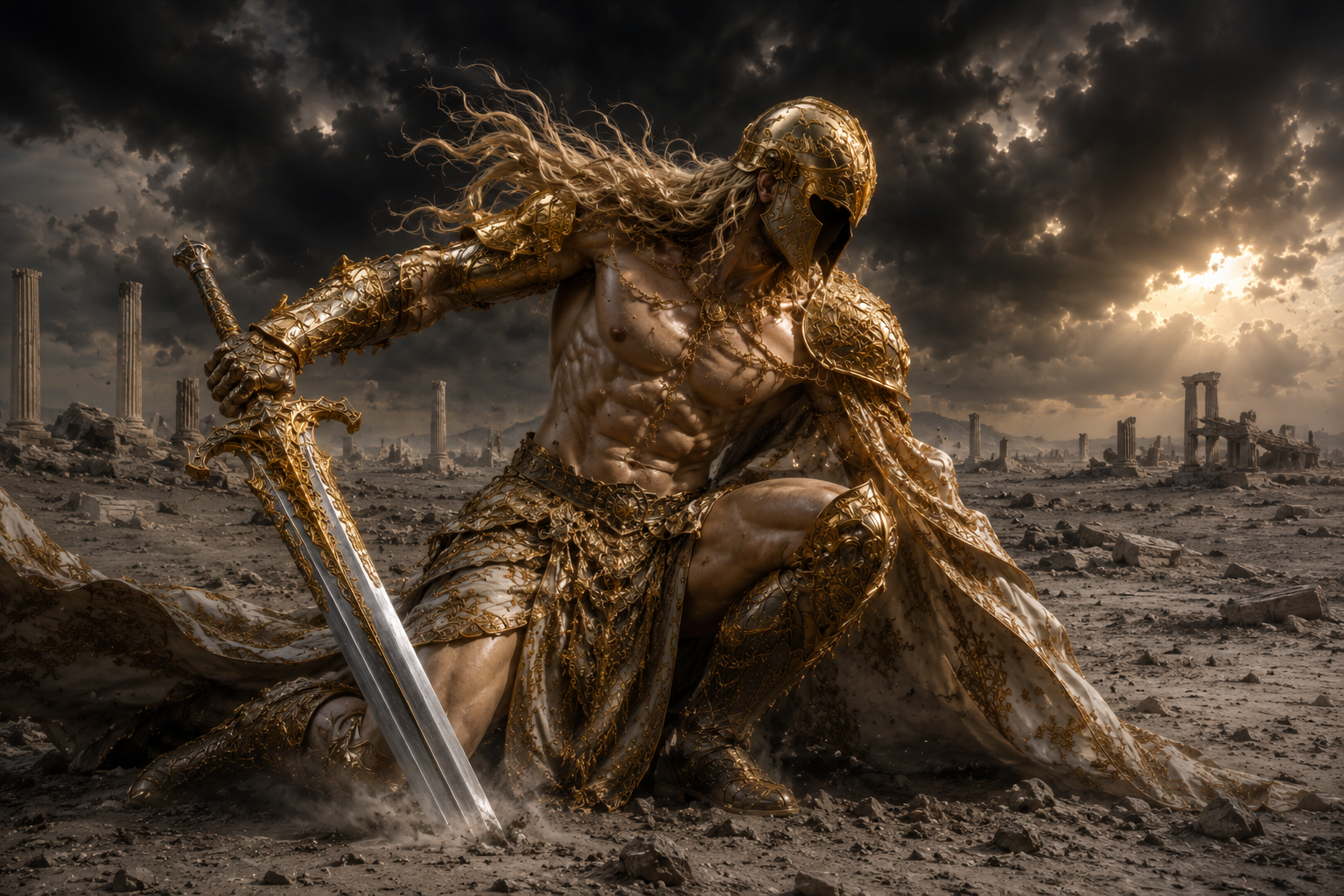
The Faith of Daevon presents itself to the world as the radiant theology of triumph. In its public face, it is not a cult of slaughter, cruelty, or naked domination, but a polished and persuasive religion of victory, prosperity, noble pride, kingly order, masculine excellence, and the rewards earned by those strong enough to seize their place in history. Daevon is praised as the patron of the victorious life: the sword raised after a duel, the contract signed after a dangerous negotiation, the inheritance secured, the lover won, the household expanded, the army returning beneath banners, and the king enthroned beneath the approving light of heaven. His temples teach that success is not merely a private achievement but a sacred revelation, proof that will, discipline, charisma, and divine favor have converged in one person, one house, one city, or one kingdom.
In its official doctrine, Daevon is not worshiped as a god of war for war’s own sake. War is only one battleground among many, and bloodshed is described as an unfortunate but sometimes necessary passage toward a higher state of order. The faith prefers to speak of victory rather than conquest, prosperity rather than greed, honor rather than domination, and grandeur rather than vanity. Its priests insist that Daevon blesses achievement wherever it flowers: in battlefields, courts, counting houses, marriages, dynastic alliances, academies of rhetoric, tournaments, shipyards, and royal councils. To serve Daevon is to cultivate the self until it becomes undeniable, to polish ambition until it can be mistaken for destiny, and to turn private hunger into public magnificence.
The central domains of Daevon are victory, glory, wealth, pride, monarchy, fire, storms, and law. Victory is understood broadly, encompassing triumph in war, commerce, love, politics, inheritance, argument, and reputation. Glory is the visible aura of success, the right of the accomplished to be seen, praised, remembered, and imitated. Wealth is treated not as a moral embarrassment but as a sacred instrument, a means by which excellence becomes durable in stone, gold, patronage, feasting, and public works. Pride is not condemned as a sin, because Daevon’s priests argue that false humility is often only cowardice in ceremonial dress. True pride, they claim, must be earned through discipline, courage, mastery, and the willingness to stand exposed before the judgment of the world.
Daevon’s faith is deeply intertwined with the Kingdom and its monarchy. The King is often portrayed as Daevon’s earthly reflection, not necessarily divine in blood, but divine in function: the victorious man raised to the scale of the realm. Royal expansion, commercial prosperity, disciplined inheritance, and political hierarchy are all cast as signs of Daevon’s blessing. In public sermons, the Kingdom is described as a vessel of order moving through a dangerous and chaotic world, and Daevon as the fire in its heart, the storm above its banners, and the gold upon its altars. This theology allows the faith to become both a spiritual institution and a political engine, sanctifying ambition while giving ambition a language of duty.
Fire and storms form the elemental language of Daevon’s worship. Fire is praised as illumination, appetite, refinement, and destruction; it consumes weakness, lights halls of judgment, purifies offerings, and gives warmth to the victorious household. Storms are celebrated as the world’s reminder that power is never entirely tame. Thunder is interpreted as Daevon’s laughter, lightning as his spear of revelation, and rain as the aftermath of force, washing the field so that new banners may rise. Together, fire and storm allow the faith to present Daevon as both civilized and dangerous, a god of palaces who has not forgotten the mountain, the battlefield, or the sea.
Law occupies a more selective and revealing place in the faith. Publicly, Daevon’s priests speak reverently of order, judgment, duty, inheritance, contracts, oaths, and lawful command. They teach that civilization cannot survive if every appetite is allowed to become a little kingdom of its own. Yet beneath this language lies a more pragmatic view: law is honored most when it preserves the structure in which the victorious may continue to rule. Justice, in Daevon’s theology, is less an abstract equality before heaven than the maintenance of a hierarchy believed to have proven itself through strength, wealth, lineage, or success. The faith rarely says this plainly, but its enemies hear it clearly enough.
Daevon’s temples are designed as public arguments in stone, metal, flame, and height. They rise with towering columns, broad stairways, polished floors, bronze doors, and vast halls built to make the visitor feel both elevated and diminished. Murals show victorious kings, armored founders, merchant princes, radiant patriarchs, storm-crowned heroes, and Daevon himself enthroned in splendor, not as a remote cosmic abstraction but as the perfected image of success made flesh. Great braziers burn before the altars, their fires tended day and night, while gold, lacquer, weaponry, trophies, contracts, laurel wreaths, and ceremonial cups accumulate in carefully staged abundance around the sacred spaces.
Offerings to Daevon are expected to demonstrate achievement rather than need. Worshipers bring coin, arms, jeweled clasps, banners, ledgers of profitable ventures, tokens from defeated rivals, wedding gifts, letters of appointment, fragments of conquered walls, or the first profits of a successful enterprise. Nobles sponsor feasts, tournaments, games, theatrical performances, public distributions of bread, or displays of military discipline in his honor, always careful to ensure that generosity and self-advertisement remain tastefully indistinguishable. To give lavishly to Daevon is to declare that one has enough power to waste beautifully, which the faith regards as one of the more persuasive forms of devotion.
The temples vary by region, although all remain recognizable as houses of Daevon. In conservative provinces, the faith emphasizes honor, obedience, law, paternal responsibility, military discipline, and the dignity of household authority. There, Daevon is stern, upright, ancestral, and nearly judicial. In richer and more cosmopolitan cities, his worship becomes more sensuous and imperial, leaning into luxury, seduction, fashion, patronage, political intrigue, and the intoxicating glamour of expansion. In frontier regions, his priests often preach endurance, masculine brotherhood, hard labor, and the right of settlers to impose order upon hostile land. In the capital, the faith becomes most dangerous because it is most beautiful: every cruelty is draped in velvet, every appetite made architectural.
The priesthood of Daevon is an elite class, usually drawn from noble families, wealthy merchants, decorated officers, and ambitious households eager to bind their sons to power. Its clergy are trained to embody confidence, command, restraint, physical poise, rhetorical force, and the subtle art of making self-interest sound like civilization. A priest of Daevon is expected to speak well, dress impeccably, read the room with predatory grace, understand money, recognize weakness, and never appear surprised by power. They are not merely temple functionaries but advisers, patrons, negotiators, educators, financiers, confessors of the ambitious, and quiet architects of royal legitimacy.
Young men educated by the clergy are taught that mastery over others must begin with mastery over the self. Their training often includes rhetoric, swordplay, history, law, genealogy, court etiquette, household management, military theory, and the disciplined performance of masculine virtue. They are told that desire is not shameful, but sloppy desire is contemptible; that anger is not forbidden, but poorly aimed anger is weakness; that wealth is not corrupting, but the inability to command wealth reveals a soul unready for rule. The faith’s public pedagogy therefore presents patriarchy not as mere entitlement but as a demanding burden of excellence, which is precisely what makes it so persuasive to those already favored by it.
Women occupy an uneasy but important place within Daevon’s religion. Officially, the faith is patriarchal and presents masculine authority as the natural spine of household, temple, army, and realm. Yet women of exceptional ambition, intelligence, beauty, lineage, or strategic talent can rise within its structures, often as advisers, patrons, diplomats, financiers, ritual consorts, or unofficial power brokers. The faith praises such women when they strengthen dynasties, sharpen men, secure alliances, or embody magnificence without openly challenging the masculine order that frames them. Its defenders call this selective inclusivity; its critics call it a gilded cage with better furniture.
Priests of Daevon are also ambassadors of wealth. They advise kings on taxation, nobles on inheritance, merchants on reputation, and military commanders on the moral theater of victory. Their temples often function as banks, courts of arbitration, schools of manners, archives of contracts, and clubs for the ambitious. Because prosperity is one of Daevon’s sacred signs, his clergy can move through financial and political spaces with unusual authority. They do not merely bless power after it has been acquired; they help design the conditions by which power becomes inevitable.
The rituals of Daevon are public, splendid, and difficult to separate from politics. Victors’ Feasts are held after major successes in battle, trade, marriage, diplomacy, succession, or legal struggle, and these celebrations operate as both acts of worship and demonstrations of status. At such feasts, the successful host gives thanks to Daevon, honors allies, humiliates rivals by omission or seating arrangement, rewards loyalty, and narrates the victory in a form future witnesses are expected to remember. The food is abundant, the wine expensive, the speeches polished, and the piety entirely sincere, though sincerity and theater are not considered opposites in Daevon’s house.
The Fire Rite is among the most important annual ceremonies. Worshipers gather before great temple braziers and cast offerings into the flames to symbolize the purging of weakness and the transmutation of achievement into divine recognition. Poorer worshipers may offer carved tokens, military scraps, written vows, or small coins saved over many months, while the wealthy compete through extravagance, burning rare woods, perfumed oils, imported fabrics, gilded weapons, or symbolic contracts representing debts forgiven or fortunes risked. Priests preach that whatever cannot survive the fire was never truly possessed, while whatever is given willingly returns as strength, reputation, and favor.
Storm Dances belong to the more ecstatic side of Daevon’s worship. During great storms, worshipers gather in courtyards, temple plazas, hilltop sanctuaries, or open military yards to dance beneath thunder and lightning. These rites are especially popular among soldiers, young nobles, duelists, sailors, and those who seek renewal after humiliation or defeat. The dances are vigorous rather than delicate, intended to display vitality, courage, and a willingness to stand exposed beneath the sky’s violence. To dance in the storm is to declare that one is not merely protected by civilization but worthy of the forces that founded it.
Daevon’s relationships with other deities reveal both the confidence and insecurity of his faith. He respects Shinthai, goddess of the Passions, because her fertility. His relationship with Alalvar is more complicated and depends heavily on the aspect of Alalvar being invoked, though Daevon’s clergy tend to respect any divine force that strengthens hierarchy, craft, sovereignty, or the shaping of raw power into enduring form.
The Church of the King is Daevon’s closest institutional ally, and in many regions the two are so interwoven that foreign observers mistake them for branches of the same faith. Daevon gives the monarchy radiance, appetite, and mythic masculinity, while the monarchy gives Daevon earthly machinery, legal privilege, and imperial reach. Together they produce a theology of expansion in which conquest becomes protection, taxation becomes stewardship, hierarchy becomes harmony, and royal ambition becomes a sacred obligation to history.
Daevon’s stance toward Aerond is generally neutral, though often tinged with impatience when Aerond’s followers appear too detached from worldly success. He has little natural interest in Hecate’s mysteries, yet he respects her as a gatekeeper of knowledge and power, especially when her secrets can be turned toward rule, inheritance, prophecy, or the preservation of dynastic advantage. Daevon’s priests may distrust hidden knowledge, but they rarely despise useful knowledge; they merely prefer that it pass through the hands of those already fit to command it.
Yet the flaws of the faith are equally deep, though its priests prefer to describe them as the shadows cast by greatness. Its reverence for victory can slide easily into contempt for the defeated. Its love of wealth can become avarice dressed in ceremonial gold. Its loyalty to monarchy can sanctify imperial overreach, exploitation, and the erasure of those who stand outside the Kingdom’s preferred story of itself. Its patriarchal structure creates strong male leaders while alienating, consuming, or instrumentalizing those who do not fit its ideal. Its selective use of law breeds corruption, because once justice becomes the servant of victory, every victor eventually discovers a theology convenient enough to forgive him.
The deeper story behind Daevon’s faith is therefore not that it is secretly false, but that it is dangerously effective. It knows how to make ambition beautiful. It knows how to turn hunger into architecture, conquest into destiny, pride into virtue, and hierarchy into sacred theater. It does not merely excuse power; it teaches power how to speak in a voice that sounds like responsibility. To its followers, Daevon is the god who teaches civilization to stand tall. To its enemies, he is the smile on the face of empire, the perfume over the battlefield, the gold leaf applied to appetite, and the hymn sung by those who have already won.
This is why Daevon’s faith is both admired and resented throughout the Kingdom and beyond. To many, it represents strength, wealth, honor, masculine charisma, disciplined ambition, and the grandeur of a realm unafraid to claim history. To others, it is the spiritual mask of greed, domination, and imperial arrogance. No one, however, can treat it as irrelevant. Daevon’s name is spoken at coronations, tournaments, weddings, duels, trade agreements, military parades, scandals, inheritances, and executions. He is invoked in triumph and controversy alike, because wherever victory demands to be praised, justified, polished, remembered, or forgiven, Daevon is already present.
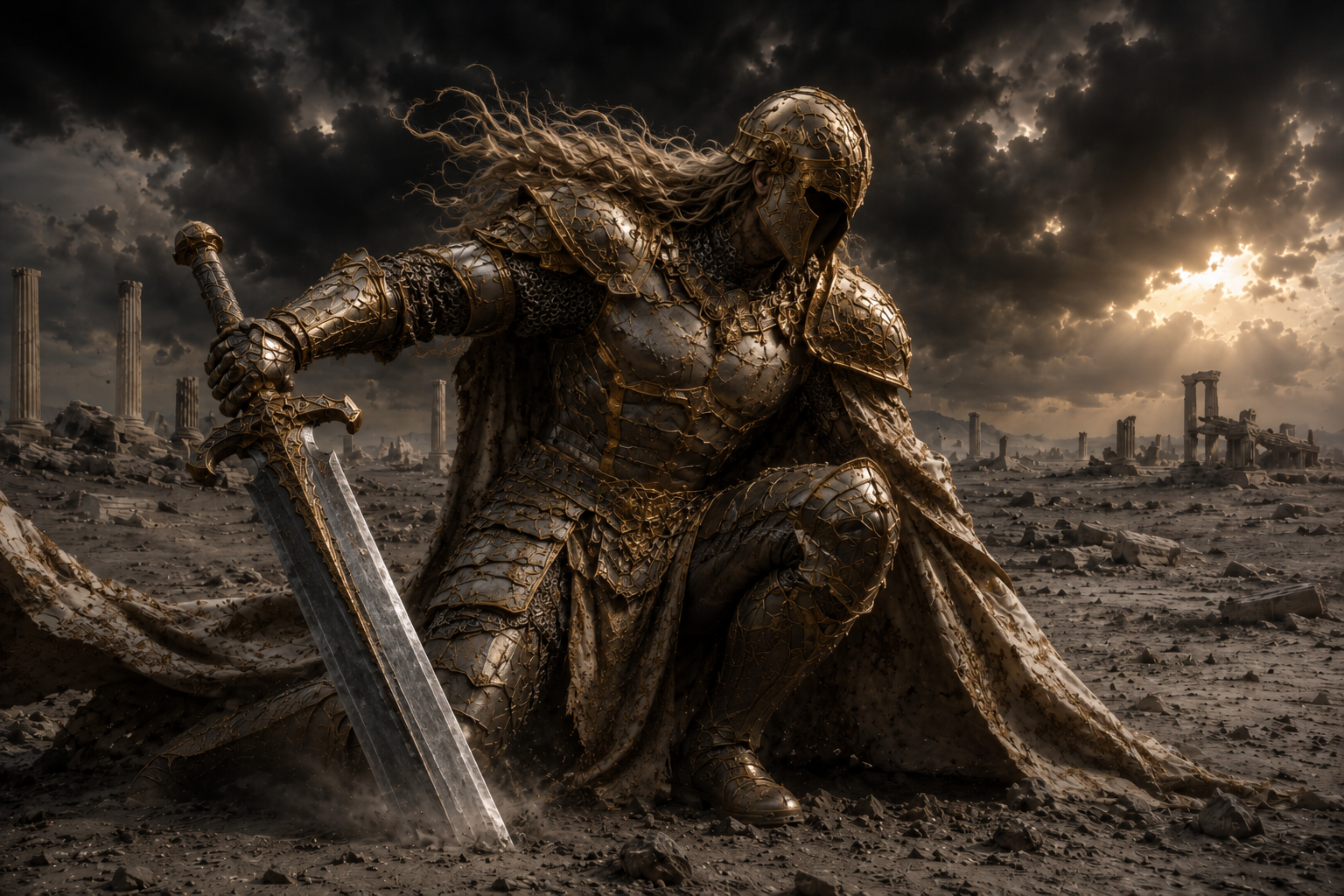
Older interpretation of Daevon: