Goblin Town
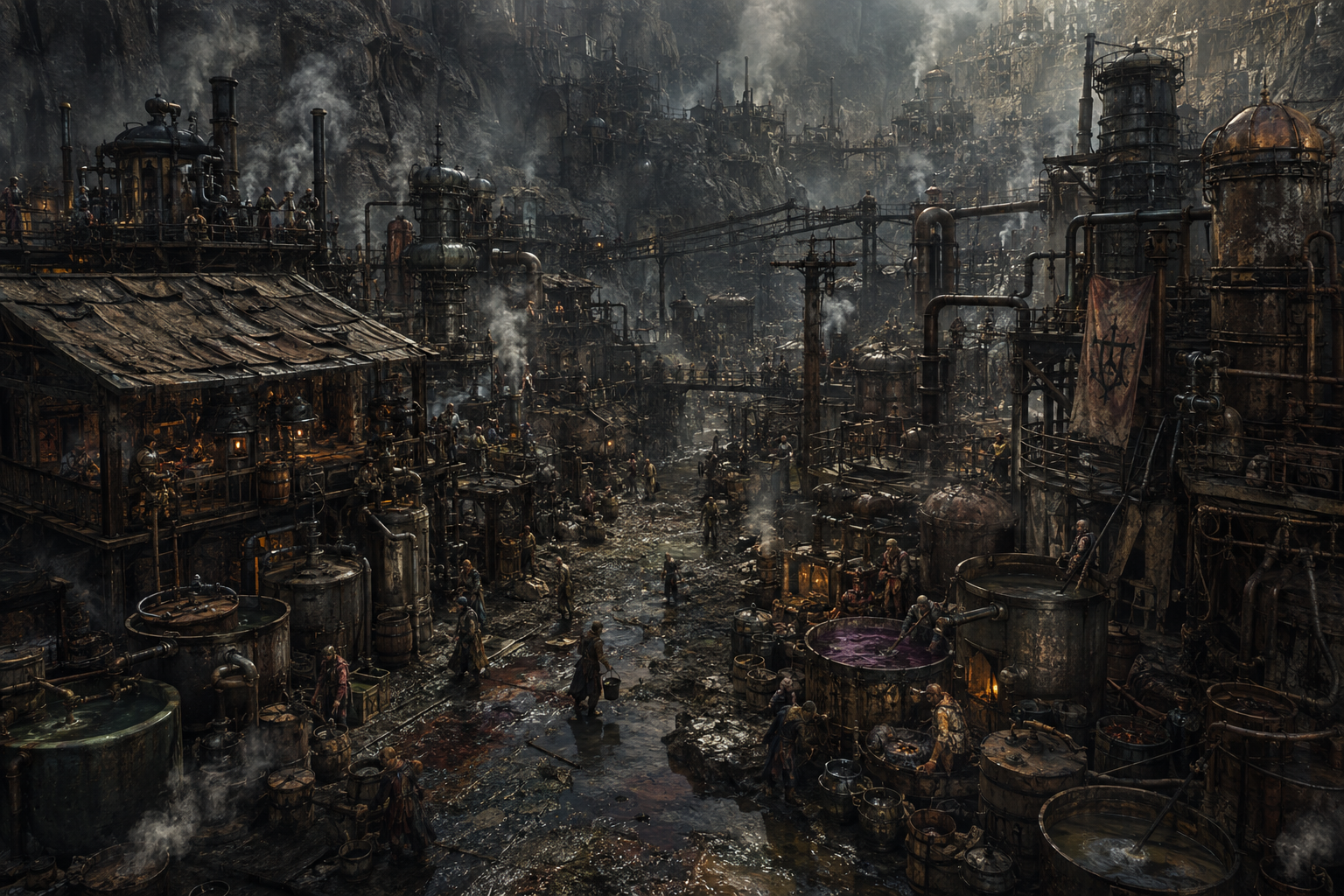
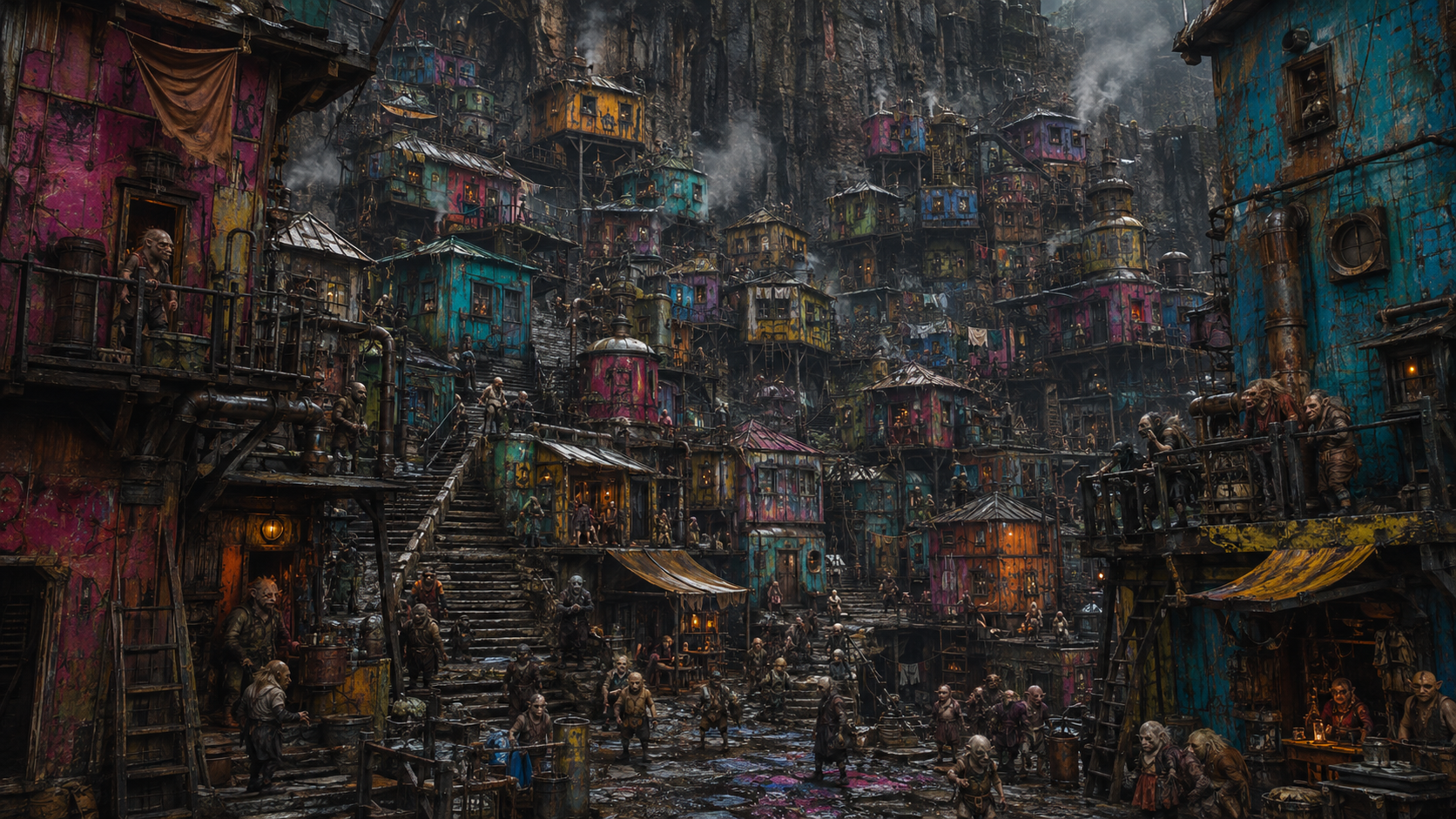
Goblin Town begins where ordinary chemistry stops being trustworthy.
The factories straddle the northeastern scar of Rinyldissen in a dense band of sheds, furnaces, towers, vats, timber gantries and stone chambers built into the base of the escarpment. Some stand beside the black contaminated lake left by the old Dox catastrophe; others climb the cliff itself, bolted into ancient masonry, natural caverns and forgotten military galleries. Pipes cross alleys overhead. Channels of yellow, blue and rust-coloured water descend through gutters cut directly into the rock. Chimneys emerge at impossible angles from buildings that appear too small to contain whatever machinery is producing the smoke.
Most of the inhabitants are tiny.
Forty centimetres is not unusual. A metre twenty is tall. A human entering the industrial quarter experiences architecture as a series of humiliations: doors at knee height, suspended walkways at chest height, staircases too narrow for human feet, ladders everywhere, trapdoors under benches, workshops stacked three or four deep inside spaces a human would mistake for cupboards. Whole labour crews can disappear through an opening scarcely large enough for a human to crawl through.
Seen from a distance, however, Goblin Town resembles a medieval industrial city in miniature that has metastasised across the cliff.
The nitrate works are among the oldest establishments. Their foundations are understandable enough. Urine, dung, ash, rotting organic material, lime, charcoal, sulphur. Saltpetre. Gunpowder. A chemist from Earth might grimace at the hygiene but recognize the logic.
Then the equations begin failing.
The old nitrate houses contain long brick beds through which solutions are filtered repeatedly. Workers test them with ceramic strips, metallic powders, flame colours and tiny caged organisms bred specifically for the purpose. Some solutions are heated. Some are cooled. Some must be left in darkness. Some apparently react differently if exposed to moonlight.
This is where a visiting medieval alchemist would become ecstatic.
Not because the place resembles medieval alchemy.
Because it proves that the medieval alchemist was partly right.
There genuinely are affinities that do not behave according to ordinary terrestrial chemistry. Certain compounds respond to geometric confinement. Some precipitates change properties according to the material of the vessel in which they formed. There are catalysts that appear to lose no measurable mass while nevertheless becoming exhausted. A few reactions display absurd sensitivity to the presence of living nervous tissue.
And Goblin Town treats this as engineering.
Nobody pauses reverently over it.
A worker throws three spoonfuls of grey powder into a vat, watches the surface become violet, swears, adds salt, and tells the apprentice that the batch has become "too leftward."
The apprentice understands.
A modern chemist initially assumes contamination.
Then experimental error.
Then unknown isotopes.
Then an unfamiliar element.
Then several unfamiliar elements.
The problem becomes considerably worse when spectroscopy begins returning results that are internally consistent.
A particularly unfortunate investigator might eventually sit at a laboratory bench surrounded by meticulously labelled samples, weighing the same substance for the seventeenth time.
"...There cannot possibly be an element with an atomic number between boron and carbon."
Another measurement.
"I am weighing it. I am eliminating every contaminant."
Silence.
"So there must be at least eight elements between lithium and carbon."
Another spectrum.
The scientist stares at it.
"...and one of them behaves like a noble gas."
At this point the Goblin assistant quietly asks whether the scientist would like tea.
That is roughly where the psychological problems begin.
Because the results are reproducible.
They are not magic in the convenient sense. They cannot be dismissed as miracles. They possess rules, ratios, thresholds, activation energies, reaction chains and industrial tolerances. Goblin Town has textbooks. Goblin Town has tables. Goblin Town has generations of empirical literature.
It simply describes a universe that should not exist.
The chemical works therefore look halfway familiar and halfway obscene to reason. Distillation towers stand beside alchemical retorts whose internal geometry is more important than their volume. Chlorine works use ceramic condensers painted with symbols which, according to repeated controlled trials, increase yield by approximately four percent. Furnaces are lined with materials that remain cold on one surface while glowing white on the other. Salt crystals are grown in racks suspended over pits because they acquire undesirable properties if allowed to touch the ground.
Nobody knows why.
That answer is considered perfectly respectable.
Some factories manufacture mundane things: acids, dyes, bleach, nitrates, cleaning compounds, preservatives, tanning agents, metal treatments.
Others manufacture substances whose names have no Earth equivalent.
Blue salt.
Glass sulphur.
Winter mercury.
Dead lime.
Hollow phosphorus.
Laughing copper.
Several are toxic. Several are explosive. One is both harmless and extremely dangerous depending on whether it is transported north-south or east-west.
The goblins have procedures for this.
The procedures work.
This is what would terrify a scientist most.
Goblin Town is not irrational.
It is brutally empirical.
It has spent centuries discovering what works without demanding that reality first become philosophically acceptable.