The Lenrira Region
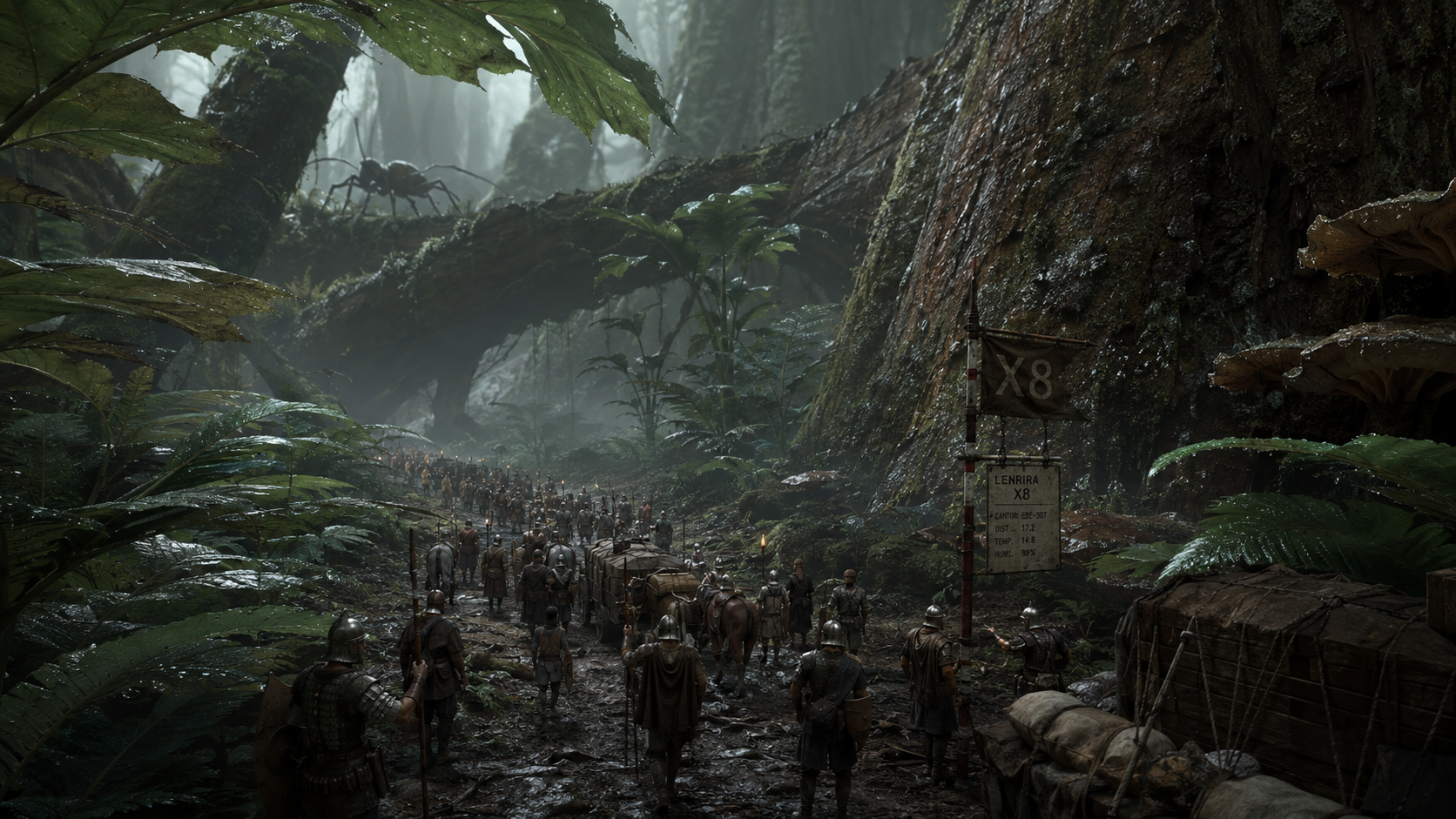
Classification: Continental spatial anomaly; primordial forest complex; permanent strategic obstruction
Administrative responsibility: Southwestern Command, King’s Rangers, Lenrira Survey, Fort Yudkowsky
Entry authority: Joint memorandum of the Senior Surveyors, Boundary Rangers, Field Medical Office and Vwaditha Weather Service
Access: Restricted beyond the First Survey Line
Lenrira is an elevated region of primordial woodland situated southwest of the Kingdom. Its externally measured area is approximately four times that of the Netherlands, although this figure is useful only for describing the boundary visible from unaffected territory. It must not be interpreted as a measurement of the traversable country within.
Lenrira is not unmapped.
Lenrira is not unstable.
Lenrira does not “change its mind,” rearrange itself, move its roads, alter its boundaries overnight or behave according to the disposition of those entering it. Such claims are repeated by travellers who have failed to understand their instruments, lost their reference markers, crossed an unrecorded contour or panicked.
The pattern is irregular but fixed.
This distinction is the foundation of all competent work in the region.
The anomaly consists of a series of continuous but contorted scale contours extending broadly from north to south. Each contour marks a measurable change in the relative scale between a traveller and the surrounding environment. By established convention, the principal contours are recorded as successive doublings: ×2, ×4, ×8 and onward. The lines twist, fork, form narrow salients and occasionally return close to the outer boundary, but their positions do not drift.
The King’s Rangers maintain a network of survey totems along the confirmed contours. Each totem records the local scale index, its relation to the nearest verified stations, the date of inspection and the identity of the responsible survey party.
A totem without a current inspection mark is not a totem. It is a piece of wood in a forest.
No expedition is to proceed on the authority of an unverified marker.
Relative scale
Persons entering Lenrira become progressively smaller in relation to the local environment. Clothing, weapons, carried supplies and animals accompanying them remain proportionate to the traveller while within the same local field. The difficulty is therefore not that a man loses his boots or that his sword becomes too small for his hand. The difficulty is that the world around him becomes larger with every significant contour crossed.
A shallow root becomes a wall.
A depression becomes a basin.
A patch of moss becomes obstructive woodland.
Rain retained in bark becomes a body of water.
An ant ceases to be vermin and becomes an armed animal with a social structure, territorial instincts and the strength to remove a wounded man.
This process compounds. It does not matter that the external distance across Lenrira appears to be only several hundred kilometres. A conventional military column cannot cross it. Neither can an ordinary caravan, survey train or settlement expedition. The material demands increase faster than supplies can be moved, while the surrounding terrain becomes progressively more difficult to negotiate.
This is why the western border of the Kingdom terminates here.
The matter was settled by measurement, not pessimism.
Movement and acclimatization
It is possible for individuals and small parties to penetrate farther than an uninterrupted march would allow. This is achieved through staged residence.
A party crosses a contour, establishes a stationary camp and remains there for a prolonged period. Several months is normal. During that time the body undergoes a partial accommodation to the local conditions. Once the party has been medically cleared, it may proceed toward the next contour and repeat the process.
“Acclimatization” must not be confused with immunity.
It is slow, incomplete and individually variable. No reliable procedure exists for accelerating it. Attempts involving stimulants, deprivation, induced fever, fasting, excessive feeding, magical enlargement, magical diminution or repeated forced crossings have produced no useful improvement.
They have produced funerals.
At greater depths, travellers develop a characteristic syndrome beginning with local muscle stiffness, irregular tremors and pain during exertion. This progresses into severe whole-body cramping. In advanced cases the jaw locks, the abdominal wall contracts continuously and the limbs draw inward with sufficient force to dislocate joints.
A person in this condition cannot march, climb, defend themselves or reliably swallow.
The cramping is not to be “walked off.”
No commander may order an affected person across another contour.
Field physicians have heard every argument. The patient feels strong enough. The objective is close. The weather is turning. The party cannot spare the delay. The patient has crossed before. The patient is indispensable.
The answer remains no.
Lenrira has killed more indispensable men than dispensable ones.
Visibility and distance
From outside the boundary, Lenrira presents an optical distortion which has never been adequately reproduced in painting. The forest does not simply appear larger. Depth becomes difficult to judge. Separate layers of woodland seem simultaneously near and remote. Trees which ought to overlap according to ordinary perspective may appear to stand beside one another. Ridges visible through the canopy resist reliable estimation.
Surveyors do not use apparent distance inside Lenrira.
They use marked cordage, timed movement, triangulation between verified totems and repeated measurement from fixed ground.
A person who says, “It is only another mile,” has ceased doing survey work.
Light beneath the canopy is generally poor. The density and scale of the vegetation create a wet green darkness even during the middle of the day. Mists persist through much of the region and may remain nearly motionless for hours. Condensation gathers on equipment, hair, leather, paper, exposed food and the inside surfaces of shelters.
A dry object placed in Lenrira is considered wet unless immediately proven otherwise.
Rot prevention is consequently a principal logistical concern. Spare bowstrings, medical cloth, maps and written records must be sealed. Metal is to be inspected daily. Foot care is compulsory. A Ranger may survive an animal encounter only to lose both feet to six weeks of disciplined negligence.
Water and heat
Lenrira contains extraordinary quantities of water and ambient heat.
It behaves, in practical terms, as an enormous elevated sponge. Rainfall, runoff and groundwater entering its margins are absorbed into soil, root systems, decaying vegetable matter, pools and innumerable minor watercourses. The country rarely presents the clean division between land and water expected elsewhere. Much of it is saturated structure.
This does not make Lenrira a swamp in the ordinary sense. A swamp drains. A swamp has a surface. Lenrira stores water through a vertical mass of living and dead material whose depth is often unknown.
The River Skai does not flow through Lenrira.
It passes outside the affected territory and terminates at Dylath-Leen. This is stated explicitly because inaccurate foreign maps continue to route the Skai through the forest, usually on the assumption that every major body of water near Lenrira must interact directly with the anomaly.
They do not.
Dylath-Leen’s enormous fish are regularly discussed in connection with Lenrira. There may be an ecological connection through groundwater, heat, drainage or food systems. No mechanism has been proven. A large fish is not evidence of a river crossing a scale contour.
Wind and the Vwaditha storms
Wind within Lenrira is uncommon and usually weak.
The stillness is one of the first conditions noticed by new personnel and one of the last they learn to respect. The canopy may remain entirely motionless while water drips continuously from a hundred levels of vegetation. Sound carries irregularly. A breaking branch may be heard at surprising distance while a large animal moving nearby produces almost no clear direction of approach.
Toward evening, accumulated wet air descends from the elevated country toward the eastern lowlands. As it leaves Lenrira and accelerates downhill, it forms a strong, moisture-laden gale. This discharge contributes directly to the persistent thunderstorms over Vwaditha.
These storms are not an omen.
They are weather.
Weather can still kill you.
Border settlements, agricultural estates, military posts and animal-handling facilities operate around the evening gale. Roofs are heavily secured. Open transport is halted before the expected descent. Capture cages are checked twice. Fires are covered. Those who schedule an exposed operation during the evening outflow without necessity are liable for the consequences.
The eastern lands receive enormous agricultural benefit from this system. Rainfall, heat and organic material descending from Lenrira support exceptionally fertile soil. Crops can be abundant to the point of structural failure. Vegetation grows quickly. Drainage and mould are perpetual concerns.
Local prosperity should not be mistaken for local ease.
The same weather that fattens a field can flatten it.
Fauna and outward movement
Animals native to the deeper contours may cross outward.
When they do, their relationship to the external environment changes. Creatures which were proportionate within their native band may emerge as animals of extraordinary size. Historical records describe incursions travelling far to the east, including periods before the scale structure of Lenrira was understood. Contemporary people often treat such accounts as exaggerations produced by frightened ancestors.
The officers responsible for the border do not.
Legions remain stationed in the region because the old accounts were accurate.
Not every outward-moving animal is aggressive. This is of little comfort. A frightened herbivore of sufficient mass is a military event. A burrowing animal can undermine a road, wall or settlement. Insects may reproduce before their significance is recognized. Plant material transported on fur, in dung or within a carcass can be as dangerous as the animal itself.
The first question is not, “What species is it?”
The first question is, “From which contour did it emerge?”
Scale origin determines handling requirements, enclosure strength, feeding demands and the probable consequences of escape.
Capture and export
The capture of large Lenriran animals and plants is a major regional industry. Specimens are purchased by noble estates, menageries, medical colleges, agricultural houses, military institutions and private collectors.
The trade is legal.
It is also one of the principal sources of preventable death along the frontier.
Commercial capture is permitted only under surveyed conditions and requires licensed handlers, a confirmed extraction route, prepared containment and a receiving facility capable of maintaining the specimen after removal. Capturing an animal first and deciding where to put it afterward is not enterprise. It is the creation of a public emergency for private profit.
Plants require equal caution. A plant does not become harmless because it lacks teeth. Root expansion, spore production, toxic sap, parasitic behaviour and seed dispersal must be assessed before transport.
Several estates east of Vwaditha have learned this at considerable expense.
The estate owners generally survived.
Their gardeners did not always do so.
Permanent populations
Human communities exist within the accessible scaling bands. Some have remained near the ×4 contour for many generations and show partial hereditary adaptation to local scale.
Persons born in these communities may travel outward and appear externally ordinary in size. Their inherited biology does not necessarily revert in every respect.
The reproductive consequences are well documented and are not a matter for tavern humour. Conception between a man of an adapted inner population and a woman from farther east may result in prolonged gestation, abnormal fetal growth and a dangerous delivery. Frontier midwives, surgeons and physicians are required to ask about paternal place of birth and long-term contour residence.
Failure to obtain this history has killed women.
The descendants of such unions are associated with the origin and continuing appearance of Oger populations. The subject remains politically, medically and socially sensitive. Personnel are reminded that “Oger” is not a diagnosis, that hereditary outcomes vary and that the mother is a patient rather than an anthropological curiosity.
No one at Fort Yudkowsky is permitted to refer to a dangerous pregnancy as “a passionate-night problem” within hearing of the medical staff.
This regulation exists because the medical staff requested it.
Fort Yudkowsky
Fort Yudkowsky is the principal military, surveying and logistical centre associated with Lenrira.
It is not the last wall between civilization and a malicious forest. Such language is popular with visitors and produces poor decisions.
The fort is a workplace.
Its functions include maintaining the totem network, training survey parties, observing outward animal movement, supporting licensed capture operations, coordinating weather reports, receiving injured personnel and keeping the eastern routes open.
Its most experienced personnel are not those who have gone deepest. They are those who have returned repeatedly with their parties intact, their records legible and their instruments accounted for.
Young officers often arrive wishing to make a discovery.
Senior officers wish them to complete the inspection roster.
Lenrira rewards the second ambition more reliably.
Professional consensus
No accepted explanation exists for the origin of the scale contours.
This does not prevent them from being measured.
No accepted explanation exists for deep cramping.
This does not prevent it from being diagnosed.
No accepted explanation exists for the total accumulation of water and heat.
This does not prevent the evening gale from being forecast.
The duty of personnel assigned to Lenrira is not to solve the forest. It is to work accurately within the conditions it presents.
Those who describe Lenrira as capricious usually mean that they were careless.
Those who describe it as unconquerable usually mean that they have finally performed the arithmetic.
Those of us who have worked here for decades do not hate Lenrira. We do not worship it, bargain with it or imagine that it watches us.
We inspect the markers.
We check the weather.
We count everyone twice.
We leave before the cramping begins.
We are not afraid of Lenrira.
We are careful, which is different.