CHAPTER 3
CHAPTER 3
BASIC GROUND-FIGHTING TECHNIQUES
Basic ground-fighting techniques build a fundamental understanding of dominant body position, which should be the focus of most combatives training before moving on to the more difficult standing techniques. Ground fighting is also where technique can most easily be used to overcome size and strength.*
Section I. DOMINANT BODY POSITION
Before any killing or disabling technique can be applied, the soldier must first gain and maintain dominant body position. The leverage gained from dominant body position allows the fighter to defeat a stronger opponent. An appreciation for dominant position is fundamental to becoming a proficient fighter because it ties together what would otherwise be a long confusing list of unrelated techniques. If a finishing technique is attempted from dominant position and fails, the fighter can simply try again. If, on the other hand, a finishing technique is attempted from other than dominant position and fails, it will usually mean defeat. The dominant body positions will be introduced in order of precedence.
3-1. BACK MOUNT
The back mount gives the fighter the best control of the fight (Figure 3-1). From this position it is very difficult for the enemy to either defend himself or counterattack. Both legs should be wrapped around the enemy with the heels "hooked" inside his legs. One arm is under an armpit and the other is around the neck and the hands are clasped. Even though a fighter may find himself with his own back on the ground this is still the back mount.
CAUTION
While in the back mount, the fighter's feet should never be crossed because this would provide the enemy an opportunity for an ankle break.
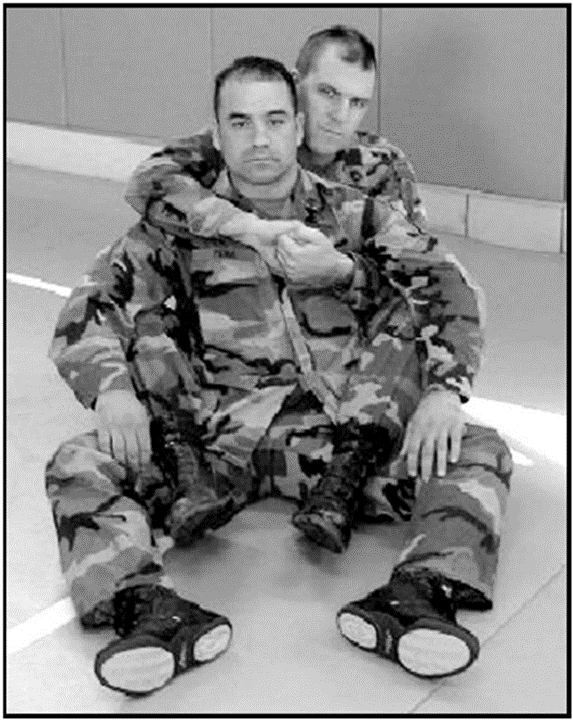
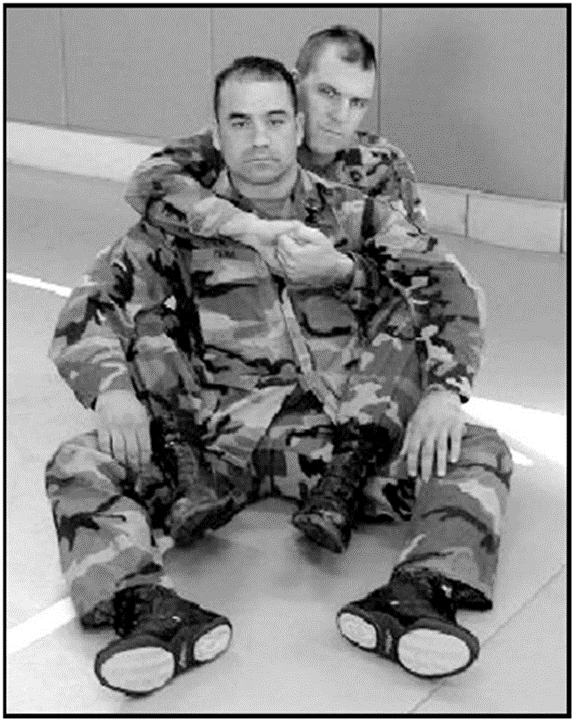
Figure 3-1. Back mount.
3-2. FRONT MOUNT
The front mount (Figure 3-2) is dominant because it allows the fighter to strike the enemy with punches without the danger of effective return punches, and also provides the leverage to attack the enemy's upper body with joint attacks. Knees are as high as possible toward the enemy's armpits. This position should be held loosely to allow the enemy to turn over if he should try.
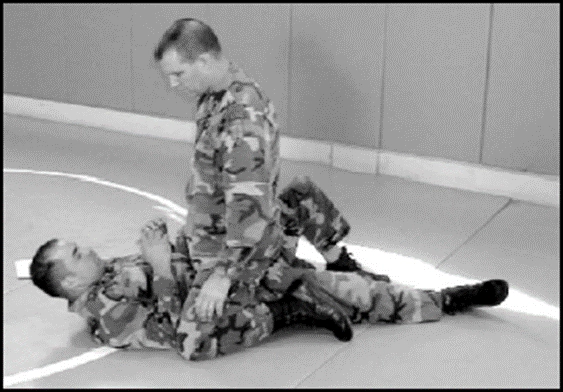
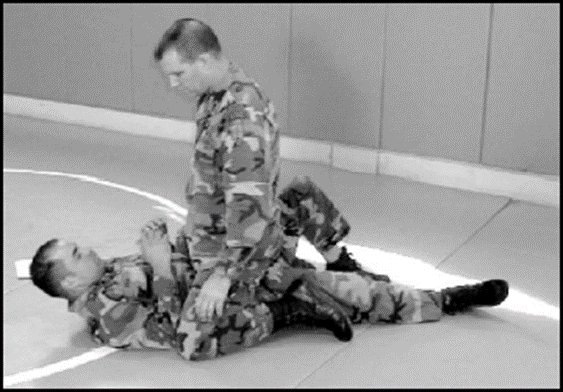
Figure 3-2. Front mount.
3-3. GUARD
If the fighter must be on the bottom, the guard position (Figure 3-3) allows the best defense and the only chance of offense. It is important initially for the fighter to lock his feet together behind the enemy's back to prevent him from simply pushing the fighter's knees down and stepping over them.
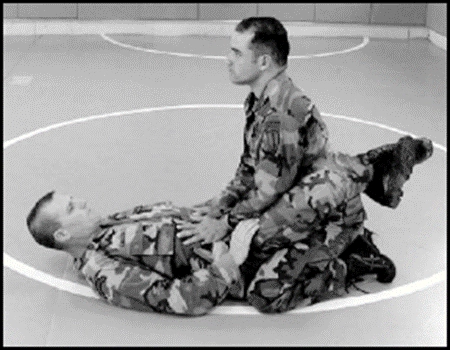
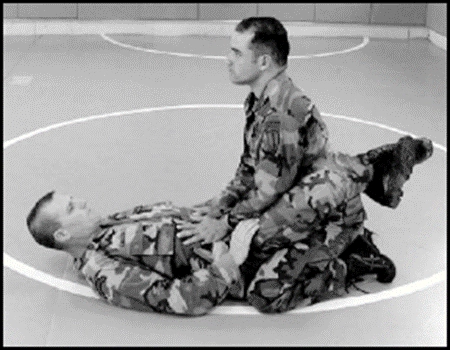
Figure 3-3. Guard.
3-4. SIDE CONTROL
Although side control (Figure 3-4) is not a dominant position, many times a fighter will find himself in this position, and he must be able to counter the enemy's defensive techniques. The fighter should place his elbow on the ground in the notch created by the enemy's head and shoulder. His other hand should be palm down on the ground on the near side of the enemy. The leg closest to the enemy's head should be straight and the other one bent so that the knee is near the enemy's hip. He should keep his head down to avoid knee strikes.
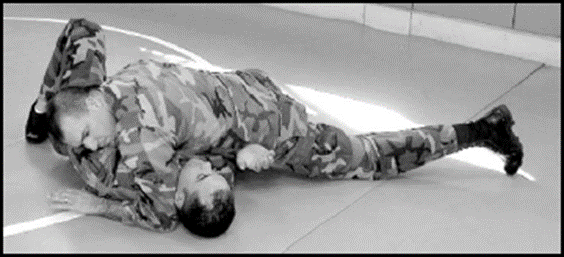
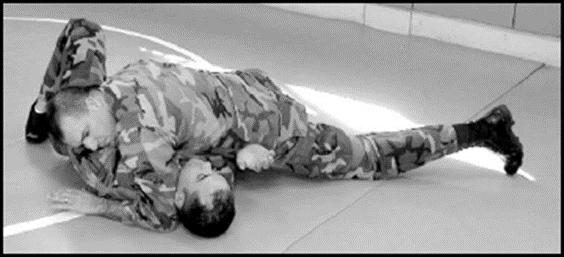
Figure 3-4. Side control.
Section II. BASIC TECHNIQUES
These basic techniques not only teach a fighter to understand dominant body position, but also provide an introduction to a systematic way of fighting on the ground. Almost all types of finishing moves are represented by the simplest and,at the same time, most effective example of the type. Before any time is spent on the more complex and harder to learn techniques presented later in this manual, the fighter must master these basics.
*