Prototyping
Prototyping
Prototyping is a key element of design thinking that lends itself well to systems thinking. It is consistent with a test and learn approach, with an emphasis on action research, learning and adapting and, sometimes, ‘failing fast’ and changing course.
Design thinking has a range of elements that are centred on ‘lived experience’ and the needs of the ‘end-user’. This is why it’s also sometimes called user or human centred design. It’s not a process as such, although it can feel like that. Rather, use each of the tools as you need them depending on the challenge you are solving at the time, and be prepared to go back and iterate as you learn more.
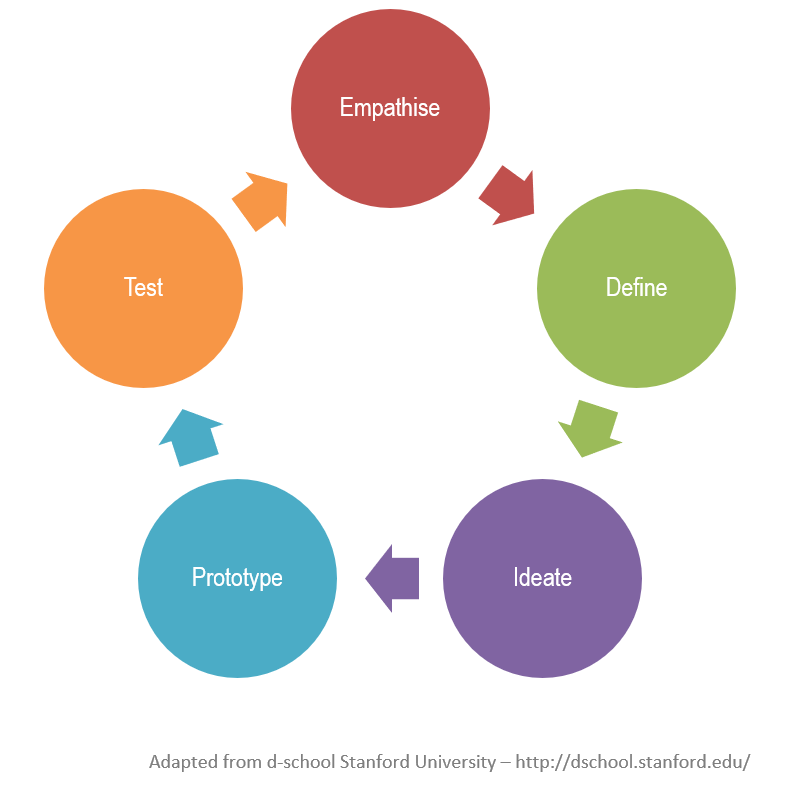
Image adapted from d-school Stanford University – http://dschool.stanford.edu/
Prototyping is about testing the whole concept, not just a perfected part of it. So don’t get stuck in the details. For example, if the concept is ‘mobility’, then the goal is to test how to get from A to B. The prototype might eventually progress from something simple like a skateboard then to a bicycle and finally to a fancy car. Each is a form of mobility. Creating the perfect design for a single wheel would not be testing mobility. It would not be a true prototype.
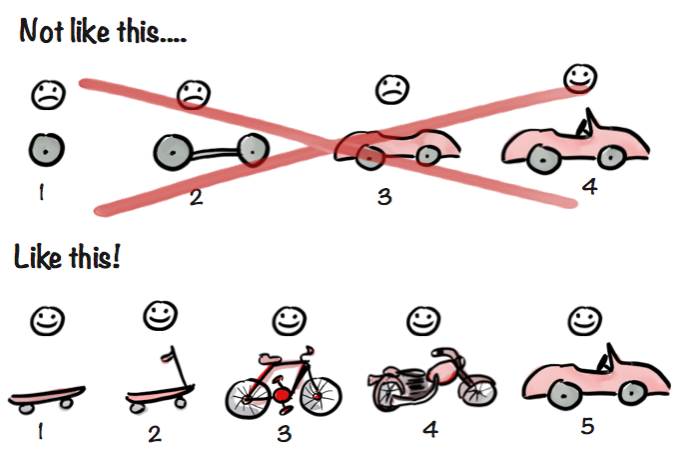
Image from: DeSmart http://desmart.com/blog/mvp-is-not-your-final-product
Prototypes typically start off very low-fidelity (such as using a paper mock-up or hand sketches), becoming more resolved and high fidelity as you learn more and develop the concept further. Don’t invest too much time and effort initially.
There are a range of prototyping methods, including simulation, scale modelling, wireframes, story-boarding, role play, paper prototyping and even lego [1].
Here the storyboard method is explained. Storyboards are great for representing a scenario. Through the drawing of several ‘scenes’ like a comic book, the storyboard helps to show how different actors might interact with a proposed solution or process. It’s a way to bring a solution to life.
Accessibility:
 This activity requires participants to write or draw on their own
 This activity requires participants to engage is social learning
 This activity requires participants to read written notes on a large wall space
Output: The output from the process produces a storyboard that can be captured simply by taking photos or through a powerpoint presentation.
Method: a larger scale procedure. It usually involves multiple participants and sessions in order to complete. The procedure to complete generally remains the same between applications, but often contains smaller actions which can be rearranged or scaled to suit context and need.
Investment: low cost, low resources, medium skill, medium time
Outcomes
- Aligns the team's thinking to the goals and behaviours of the proposed solution
- Provides the team a shared understanding of exactly what they are prototyping
- A means to capture a concept without getting lost in detailed design
- A way to identify and test critical assumptions that underpin an idea or solution
- Generates learning in order to improve and evolve the idea or solution
When and Why Do I Use This
Act Strategically: Prototyping comes after the stage of ‘finding leverage’, at the point of Act Strategically - when opportunities or possible solutions have been identified and it is time to start thinking through possible design. Often used for early-stage prototyping of software and apps, the storyboard method outlined below is useful for thinking about iterative solutions in complex systems.