35 Lapis Lazuli
- INTROSPECTION
- MIDDLE WEST
- CHAMOMILE
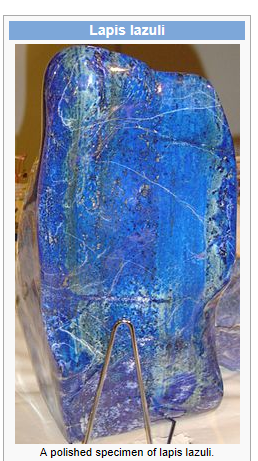
Lapis lazuli (pron.: /:{ˈ:(style="border-bottom-color:currentcolor;border-bottom-width:1px;border-bottom-style:dotted"):}::{l:(style="border-bottom-color:currentcolor;border-bottom-width:1px;border-bottom-style:dotted"):}::{æ:(style="border-bottom-color:currentcolor;border-bottom-width:1px;border-bottom-style:dotted"):}::{p:(style="border-bottom-color:currentcolor;border-bottom-width:1px;border-bottom-style:dotted"):}::{ɪ:(style="border-bottom-color:currentcolor;border-bottom-width:1px;border-bottom-style:dotted"):}::{s:(style="border-bottom-color:currentcolor;border-bottom-width:1px;border-bottom-style:dotted"):}: :{ˈ:(style="border-bottom-color:currentcolor;border-bottom-width:1px;border-bottom-style:dotted"):}::{l:(style="border-bottom-color:currentcolor;border-bottom-width:1px;border-bottom-style:dotted"):}::{æ:(style="border-bottom-color:currentcolor;border-bottom-width:1px;border-bottom-style:dotted"):}::{z:(style="border-bottom-color:currentcolor;border-bottom-width:1px;border-bottom-style:dotted"):}::{j:(style="border-bottom-color:currentcolor;border-bottom-width:1px;border-bottom-style:dotted"):}::{ʉ:(style="border-bottom-color:currentcolor;border-bottom-width:1px;border-bottom-style:dotted"):}::{l:(style="border-bottom-color:currentcolor;border-bottom-width:1px;border-bottom-style:dotted"):}::{aɪ:(style="border-bottom-color:currentcolor;border-bottom-width:1px;border-bottom-style:dotted"):}:/ or /:{ˈ:(style="border-bottom-color:currentcolor;border-bottom-width:1px;border-bottom-style:dotted"):}::{l:(style="border-bottom-color:currentcolor;border-bottom-width:1px;border-bottom-style:dotted"):}::{æ:(style="border-bottom-color:currentcolor;border-bottom-width:1px;border-bottom-style:dotted"):}::{z:(style="border-bottom-color:currentcolor;border-bottom-width:1px;border-bottom-style:dotted"):}::{j:(style="border-bottom-color:currentcolor;border-bottom-width:1px;border-bottom-style:dotted"):}::{ʉ:(style="border-bottom-color:currentcolor;border-bottom-width:1px;border-bottom-style:dotted"):}::{l:(style="border-bottom-color:currentcolor;border-bottom-width:1px;border-bottom-style:dotted"):}::{i:(style="border-bottom-color:currentcolor;border-bottom-width:1px;border-bottom-style:dotted"):}:/ ***:{:{LAP:(style="text-transform:lowercase"):}::(style="font-variant:small-caps"):}:**-iss* ***:{:{LAZ:(style="text-transform:lowercase"):}::(style="font-variant:small-caps"):}:**-zew-ly/lee*,[1] Arabic: لازورد Persian: لاژورد Urdu: لاجورد) (sometimes abbreviated to lapis) is a relatively rare semi-precious stone that has been prized since antiquity for its intense blue color.
Lapis lazuli was being mined in the Badakhshan province of Afghanistan as early as the 3rd millennium BC,[2] and there are sources that are found as far east as in the region around Lake Baikal in Siberia. Trade in the stone is ancient enough for lapis jewelry to have been found at Predynastic Egyptian and ancient Sumerian sites, and as lapis beads at neolithic burials in Mehrgarh, the Caucasus, and even as far from Afghanistan as Mauritania.[3]
Lapis takes an excellent polish and can be made into jewelry, carvings, boxes, mosaics, ornaments, and vases. It was also ground and processed to make the pigment ultramarine for tempera paint and, more rarely, oil paint. Its usage as a pigment in oil paint ended in the early 19th century when a chemically identical synthetic variety, often called French ultramarine, became available.
Historical usage
In ancient Egypt, lapis lazuli was a favorite stone for amulets and ornaments such as scarabs; it was also used in ancient Mesopotamia by the Sumerians, Akkadians, Assyrians, and Babylonians for seals and jewelry. Lapis jewelry has been found at excavations of the Predynastic Egyptian site Naqada (3300–3100 BC), and powdered lapis was used as eyeshadow by Cleopatra.[3] In ancient Mesopotamia, lapis artifacts can be found in great abundance, with many notable examples having been excavated at the Royal Cemetery of Ur (2600-2450 BC).[11] The 25th-century BC Statue of Ebih-Il, discovered in ancient Mari in Syria, uses lapis lazuli inlays that were imported from as far east as Afghanistan.[12]
In ancient times, lapis lazuli was known as sapphire,[13] which is the name that is used today for the blue corundum variety sapphire. It has also been used in the Taj Mahal in India.
[edit] Color
The intense blue color is due to the presence of the S3- radical anion in the crystal.[14] An electronic excitation of one electron from the highest doubly filled molecular orbital (No. 24) into the lowest singly occupied orbital (No. 25)[15] results in a very intense absorption line at λmax ~617 nm.