Green Chls
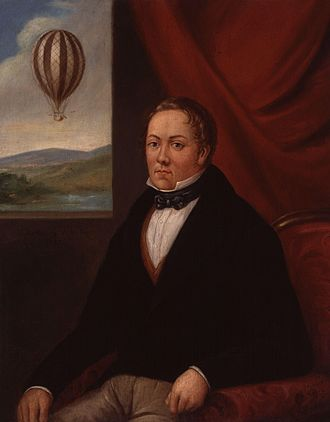
Name: Charles Green
Achievements: Pioneered the use of coal gas in balloons
Born: January 31, 1785; London, England
Died: March 26, 1870; London, England (Aged 85)
Field & Discipline: Aviation; Aeronaut; Balloonist
Language: English
Father: Thomas Green
Mother: Unknown
Siblings: Unknown
Spouse: Martha Morrell
Children: George
Education: Unknown
Life & Times:
Green’s interest in ballooning is said to have originated when he experimented with the use of coal gas to light the family vegetable shop. Ever since the [influenced by] Montgolfiers* had accomplished the sending of the first men into free flight above the earth in 1783, ballooning had seized imagination of adventurers and the populace at large.
When Green became interested balloons were still powered with hydrogen gas but Green became convinced that coal gas was a better bet. Hydrogen gas was expensive and volatile, and it took two days to fill a large balloon. He reasoned that it made it easier and quicker to inflate the balloon; it was cheaper; it was less harmful to the balloon’s silk fabric; and it did not penetrate the fabric as easily as hydrogen did.
It appears that Green had not yet realized another advantage: that coal gas, in contrast to hydrogen gas, has a higher specific heat than air which means that it is less susceptible to changes of temperature and reacts less quickly by expansion and contraction to the effects of sunshine and cloud.
As a result of the work of [work related to] Murdock* and [work related to] Clegg*, the use of coal-gas for lighting had spread and the London Gas Light and Coke Company had laid almost thirty miles of gas mains in London. To inflate a balloon, all you had to do was connect it to a gas main. On 19 July 1821, Green made the first-ever balloon ascent using coal-gas.
He took off from Green Park in the center of London as part of the celebrations for the coronation of George IV. The balloon, which rose to 11,000 ft, was decorated with the royal coat of arms and had been filled from a gas main in Picadilly. Green was hooked and began to make regular ascents.
He had to learn the hard way and before he became truly experienced he landed frequently in trees, hit the chimney of the Oxford Gas Works and fell into the sea at Brighton. In 1822 he was involved in a serious crash landing after which he made no more ascents for a year. Large bets were laid involving the distances a balloon might travel and where it would land and Green maintained that his crash was due to someone in the crowd severing a vital wire during his ascent. He also performed stunts in his early ballooning career, such as ascending from the back of a horse.
By 1835 he had made two hundred ascents and he decided to build a new spectacular balloon. The owners of Vauxhall pleasure gardens provided the capital and two thousand yards of fine silk was imported from Italy. The red and white segments of the 80 ft-high balloon were held together by a special glue invented by Green which he said was stronger than any stitching (no details).
The inaugural flight of the “The Royal Vauxhall” took place in September 1836 and was watched by huge crowd. Thirty-six policemen helped to hold down the balloon and twenty workmen were hurriedly co-opted when it looked as though the balloon would rise too soon.
Green was a very large man with a red face who was convivial and talkative on ground but a tyrant in the air. He inspired great confidence and two of the passengers he took up in the “Royal Vauxhall” conceived the idea of making a long distance flight.
Green estimated that the balloon could stay airborne for three weeks and gargantuan amounts of food and drink were stowed on board (including twenty pounds of sugar, forty pounds of ham, beef and tongue, 45 pounds of fowls and preserves, and 2 gallons each of sherry, port and brandy), together with a device for heating coffee with quick lime. Green installed a trail rope which would take some weight from the balloon at lower heights and would also warn them of getting too low when flying at night.
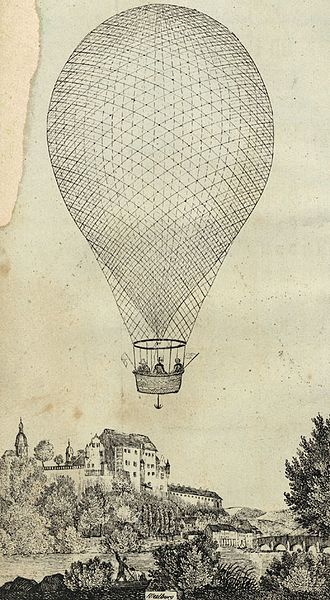
The three men took off from London on 7 November 1836 and having flown over the English channel arrived in French air space four hours later. They wined and dined as they flew through a moonless night, Green accidentally dropped the coffee maker over Liege, they flew over snow-capped mountains and thought they were in Poland, and at the third attempt they landed near Weilburg in the Duchoy of Nassau at 7.30 am the next morning.
They had flown 480 miles in eighteen hours which was the longest flight ever accomplished by man. Their precise landing place was at Dilhausen Mill on the Elbern (almost exactly where Jean-Pierre Blanchard had landed after ascending from Frankfort in 1785). Green was feted at balls, dinners and concerts, and a lavish christening ceremony was arranged at which the local nobility acted as godparents and the balloon (specially re-inflated) was renamed “The Great Nassau.”
In 1837, Green acted as pilot for the first parachute attempt by a Briton, the sixty-five year old Robert Cocking. Cocking had been wanting to try out his invention for thirty-five years (ever since seeing Andre-Jacques Garnerin make his parachute descent over London in 1802) but only “The Great Nassau” was capable of lifting his apparatus.
It was a dangerous feat for both men and Green was not eager to accept the assignment, mainly because when the parachutist jumped the loss of nearly 400 lbs would send the balloon up fast and it would be in danger of bursting.
He made special preparations, including an air bag and two breathing tubes so that he and the friend who accompanied him would not be asphyxiated by the sudden release of gas. When Cocking released himself from his basket under the balloon, Green and his companion were blinded by five minutes by escaping gas, rose to a height of at least 23,000 feet and had to throw out everything portable in order to land. Cocking’s parachute collapsed soon after he released it and he died soon after crash landing.
The following year (1848), Green made an attempt to attain the highest altitude ever recorded. He had been approached by George Rush, a wealthy amateur scientist, who wanted to test an improved aneroid barometer he had invented. Green chucked out a large amount of ballast at take off, hoping to gain the impetus for a rush of height. They went up about two miles in seven minutes and then attained a height of just over 27,000 feet (a little over 5 miles) which was near to the maximum height survivable without oxygen.
Green was pestered to make flights by passengers willing to pay a great deal of money and by 1852 he had made a record 500 ascents. After making several “farewell ascents” and “positively last appearances”, he made his last flight on 12 September 1852.
He then retired to his home, named Aerial Cottage, in London. He was made a member of the Aeronautical Society when it was founded in 1866.
Assessment: Green made the first coal gas-fuelled ascent in a balloon.
Oneliner: Charles Green, famous early balloonist
Bibliography:
- Rolt, LTC, The Aeronauts, Allan Sutton Publishing Ltd., Gloucester, 1985.
Charles Green (balloonist) - Wikipedia