Abel
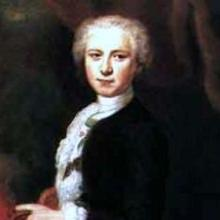
Leopold August Abel (24 March 1718 – 25 August 1794[1]) was a German violinist and composer. He was born in Köthen in 1718. He was the elder brother of Karl Friedrich Abel, and the grandfather of Johann Leopold Abel. August Abel studied violin under Benda. He played in the orchestra of the theatre at Brunswick, and was successively conductor of the court band to the Prince of Schwarzburg-Sondershausen (1758), the Margrave of Schwedt (1766), and the Duke of Schwerin (1770). He composed a sinfonia a 8 voci in 1766, and some of his violin studies and other compositions are in the possession of the Gesellschaft der Musikfreunde at Vienna. However, he never rose to the reputation of his brother. He died at Ludwigslust on 25 August 1794.[2]
One of Karl Abel's works became famous due to a misattribution: in the 19th century, a manuscript symphony in the hand of Wolfgang Amadeus Mozart, was catalogued as his Symphony No. 3 in E flat, K. 18, and was published as such in the first complete edition of Mozart's works by Breitkopf & Härtel. Later, it was discovered that this symphony was actually the work of Abel, copied by the boy Mozart, evidently for study purposes, while he was visiting London in 1764. That symphony was originally published as the concluding work in Abel's Six Symphonies, Op. 7.
Leopold August Abel - Wikipedia
MECKLENBURG & ABEL:
Duchy of Mecklenburg-Schwerin lay to east of Hamburg and Holstein, on shores of Baltic Sea. Duke Friedrich Franz I, and his son Prince Friedrich Ludwig were Ramee's clients. Young Prince Friedrich Ludwig's wife, Helena Paulowna, was a daughter of Tsar Paul I of Russia; she died in 1803 when aged only 19, and grieving husband erected a splendid mausoleum in park of the ducal
palace at Ludwigslust, south of Schwerin - mausoleum so grand that it ultimately came to serve as tomb for much of the Mecklenburg dynasty.
DUKE FRIEDRICH OF MECKLENBURG-SCHWERIN (d. 1785):
Duke Friedrich, the Pious, the son of Christian Ludwig II (d. 1756), strove much for the welfare of his country during the Seven-Years' War, during which Mecklenburg was on the imperial side and was ruthlessly plundered by Prussia. He then succeeded to the redemption of the offices pawned at Hanover and Braunschweig by his father and, because of a controversy with the city and university of Rostock, he withdrew the ducal professorships
there, and instead in 1760 endowed professorships at the University of Butzow. In 1785 he was succeeded by his nephew, Friedrich Franz I.
Frederick II, Duke of Mecklenburg-Schwerin - Wikipedia
LEOPOLD AUGUST ABEL (1718-94):
Elder brother to Karl Friedrich Abel (1725-87), became first violinist in the Hofkapelle at Mecklenburg-Schwerin in 1770, to Duke Friedrich (d. 1785).
Leopold August was born at Kothen on 24 March 1718, eldest of seven children of Christian Ferdinand Abel (d. 1737), court cellist in Anhalt-Kothen while J.S. Bach was Kapellmeister there, and his Swedish-born wife Anna-Christina Holm. (CFA had served in the Swedish Army under the leadership of King Carl XII, where met Swedish bride and brought her back to Germany - and possibly
met J.S. Bach's next older brother there, Johann Jacob Bach, who was an oboist in the employ of Carl XII).
L-A was first taught music teacher by his father, and all likelihood
probably received instruction also from Johann Sebastian Bach (who was good friends with CFA - JSB godfather to CFA's daughter, Sophie Charlotte in 1720) and from his oldest son, William Friedemann Bach (born 1710). Family fell on harder times, however, with death of CFA's patron Prince Leopold in 1728, and CFA plus family of seven children lived in severely reduced circumstances until death of father in 1737.
About 1733, Leopold August left Cothen and moved first to Dresden where he became a pupil of Franz Bendas, but returned to the homeland of his ancestors in Brunswick around 1745, where he worked as a violinist in the court orchestras. In 1758 he became a member and later director of the Court Chapel at Sonderhausen in Thuringia where he was employed until the end of the Seven Years' War; he was next appointed concert master in the orchestra
at Brandenburg-Schwedt (1765), then re-entered the service of the royal-Prussian concert master Franz Benda in Berlin (1768). From 1770, he was first violinist in the chapel of Friedrich, Grand-Duke of Mecklenburg-Schwerin in Ludwigslusts, where he remained until his death on 25 August 1794. His compositions include a Symphony in D (1776) and a violin 'Arpeggien'. Had 2 sons, August Christian Andreas Abel (1751-1834) and
Friedrich Ludwig Aemilius (b. 1770), who both became violinists at
Ludwigslust, although former was also court miniature-painter to Grand-Duke of M-S (his grandson was Sir Frederick Augustus). L-A's great-grandson, Ludwig Abel (1835-95) was a violinist at Basle from 1865, and from 1867 at Munich, where he taught at the conservatory, composed for the violin, and published a violin method (1875). L-A notable cos became patriarch of both the English and German branches of the highly musical Abel family.
Only possible thing of interest is Group Portrait painting that surfaced in 1985, attributed toBalthasar Denner. Was announced to world as group portrait of Johann Sebastian Bach and three of his sons on cover of 'Early Music' - J.S. Bach Tercentenary Issue, Spring 1985 (and during late 1980s and 1990s has appeared on numerous Bach CD covers etc), but is in fact -
according to Teri Noel Towe (2001)- a family portrait of Christian Ferdinand Abel: five of CFA's six sons appear to have reached maturity, and of these certainly two, if not three (if youngest son Markus Christian is included) became professional musicians of highest quality: if painting dates from around 1735, then young man standing on far right holding violin wd be perfect age for Leopold August - shows has dramatic overbite (family thing,
so had Karl Friedrich, as shown in caricatures).