Albani
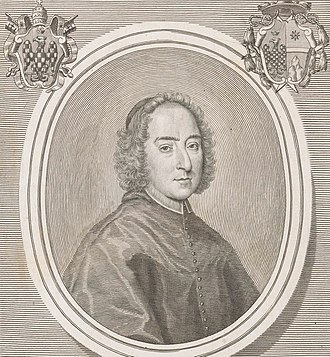
Alessandro Albani (15 October 1692 – 11 December 1779) was a Roman Catholic cardinal, but should be best remembered as a leading collector of antiquities, dealer and art patron in Rome. He supported the art historian, Johann Joachim Winckelmann and commissioned paintings from Anton Raphael Mengs. As a cardinal (from 1721) he furthered the interests of the governments of Austria, Savoy and Britain against those of France and Spain; he was a noted jurist and papal administrator in his earlier career. Upon his death he was the last cardinal created by Pope Innocent XIII.
Biography
Alessandro Albani was born on 15 October 1692 in Urbino, then part of the Papal States. He was the son of Orazio Albani. His studied jurisprudence at the La Sapienza University in Rome. Early in life he also prepared for a military career. At the age of 9 years, on 26 August 1701, he was made an honorary member of the military brotherhood of justice of the Knights of St John of Rome, and in 1707, a colonel of a regiment of dragoons in the pontifical military.
Alessandro was a member of the Albani family (branch of Urbino), which originated from into the Albani (family) that had established itself there from northern Albania in the 15th century.[1] Alessandro's father, Orazio, was the brother of Pope Clement XI Albani, who convinced Alessandro to set aside his budding military career. In part, his weak eyesight, that led to blindness in his advanced age, was not propitious for a soldier, and hence Alessandro entered the clergy. After Pope Clement XI's death in March 1721, Pope Innocent XIII appointed Alessandro as a cardinal, on 16 July 1721 as Cardinal-Deacon of Sant’Adriano al Foro - for which Alessandro required numerous special dispensations, not least because his brother, Annibale Albani, had been made a cardinal in 1711 and still sat in the Sacred College.[2]
 Bust of Demosthenes from Alessandro Albani's collection (Musée du Louvre).
Albani developed into one of the most astute antiquarians of his day, an arbiter of taste in the appreciation of Roman sculpture, and "a powerful and enterprising collector of Roman antiquities and patron of the arts... He used both ancient and modern art as a form of cultural capital," Seymour Howard observed,[3] "giving away acquisitions as favours and selling them for perpetually needed funds or when they lost efficacy for him." His first apprenticeship in this area was served under the papal antiquary and curator Marcantonio Sabatini.[4]
He was the formal protector of Rome's artists as patron of the Accademia di San Luca and was a powerful advocate for his favourites. Among the works of modern artists that passed through his hands was the album of drawings by Carlo Maratti that was sold in 1763 to George III and is conserved in the Royal Collection.[5]
His worldly manner and his sympathy with the Hanoverian party in Britain[6]- (Clement kept the Stuart pretender as his perennial guest in Rome) was exemplified by his friendship with Baron Philipp von Stosch, who shared many of Alessandro Albani's interests, and his correspondence with Sir Horace Mann, the British envoy at Florence,[7] who caused Clement many occasions of concern. Named papal envoy, with his brother Cardinal Carlo, to Bologna to welcome King Frederick IV of Denmark, he was sent in 1720 to Vienna in an attempt to retain Papal territorial rights in the duchy of Parma and Piacenza, recently awarded to Charles de Bourbon, and to conclude the negotiations for the restitution of Comacchio, in the possession of Habsburg troops since 1707.
Sir Horace Mann, a close correspondant with Horace Walpole in England at the request of the Cardinal, arranged for John Chute of 'The Vyne' in Hampshire, who was enjoying the Grand Tour, to spy on the Jacobites, who were in Rome making their plans for an invasion of England from Scotland. Information he collected was passed to Albani and then sent to England.
A mid-18th-century view of the Villa Albani by Giuseppe Vasi.
Albani's accommodating manner suited him for diplomatic tasks, such as the successful negotiations with Vittorio Amedeo II over conflicting rights of nomination and investiture, aggravated by the acquisition by the House of Savoy of Sardinia, to which the papacy had long-standing feudal pretensions. Accords were finalised in 1727 during the pontificate of Pope Benedict XIII, for which Vittorio Amedeo expressed his gratitude to Cardinal Alessandro with a rich abbacy and the title of "Protector of the Kingdom". Within the Papal Curia, however, the party of the zelanti considered the terms of the accords too generous. Tensions increased with the accession of Pope Clement XII, who was unsympathetic to Savoy. When a new concordat was arrived at in 1741, Alessandro Albani signed on the part of Savoy.
As a cardinal Albani participated in the conclaves of 1724, 1730, 1740, 1758, 1769, and 1774-1775. He announced the elections of Pope Clement XIII (1758), Pope Clement XIV (1769) and Pope Pius VI (1775). His consistent stand against French interests brought him closer to those of the Hapsburgs; he represented Hapsburg Austria at the Holy See, from 1756 until his death. On 12 August 1761 he was appointed Librarian of Holy Roman Church.
During the papacy of Pope Clement XIV Albani realigned himself with the zelanti against the interference of Catholic monarchs in the diplomacy that surrounded the eventual expulsion and Suppression of the Jesuits from most Catholic countries.
He died on 11 December 1779 and was buried in the Observant Franciscan Church of San Pietro in Urbino, Marche.
Villa Albani
Alessandro commissioned in 1745 the construction of the prominent Villa Albani in Rome. Building began in 1751 according to Giuseppe Vasi and celebrated as complete in 1763,[8] to house his evolving, constantly replaced and renewed collections of antiquities and ancient Roman sculpture, which soon filled the casino that faced the Villa down a series of formal parterres. Albani's lifelong friend Carlo Marchionni was the architect in charge, at the Villa and perhaps also for the two temples in the park, an Ionic temple of Diana and a sham ruin. The Albani antiquities were catalogued by the Cardinal's secretary, the first professional art historian, Johann Joachim Winckelmann, who was supported by Albani from the time when the Seven Years' War stranded him in Rome without his pension, and whose own connoisseurship was sharpened by the connection.[9]
After the Napoleonic upheavals the Albani heirs sold the villa to the Chigi, who were themselves related to the Albani and by this time had added the Albani name to their own. The Chigi eventually sold it to the Torlonia, the Roman bankers, to whom the villa still belongs. Cardinal Albani's coins and medals went to the Vatican Library, over which he had presided from 1761. The sarcophagi, columns and sculptures have been dispersed, but the famous bas-relief of Antinous remains in the villa.
Cardinal Alessandro Albani had another villa and park at Porto d'Anzio, that was finished in February 1732,[10] but was habitable for a few weeks only in spring because of malaria. Perhaps the villa and a casina in the park were by Marchionni.[11] Excavations in the park brought to light many ancient Roman sculptures.[12]
Further reading
- Debenedetti, ed., Alessandro Albani, patrono delle arti ... = Studi sul Settecento Romano; 9 (1993)
Research Notes:
CARDINAL ALBANI, ALESSANDRO (1692-1779)
Alessandro Albani was born at Urbino on 15 October 1692, third and youngest
son of Orazio, a brother of Pope Clement XI. Elder brothers were Annibale,
who became a cardinal in 1711, and Carlo, who received title of prince given
to family by Emperor Joseph I in 1710. On Clement XI's election in 1700,
family moved to Rome to enjoy traditional advantages of close relationship
to Pope, but retained their palace at Urbino and their connections there.
However, for much of his life, Alessandro moved only between his palazzo at
Rome, his mother's home at Soriano, his villa at the Porta Salaria, and
various seaside retreats.
AA does not at first seem to have been intended for ecclesiastical career,
although distinguished himself as a student of law, history and classical
languages. Was however also a fine horseman, and in 1708 (aged 16) he was
commanding a regiment of the Pope's cavalry in a minor engagement against
the Emperor's forces, which had occupied the small Adriatic port of
Comacchio. However, he entered the Church in 1712, aged 20, on his father's
death, and immediately came under direct protection of his uncle the pope.
Clement XI was highly cultured, and had been prominent in brilliant circle
surrounding Queen Christina of Sweden in Rome. As Pope, had become a notable
collector and patron of the arts, and fostered similar tastes in his two
nephews, Annibale and Alessandro. Through Clement, brothers came into
contact with many scholars, esp. Marcantonio Sabatini, the papal antiquary,
and Francesco Bianchini, scholar, scientist and archaeologist. In this way,
young AA developed v. early passion for art and classical antiquities, and
even recurrent youthful eye disease which weakened his sight did not become
a handicap: instead, had bronzes and medals brought to his bed for him to
handle, by which he acquired remarkable ability to judge antiques by touch -
used same capacity when grew blind in old age.
AA has been described when young as being of delightful appearance, blond,
blue-eyed, short, of athletic build, vivacious, intelligent, generous and
wildly impetuous. In 1714, AA acquired from Clement XI, Cassiano dal Pozzo's
famous collection of drawings of antique remains, and in 1715 he was made an
honorary member and director of studies in the Academy of San Luca. In same
year he met Philip von Stosch, his almost exact contemporary, a brilliant
scholar, antiquarian and would-be diplomat who was paying first visit to
Rome. Pair became great friends, and together excavated in Nettuno and
Tivoli - within few years AA had established collection of Roman coins
considered to be superior to that of Medici family.
In 1718, AA became domestic chaplain (Clerk of Apostolic Chamber) to his
uncle Clement XI, and later in the same yr he replaced his brother Annibale
as Secretary of the Memorials - clearly being groomed for high political
office as was v.promising - immensely clever, likeable and gifted
negotiator. Was in this post that AA became embroiled in numerous cabals and
intrigues which best Roman affairs at the Emperor's court, plus several love
affairs as was v. handsome, but all this not so great as AA considered
Pope's representative. In March 1720 he was sent as Nuncio Extraordinary to
Congress of Cambrai at Vienna, ostensibly to negotiate on specific matters
at issue between Clement XI and the Emperor - including the former's
recognition of the Sicilian monarchy, rights of ecclesiastical presentation
and investitures in Naples, and much-disputed possession of Comacchio which
the Emperor needed for the landing of troops for Naples. However, Clement
now in desperate political tangle as result of his own vacillations and of
rivalries of Bourbons and Hapsburgs, and AA sent as emissary to try and gain
some kind of advantage for him. This proved v. difficult, as Clement had
pleased neither French nor Emperor during War of Spanish Succession, and
with Peace of Utrecht in 1713 had lost valuable papal fiefs, plus had
greatly angered British by his support of the Stuart cause (AA also from
family of devoted Jacobite sympathizers). British Govt, under George I,
Elector of Hanover, in particular worried that Clement might be driven to
some desperate expedient which wd not only disturb delicately balanced peace
of Europe, but bring the Pretender again into dangerous prominence: Jacobite
threat remained real, with rebels still living in considerable numbers in
the Netherlands, and in seaport towns of France, while every prince and
state in Italy except Duke of Modena was pro-Jacobite and hostile to
existing alliance of great powers. George I even fearing a Holy War launched
by Emperor, persuaded by Pope, so AA's appearance at Vienna generally
regarded as sinister - loads of intrigues etc. during which AA apparently
lost some faith in Jacobite cause, and in end his trip generally considered
a failure.
On Clement's death on 19.3.1721, AA left Vienna and returned to Rome, with
business uncompleted. In Rome, in July 1721, AA made a cardinal, of church
of St Adriano by new pope Innocent XIII (although still had not taken holy
orders), and in 1722 as Cardinal of St Maria in Cosmedin. However, Clement's
death clearly affected his career, and little is heard of him for next few
years. Seems, however, that so short of money he had to sell bulk of his art
collection to Innocent XIII and Augustus the Strong, but was able to start
new collection with aid of a distant relative, the Duke of Modena, who owned
land on which Hadrian's Villa and the Villa d'Este stood in Tivoli - here,
and later accompanied by Winckelmann, AA spent many weeks digging up
artefacts.
AA crops up again in 1724, when he and brother Cardinal Annibale frantically
intruiging to procure election of one of their creatures to papacy - made
them so unpopular that family palace was nearly burned down by mob. However,
his systematic campaigning for a position finally paid off, and later the
same year he was given the Abbey of Nonantola, worth 6,000 crowns a year.
Next heard of in June 1726: as a member of a family of Jacobite
sympathizers, he travelled to Frascati with Cardinals Alberoni, Polignac and
others to condole with Pretender on death of his great friend Duke of
Ripperda, but later same year his support for Pretender clearly gone, as was
giving von Stosch - now a spy for the British - information on the
Pretender's movements to be sent to Britain.
This turning against Pretender seems to have been part of whole way AA's
career progressing: in 1726 had already become disassociated from powerful
group in Rome over his support for the affairs of the King of Sardinia
against the Pope in negotiations following Victor Amadeus III, Duke of
Savoy's assumption of crown of Sardinia and his claim to royal prerogatives.
(This possibly cos AA angry cos rejected by Benedict XIII for post of
Prefect of Signature, in 1725 - made him turn to external politics as
career, rather than seeking other Roman appointments). In 1727, result of
negotiations went in Sardinia's favour, and AA now highly unpopular with
Benedict XIII and many influential clerics. Thus, from this point, AA had to
look for reward to the King of Sardinia, who immediately gave him the rich
abbey of Staffarda and in 1730 made him Protector of Sardinia. Support for
Sardinia (now allied to France) tended to throw him on side of British -
like von Stosch. Result was that von Stosch and AA now back v. close
friends, spending weeks together at Nettuno.
In 1731, AA also was made Protector of Savoy, through which he became
seriously involved with disputes between Rome and Turin which reopened when
new king of Sardinia-Piedmont, Charles Emmanuel III demanded homage from
papal fiefs in Piedmont. AA boldy championed interests of Savoy to detriment
of those of the Pope whom he openly defied, and was in consequence suspended
from all Congregations. Through von Stosch, instead AA established stronger
connections with Britain during early 1730s - often through exchanges and
sales of artefacts - although during this period he also increased contact
with the Pretender and Jacobites: whether as spy, or contemplating return to
family allegiance is unknown. However, after 1740, with triumphant
resurgence of Jacobites under Young Pretender (til ended in 1746), his
meetings with Jacobites again ceased.
During 1730s, AA had turbulent time as Protector of Sardinia, as main
feature was long struggle with papacy. However, in 1740 new pope elected,
Benedict XIV, who few months after his election agreed to end of struggle on
terms favourable to Charles Emmanuel III. This big coup for AA, plus recent
reconciliation effected between England, Austria and Sardinia meant he cd
serve all three of these powers together without equivocation, as all on
same side. Fortunes now much improved: in 1743 he was made Protector for all
states subject to Maria Theresa (daughter of Emperor Charles VI, known as
Queen of Hungary and Bohemia until her husband, Francis Stephen, was elected
as Emperor Francis I in 1745), and continued to hold his original post for
Sardinia. This the period - with naval activity in Mediterranean and
threatened Jacobite invasion of England - when AA forged v. strong links
with British, and began his immense correspondence with Horace Mann in June
1743, which were to keep up through three decades of peace and war, and -
with Romans having antiques, and English gentlemen the money - assisted AA
in becoming best known international art dealer - sold collections to George
II, Pope and the King of Poland.
Through support for Austro-British interests, AA inevitably became deeply
involved in machinations behind Second War of Austrian Succession (1740-48),
frequently seeking help of British ships etc., plus was of great service to
these countries frequently acting as confidential adviser to British
ministers, and helped with spying matters. In return, in 1747-48 the British
greatly helped him with family matter, smoothing way for marriage between
AA's nephew, Prince Soriano, and the second Princess of Massa, which had
been strongly opposed by the Duke of Modena.
In 1748, AA made joint protector, with Cardinal Portocarero, of the Order of
the Knights of St. John on Malta. After Treaty of Aix-la-Chapelle (1748),
until outbreak of Seven Years War (1756), AA able to settle down to lot of
art dealing for great houses of England with cooperation of Horace Mann -
e.g. for big art collectors Lord Leicester, Bubb Dodington and Duke of
Northumberland - and was esp. adept at smuggling out artefacts during period
when edicts passed by popes restraining exports of antiques and works of art
- to him must be attributed many choice items in English collections, as was
master of evasion of export regulations. In 1755, von Stosch recommended to
AA the German scholar Johann Joachim Winckelmann, whose fame as an antiquary
and historian of ancient art became so great that AA is now better known
outside Italy as Winckelmann's patron than anything else - became great
friends with JJW.
European life changed dramatically, however, in 1756 when bitter rivals
Austria and France signed treaty, immediate result of which was Seven Years
War. AA remained in service to Empress Maria Theresa, but with beginning of
war became her Principal Minister based at Rome, in 1757 his salary being
raised to 8000 florins a year. In Rome AA met many Englishmen, plus in 1760
American artist Benjamin West, and in 1761 Casanova - same year he was
admitted with Winckelmann to the Society of Antiquaries. Meanwhile, in 1757
had begun construction of his amazing villa at the Porta Salaria, on
north-east side of Rome (architect Carlo Marchionne, 1702-86), building of
which took til 1761: built as showcase for his antiques (much of which came
from his digs in Tivoli, plus Raphaels, Peruginos, Van Dycks etc) - became
one of the wonders of Europe.
Meanwhile, in 1758, now losing his eyesight, AA wrote to JJ Winckelmann and
offered him post of secretary and librarian in Rome. JJW accepted
immediately, and moved into four-room apartment in attic of the Palazzo
Albani, now Palazzo del Drago in Via Quattro Fontane on the Quirinal. Ably
assisted by Winckelmann, AA spent 1760s and 1770s in Rome, as highly
respected art collector and still in great favour with British and House of
Austria. Received vast amounts of visitors - many English, including Duke of
York (March 1764), Laurence Sterne (Dec 1765) and James Barry (Jan 1767). AA
died of short illness on 11 December 1779, and remains were placed in
catacomb beneath Church of San Sebastian on the Appian Way. His townhouse in
Rome, the Palazzo del Drago, is now occupied by British Council; his villa
(now known as Villa Albani) remains in original splendour as private
property of Torlonia family.