Nylon
Nylon is a generic designation for a family of synthetic polymers, more specifically aliphatic or semi-aromaticpolyamides. They can be melt-processed into fibers, films or shapes.[1] The first example of nylon (nylon 6,6) was produced on February 28, 1935, by Wallace Carothers at DuPont's research facility at the DuPont Experimental Station.[2][3] Nylon polymers have found significant commercial applications in fibers (apparel, flooring and rubber reinforcement), in shapes (molded parts for cars, electrical equipment, etc.), and in films (mostly for food packaging).[4]

- 1Overview
- 2Etymology
- 3Chemistry
- 4Bulk properties
- 5Uses
- 6Hydrolysis and degradation
- 7Environmental impact, incineration and recycling
- 8Current market and forecast
- 9See also
- 10References
- 11Further reading
- 12External links
Overview
[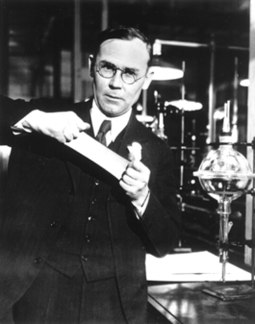
Wallace Carothers
[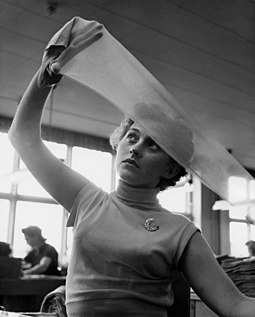
Nylon stockings being inspected inMalmö, Sweden, in 1954

Nylon is a thermoplastic,[5] silky material, first used commercially in a nylon-bristled toothbrush (1938), followed more famously by women's stockings ("nylons"; 1940) after being introduced as a fabric at the 1939 New York World's Fair.[6] Nylon is made of repeating units linked by peptide bonds and is a type of polyamide and is frequently referred to as such.[7][8] Nylon was the first commercially successful synthetic thermoplastic polymer.[7] Commercially, nylon polymer is made by reacting monomers which are either lactams, acid/amines or stoichiometric mixtures of diamines (-NH2) and diacids (-COOH). Mixtures of these can be polymerized together to make copolymers. Nylon polymers can be mixed with a wide variety of additives to achieve many different property variations.
Nylon was intended to be a synthetic replacement for silk and substituted for it in many different products after silk became scarce during World War II. It replaced silk in military applications such as parachutes and flak vests, and was used in many types of vehicle tires.[6]
After initial commercialization of nylon as a fiber, applications in the form of shapes and films were also developed. The main market for nylon shapes now is in auto components, but there are many others.
Etymology[]
In 1940, John W. Eckelberry of DuPont stated that the letters "nyl" were arbitrary and the "on" was copied from the suffixes of other fibers such as cotton and rayon. A later publication by DuPont (Context, vol. 7, no. 2, 1978) explained that the name was originally intended to be "No-Run" ("run" meaning "unravel"), but was modified to avoid making such an unjustified claim. Since the products were not really run-proof, the vowels were swapped to produce "nuron", which was changed to "nilon" "to make it sound less like a nerve tonic". For clarity in pronunciation, the "i" was changed to "y".[6][9]
Chemistry[]
Nylons are condensation copolymers, formed by reacting difunctional monomers containing equal parts of amine and carboxylic acid, so that amides are formed at both ends of each monomer in a process analogous to polypeptide biopolymers. ...
Bill Pittendreigh, DuPont, and other individuals and corporations worked diligently during the first few months of World War II to find a way to replace Asian silk and hemp with nylon in parachutes. It was also used to make tires, tents, ropes, ponchos, and other military supplies. It was even used in the production of a high-grade paper for U.S. currency. At the outset of the war, cotton accounted for more than 80% of all fibers used and manufactured, and wool fibers accounted for nearly all of the rest. By August 1945, manufactured fibers had taken a market share of 25%, at the expense of cotton. After the war, because of shortages of both silk and nylon, nylon parachute material was sometimes repurposed to make dresses.[34]
Nylon 6 and 66 fibers are used in carpet manufacture.
Nylon is one kind of fiber used in tire cord.
Shapes
Nylon resins are widely used in the automobile industry especially in the engine compartment.[35][36]
Solid nylon is used in hair combs and mechanical parts such as machine screws, gears and other low- to medium-stress components previously cast in metal.[37] Engineering-grade nylon is processed by extrusion, casting, and injection molding. Type 6,6 Nylon 101 is the most common commercial grade of nylon, and Nylon 6 is the most common commercial grade of molded nylon.[38]
For use in tools such as spudgers, nylon is available in glass-filled variants which increase structural and impact strength and rigidity, and molybdenum disulfide-filled variants which increase lubricity. Its various properties also make it very useful as a material in additive manufacturing; specifically as a filament in consumer and professional grade fused deposition modeling 3D printers.[39] Nylon can be used as the matrix material in composite materials, with reinforcing fibers like glass or carbon fiber; such a composite has a higher density than pure nylon.[40] Such thermoplastic composites (25% to 30% glass fiber) are frequently used in car components next to the engine, such as intake manifolds, where the good heat resistance of such materials makes them feasible competitors to metals.[41]
Nylon was used to make the stock of the Remington Nylon 66 rifle.[42] The frame of the modern Glock pistol is made of a nylon composite.[43]...
In the mid-1940s, classical guitarist Andrés Segovia mentioned the shortage of good guitar strings in the United States, particularly his favorite Pirastro catgut strings, to a number of foreign diplomats at a party, including General Lindeman of the British Embassy. A month later, the General presented Segovia with some nylon strings which he had obtained via some members of the DuPont family. Segovia found that although the strings produced a clear sound, they had a faint metallic timbre which he hoped could be eliminated.[49]
Nylon strings were first tried on stage by Olga Coelho in New York in January, 1944.[50]
In 1946, Segovia and string maker Albert Augustine were introduced by their mutual friend Vladimir Bobri, editor of Guitar Review. On the basis of Segovia's interest and Augustine's past experiments, they decided to pursue the development of nylon strings. DuPont, skeptical of the idea, agreed to supply the nylon if Augustine would endeavor to develop and produce the actual strings. After three years of development, Augustine demonstrated a nylon first string whose quality impressed guitarists, including Segovia, in addition to DuPont.[49]
Wound strings, however, were more problematic. Eventually, however, after experimenting with various types of metal and smoothing and polishing techniques, Augustine was also able to produce high quality nylon wound strings.[49]...