Chapman G
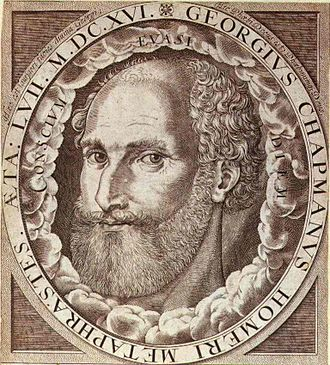
Name: George Chapman
Achievements: Translation of Homer
Born: 1559/60; Hitchin, Hertfordshire, England
Died: May 12, 1634; London, England (Aged around 75)
Field & Discipline: Art; Literature; Theatre; Poet; Dramatist
Language: English
Father: Thomas Chapman
Mother: Joan Nodes
Siblings: Thomas
Spouse: None
Children: None
Education: Hitchin Grammar School; University of Oxford
Major Work:
Translation of Homer works (1598-1624)
“Euthymiae Raptus”
"The Teares of Peace" (1609)
Plays:
"Bussy d'Ambois" (1607)
"The Conspiracy and Tragedy of Byron" (1608)
"The Widdowes Teares" (1612)
Life & Times:
In 1591-2 it is probable that Chapman was in military service in the Low Countries, where England was supporting the struggle of the Protestants against the Catholic South Netherlands.
Chapman was part of a group who met in the evenings with [a pal of] Raleigh* to discuss philosophy, poetry and scientific subjects. [knew] Shakespeare* nicknamed this group "The School of Night" and parodied them in "Love's Labours Lost.”
Chapman’s first published work, in 1594, was an allegorical poem called "The Shadow of Night.” The following year, he published "Ovid's Banquet of Sense,” a poem about the value of an ordered life, which was satirised by the playwright Thomas Nashe in his "Terrors of the Night.” He remained part of the group, and later wrote a verse preface for an account of Raleigh's expedition to Guinea.
He then turned his hand to writing for the stage and his play, "The Blind Beggar of Alexandria," was performed at the Rose Theatre in London in 1595-6 by the theatre company The Admiral’s Men. In 1597, his "A Humorous Day's Mirth" saw the birth of the humour plays, based on observing human emotions. Around this time, Chapman became friendly with the writer [a pal of] Jonson*, who wrote his first humorous play a year later and really established the genre.
In 1598, Chapman completed "Hero and Leander,” the poem which [completed work by] Marlowe* had left unfinished at his death. In the same year, he published the first books of his English translation of the ancient Greek author Homer, dedicating it to the [a patron was] Earl of Essex* and in the preface, passionately defending Homer against the criticisms of the Renaissance scholar, [argued with] Scaliger* who preferred Virgil.
Chapman was beginning to establish a respectable reputation and, although he was making very little money, "The English Parnassus,” an anthology of verse published in 1600, contained eighty extracts from his poems.
By this time, he was writing for the Blackfriars and the Whitehall theatres. His audiences appreciated his topical satire, but after his "May Day,” in 1601, he abandoned humorous plays. Instead, he introduced the romantic tragi-comedy that Nicholas Beaumont and John Fletcher later made highly successful. Unique among Chapman’s comedies was “The Gentleman Usher,” performed in 1602 and written in blank verse.
In 1603, thanks to the wife of Sir Thomas Walsingham, he was given the position of Server-in-Ordinary to Prince Henry, the son of King James. The job didn’t pay much, but it carried prestige and the chance to find patrons at court.
"Monsieur Olive" appeared in 1604. Chapman in prison in 1605 after he collaborated with Jonson and John Marston on "Eastward Ho,” a play written during the so-called Poets' War, in which [satirized] Dekker* and [satirized] Webster* were also involved, when the dramatists satirized each other in their plays. In "Eastward Ho,” they made the mistake of mocking the Scots accent. King James, who was Scottish, did not find this amusing. Prince Henry was his saving grace, and promised a large sum of money and a substantial pension to Chapman for translating the "Iliad.”
After this, he wrote six tragedies, five of which were based on recent or current French history. His cousin, Edward Grimeston, was attached to the embassy in Paris and had come back to England with Henri IV's ambassador, becoming Chapman's source of information.
The best known of these was "Bussy d'Amboise" (1607), based on the escapades of a French courtier, but another, "The Conspiracy and Tragedy of Byron" (1608), controversially involved a scene where the French Queen boxed the ears of the King’s mistress. Chapman was lucky not to be imprisoned again and took refuge with the Duke of Lennox.
The following year, he published his allegorical poem, "Euthymiae Raptus" dedicated to Prince Henry and, in 16ll, he published the first twelve books of the "Iliad.” Prince Henry died the following year and King James cancelled the royal patronage.
Despite his lack of patron, Chapman wrote the successful "Masque of the Inner Temple" to celebrate the marriage of the King's daughter in 1613. Three years later, his translation of Homer's "Odyssey" was published and, in 1624, "Crown of Homer's Works" appeared.
During the 1630s, a quarrel broke out between Jonson and the designer [supported] Inigo Jones*, during which Chapman wrote a manuscript supporting Jones, entitled "An Invective ...against Mr Ben Jonson.”
Apart from his writings, little is known about Chapman’s private life, where he lived, or even if he ever married. His death, in 1634, took place in London, followed by a burial at St Giles-in-the-Fields. Inigo Jones designed a classical monument for him.
Assessment: Chapman's life work was his translation of Homer's writing which for a long time remained the standard English version.
Oneliner: George Chapman, major literary contemporary of Shakespeare
Bibliography:
- Bradbrood, M.C., George Chapman, Longman Group Ltd., 1977.
- Spivack, Charlotte, George Chapman, Twayne Publishers, Inc., New York, 1967.