Eads JB
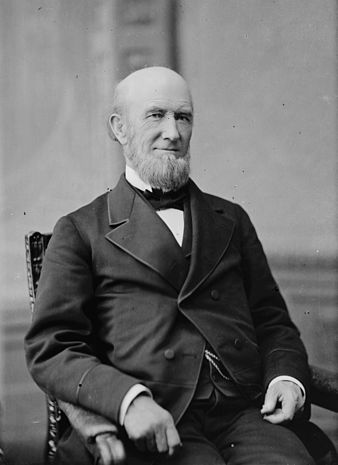
NAME: Eads, James Buchanan.
ACHIEVEMENTS: Built Eads Bridge across the Mississippi at St Louis. Developed ironclad gunboats.
NICKNAME/ALIAS: None.
DATE/PLACE OF BIRTH: 23rd May 1820, in Lawrenceburg, IN.
DATE/PLACE/AGE AT DEATH: 8th March 1887, Nassau, Bahama Islands. Aged 67.
DISCIPLINE: Civil Engineer.
FIELD: Civil engineering.
LANGUAGE: English.
PARENTS: Thomas Clark Eads and Ann Buchanan.
SIBLINGS: Eliza-Ann and Genevieve.
SPOUSE: Martha Dillon then Eunice Hagerman.
CHILDREN: Eliza-Ann and Martha, by Martha Dillon.
EDUCATION: No formal education.
MAJOR WORK: The Eads Bridge across the Mississippi at St Louis (1867 to 1874).
LIFE AND TIMES:
Eads’ mother named him after her cousin, Buchanan*, who later became President of the United States. In 1842, after a short period as a clerk and having managed to raise financial support from a St Louis boat-building firm, Eads set up a salvage business and became the talk of the Mississippi river.
He would jump from his boat with a diving bell over his head to recover cargo from sunken vessels on the riverbed. This was a pretty dangerous job, because his airline could snag at any time and the sediment on the riverbed was full of treacherous sinkholes.
He designed new versions of his diving bell, with steam-driven pumps that could clean the sand and silt out of the sunken vessels. This changed the nature of salvage, because the ships, now lighter, could then be raised whole out of the water instead of just giving up their cargo and machinery.
In 1856, Eads went to Washington DC to lobby for a bill to clear the poor navigation channels on the Mississippi. His persistence won the day and Congress passed a bill, but, when it reached the Senate, future Confederate President Davis* defeated it.
Eads went back to St Louis and set up the Western River Improvement Company but, in 1857, his doctors forced him to give up salvage work. He bought a riverside mansion and held meetings with the rivermen, industrialists, bankers and politicians, who were all concerned in one way or another with the Mississippi.
With the Civil War looming, Eads realised that control of the Mississippi would play a large part in the military strategy of both sides. As a Union supporter committed to anti-slavery, he opposed Buchanan in the constitutional crisis over Kansas. He then laid out a plan for the blockade of the river, south of Cairo, Illinois, and recommended a defense of the river by ironclad steam-driven gunboats.
In 1861, Eads was awarded a government contract for the gunboats and, in February 1862, even though he had not yet been paid, the ironclads won their first important victory for the Union when they forced the surrender of Fort Donelson. Two months later, he was asked to design an armoured, light-draft naval gunboat which could easily navigate tributaries.
He produced a boat based on the Monitor, designed earlier by Ericsson*, with a draft of just three and a half feet, rather than the Monitor’s eleven and a half. He then went to Europe to convalesce from an illness and to assess European developments in gunboats on behalf of the US Navy. While he was there, he heard the news that, on July 4th 1863, the whole of the Mississippi was open, largely due to his ironclads.
In 1866, Eads was involved in the designing of a new bridge over the Mississippi. The rivermen opposed the plan at first, but soon realised that without a new bridge, railroads would use the bridges on the shallower reaches of the river, and divert trade away from St Louis.
With the help of German-trained engineers, Eads submitted plans for a steel arch construction, even though steel was still unproven as a structural material. When work started on the bridge in 1867, Eads was given the job of supervising the project and spent the next eight years working on it.
A year or so after the start of the construction, while on a visit to Europe, he was shown a bridge being built at Vichy, over the river Allier. The piers for the bridge were being sunk by excavation, with engineers working in huge diving bells, or caissons. This compressed air method for sinking deep channel piers had not been used in America until, in 1869, Eads began work on producing huge elliptical bells.
His divers had never worked at such depths before and some of them suffered stomach pains and short-term paralysis that caused them to stoop. This posture became known as the "Grecian bend", adapted later to give us the modern name for the decompression condition, "the bends".
In February 1870, the east pier diving bell reached bedrock after four months work, but a diver had died of the bends. Dr Jaminet, Eads’ personal physician, urged him to provide a lift that allowed the men to go through slow decompression as they rose to the surface and this considerably reduced the problem.
In the same year, the steel sections for the bridge were individually tested but the hollow steel tubes, delivered from Carnegie's* firm, Carnegie-Kloman, didn’t meet the required specifications, so Carnegie was forced to re-roll his steel using chrome. Eads then pioneered a design allowing the metal arches to cantilever to the centre of the span from their masonry piers, avoiding obstruction of the river traffic below.
Both the eastside and westside of the arch were built upward and outward from their piers at the same time, using weights to prevent the structures from falling forward. When the two sides of the arch were complete, the weights were removed and they met in the middle, each supporting the other. With the arch in place, a lower deck was erected for a double track railroad line and an upper deck for a roadway and, on 4th July 1874, the bridge was opened on.
Soon after, Eads was asked to work out a way to connect New Orleans directly to the ocean. This gave him the chance to clear the navigation channels, the project he had dreamed of twenty years before, when he was walking along the riverbed during his earlier salvage operations. His South Pass jetties, built between 1875 and 1879, served as dams to prevent the formation of sandbars and turned New Orleans into a seaport.
ASSESSMENT: His use of steel alloy to build the St Louis bridge was a major development in structural engineering and he was responsible for the introduction of caisson construction methods to the United States.
EXTRA CONNECTIONS:
During the Civil War, Eads wrote a check to the War Department for $1,000 to help homeless Confederates and Union sympathizers. After the war, he held a fair to raise money for the thousands of homeless refugees in St. Louis.
In 1927, the deans of America's engineering colleges vote Eads one of the top five engineers of all time, an accolade he shared with Leonardo da Vinci, James Watt, Ferdinand de Lesseps, and Thomas A. Edison
ONELINER: James Eads, of the St Louis Eads Bridge
BIBLIOGRAPHY:
Dorsey, Florence, Road to the Sea and the Mississippi River: The Story of James B Eads, Rinehart and Co. Inc., New York, 1947.
ANB