Anne Frank
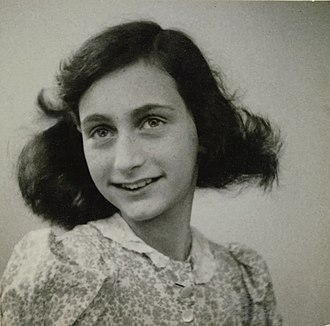
Annelies Marie Frank (German: [ˈanə(liːs maˈʁiː) ˈfʁaŋk] ( listen), Dutch: [ˌɑnəˈlis maːˈri ˈfrɑŋk, ˈɑnə ˈfrɑŋk] (
 listen); 12 June 1929 – c.February or March 1945)[1] was a German-born Jewish girl who kept a diary in which she documented life in hiding under Nazi persecution.
She is a celebrated diarist who described everyday life from her family hiding place in an Amsterdam attic. One of the most-discussed Jewish victims of the Holocaust, she gained fame posthumously with the 1947 publication of The Diary of a Young Girl (originally Het Achterhuis in Dutch, lit.'the back house'; English: The Secret Annex), in which she documents her life in hiding from 1942 to 1944, during the German occupation of the Netherlands in World War II. It is one of the world's best-known books and has been the basis for several plays and films.
Anne was born in Frankfurt, Germany. In 1934, when she was four and a half, her family moved to Amsterdam, Netherlands, after Adolf Hitler and the Nazi Party gained control over Germany. She spent most of her life in or around Amsterdam. By May 1940, the Franks were trapped in Amsterdam by the German occupation of the Netherlands. Anne lost her German citizenship in 1941 and became stateless. As persecutions of the Jewish population increased in July 1942, they went into hiding in concealed rooms behind a bookcase in the building where Anne's father, Otto Frank, worked. Until the family's arrest by the Gestapo on 4 August 1944, Anne kept a diary she had received as a birthday present, and wrote in it regularly.
Following their arrest, the Franks were transported to concentration camps. On 1 November 1944,[2] Anne and her sister, Margot, were transferred from Auschwitz to Bergen-Belsen concentration camp, where they died (probably of typhus) a few months later. They were originally estimated by the Red Cross to have died in March, with Dutch authorities setting 31 March as the official date. Later research has suggested they died in February or early March.
Otto, the only survivor of the Frank family, returned to Amsterdam after the war to find that Anne's diary had been saved by his female secretaries, Miep Gies and Bep Voskuijl. He decided to fulfil Anne's greatest wish to become a writer and publish her diary in 1947.[3] It was translated from its original Dutch version and first published in English in 1952 as The Diary of a Young Girl, and has since been translated into over 70 languages.[4]
Early life
 Anne Frank at the 6th Montessori School,
1940 Photographs of Anne Frank, 1939
Frank was born Annelies[5] or Anneliese[6] Marie Frank on 12 June 1929 at the Maingau Red Cross Clinic[7] in Frankfurt, Germany, to Edith (née Holländer) and Otto Heinrich Frank. She had an older sister, Margot.[8] The Franks were liberal Jews, and did not observe all of the customs and traditions of Judaism.[9] They lived in an assimilated community of Jewish and non-Jewish citizens of various religions. Edith and Otto were devoted parents, who were interested in scholarly pursuits and had an extensive library; both parents encouraged the children to read.[10][11] At the time of Anne's birth, the family lived in a house at Marbachweg 307 in Frankfurt-Dornbusch, where they rented two floors. In 1931, the family moved to Ganghoferstrasse 24 in a fashionable liberal area of Dornbusch, called the Dichterviertel (Poets' Quarter). Both houses still exist.[12]
In 1933, after Adolf Hitler's Nazi Party won the federal election and Hitler was appointed Chancellor of the Reich, Edith Frank and the children went to stay with Edith's mother Rosa in Aachen. Otto Frank remained in Frankfurt, but after receiving an offer to start a company in Amsterdam, he moved there to organize the business and to arrange accommodations for his family.[13] He began working at the Opekta Works, a company that sold the fruit extract pectin. Edith travelled back and forth between Aachen and Amsterdam and found an apartment on the Merwedeplein (Merwede Square) in the Rivierenbuurt neighbourhood of Amsterdam, where many more Jewish-German refugees settled.[14] In November 1933, Edith followed her husband and a month later Margot moved to Amsterdam.[15] Anne stayed with her grandmother until February, when the family reunited in Amsterdam.[16] The Franks were among 300,000 Jews who fled Germany between 1933 and 1939.[17]
After moving to Amsterdam, Anne and Margot Frank were enrolled in school—Margot in public school and Anne in the 6th Montessori School. Despite initial problems with the Dutch language, Margot became a star pupil in Amsterdam. Anne soon felt at home at the Montessori school and met children of her own age, like Hanneli Goslar, who would later become one of her best friends.[18]
In 1938, Otto Frank started a second company, Pectacon, which was a wholesaler of herbs, pickling salts, and mixed spices, used in the production of sausages.[19][20] Hermann van Pels was employed by Pectacon as an advisor about spices. A Jewish butcher, he had fled Osnabrück with his family.[20] In 1939, Edith Frank's mother came to live with the Franks, and remained with them until her death in January 1942.[21]
In May 1940, Germany invaded the Netherlands, and the occupation government began to persecute Jews by the implementation of restrictive and discriminatory laws; mandatory registration and segregation soon followed.[21] Otto Frank tried to arrange for the family to emigrate to the United States—the only destination that seemed to him to be viable[22]—but Frank's application for a visa was never processed,[23] because the U.S. consulate in Rotterdam was destroyed in the German bombing on 14 May 1940, resulting in the loss of all the paperwork there, including the family's visa application.[24][unreliable source?]
After the summer holidays in 1941, Anne learned that she would no longer be allowed to go to the Montessori School as Jewish children had to attend Jewish schools. From then on Anne, like her sister Margot, went to the Jewish Lyceum [nl],[25] an exclusive Jewish secondary school in Amsterdam opened in September 1941.[26]...
Reception
The diary has been praised for its literary merits. Commenting on Anne Frank's writing style, the dramatist Meyer Levin commended Frank for "sustaining the tension of a well-constructed novel",[121] and was so impressed by the quality of her work that he collaborated with Otto Frank on a dramatization of the diary shortly after its publication.[122] Levin became obsessed with Anne Frank, which he wrote about in his autobiography The Obsession. The poet John Berryman called the book a unique depiction, not merely of adolescence but of the "conversion of a child into a person as it is happening in a precise, confident, economical style stunning in its honesty".[123]
In her introduction to the diary's first American edition, Eleanor Roosevelt described it as "one of the wisest and most moving commentaries on war and its impact on human beings that I have ever read."[124] John F. Kennedy discussed Anne Frank in a 1961 speech, and said, "Of all the multitudes who throughout history have spoken for human dignity in times of great suffering and loss, no voice is more compelling than that of Anne Frank."[125][126] In the same year, the Soviet writer Ilya Ehrenburg wrote of her: "one voice speaks for six million—the voice not of a sage or a poet but of an ordinary little girl."[127]
As Anne Frank's stature as both a writer and humanist has grown, she has been discussed specifically as a symbol of the Holocaust and more broadly as a representative of persecution.[128] Hillary Clinton, in her acceptance speech for an Elie Wiesel Humanitarian Award in 1994, read from Anne Frank's diary and spoke of her "awakening us to the folly of indifference and the terrible toll it takes on our young," which Clinton related to contemporary events in Sarajevo, Somalia and Rwanda.[129]
After receiving a humanitarian award from the Anne Frank Foundation in 1994, Nelson Mandela addressed a crowd in Johannesburg, saying he had read Anne Frank's diary while in prison and "derived much encouragement from it." He likened her struggle against Nazism to his struggle against apartheid, drawing a parallel between the two philosophies: "Because these beliefs are patently false, and because they were, and will always be, challenged by the likes of Anne Frank, they are bound to fail."[130] Also in 1994, Václav Havel said "Anne Frank's legacy is very much alive and it can address us fully" in relation to the political and social changes occurring at the time in former Eastern Bloc countries.[125]
Primo Levi suggested Anne Frank is frequently identified as a single representative of the millions of people who suffered and died as she did because "One single Anne Frank moves us more than the countless others who suffered just as she did but whose faces have remained in the shadows. Perhaps it is better that way; if we were capable of taking in all the suffering of all those people, we would not be able to live."[125] In her closing message in Müller's biography of Anne Frank, Miep Gies expressed a similar thought, though she attempted to dispel what she felt was a growing misconception that "Anne symbolizes the six million victims of the Holocaust", writing: "Anne's life and death were her own individual fate, an individual fate that happened six million times over. Anne cannot, and should not, stand for the many individuals whom the Nazis robbed of their lives… But her fate helps us grasp the immense loss the world suffered because of the Holocaust."[131]
Otto Frank spent the remainder of his life as custodian of his daughter's legacy, saying, "It's a strange role. In the normal family relationship, it is the child of the famous parent who has the honour and the burden of continuing the task. In my case the role is reversed." He recalled his publisher's explaining why he thought the diary has been so widely read, with the comment, "he said that the diary encompasses so many areas of life that each reader can find something that moves him personally".[132] Simon Wiesenthal expressed a similar sentiment when he said that the diary had raised more widespread awareness of the Holocaust than had been achieved during the Nuremberg Trials, because "people identified with this child. This was the impact of the Holocaust, this was a family like my family, like your family and so you could understand this."[133]
In June 1999, Time magazine published a special edition titled "Time 100: The Most Important People of the Century". Anne Frank was selected as one of the "Heroes & Icons", and the writer, Roger Rosenblatt, described her legacy with the comment, "The passions the book ignites suggest that everyone owns Anne Frank, that she has risen above the Holocaust, Judaism, girlhood and even goodness and become a totemic figure of the modern world—the moral individual mind beset by the machinery of destruction, insisting on the right to live and question and hope for the future of human beings." He notes that while her courage and pragmatism are admired, her ability to analyse herself and the quality of her writing are the key components of her appeal. He writes, "The reason for her immortality was basically literary. She was an extraordinarily good writer, for any age, and the quality of her work seemed a direct result of a ruthlessly honest disposition."[134]
Denials of authenticity and legal action
After the diary became widely known in the late 1950s, various allegations against the veracity of the diary and/or its contents appeared, with the earliest published criticisms occurring in Sweden and Norway.[135] In 1957, Fria ord ("Free Words"), the magazine of the Swedish neofascist organization National League of Sweden, published an article by Danish author and critic Harald Nielsen, who had previously written antisemitic articles about the Danish-Jewish author Georg Brandes.[136] Among other things, the article claimed that the diary had been written by Meyer Levin.[137]
In 1958, at a performance of The Diary of Anne Frank in Vienna, Simon Wiesenthal was challenged by a group of protesters who asserted that Anne Frank had never existed, and who challenged Wiesenthal to prove her existence by finding the man who had arrested her. Wiesenthal indeed began searching for Karl Silberbauer and found him in 1963. When interviewed, Silberbauer admitted his role, and identified Anne Frank from a photograph as one of the people arrested. Silberbauer provided a full account of events, even recalling emptying a briefcase full of papers onto the floor. His statement corroborated the version of events that had previously been presented by witnesses such as Otto Frank.[138]
In 1959, Otto Frank took legal action in Lübeck against Lothar Stielau, a school teacher and former Hitler Youth member who published a school paper that described the diary as "a forgery". The complaint was extended to include Heinrich Buddegerg, who wrote a letter in support of Stielau, which was published in a Lübeck newspaper. The court examined the diary in 1960 and authenticated the handwriting as matching that in letters known to have been written by Anne Frank. They declared the diary to be genuine. Stielau recanted his earlier statement, and Otto Frank did not pursue the case any further.[137]
In 1976, Otto Frank took action against Heinz Roth of Frankfurt, who published pamphlets stating that the diary was "a forgery". The judge ruled that if Roth were to publish any further statements he would be subjected to a fine of 500,000 German marks and a six-month jail sentence. Roth appealed against the court's decision. He died in 1978, and after a year his appeal was rejected.[137]
Otto Frank mounted a lawsuit in 1976 against Ernst Römer, who distributed a pamphlet titled "The Diary of Anne Frank, Bestseller, A Lie". When a man named Edgar Geiss distributed the same pamphlet in the courtroom, he too was prosecuted. Römer was fined 1,500 Deutschmarks,[137] and Geiss was sentenced to six months' imprisonment. The sentence of Geiss was reduced on appeal, and the case was eventually dropped following a subsequent appeal because the time limit for filing a libel case had expired.[139]
With Otto Frank's death in 1980, the original diary, including letters and loose sheets, was willed to the Dutch Institute for War Documentation,[140] which commissioned a forensic study of the diary through the Netherlands Ministry of Justice in 1986. They examined the handwriting against known examples and found that they matched. They determined that the paper, glue, and ink were readily available during the time the diary was said to have been written. They concluded that the diary is authentic, and their findings were published in what has become known as the "Critical Edition" of the diary.[141] In 1990, the Hamburg Regional Court confirmed the diary's authenticity.[142]
In 1991, Holocaust deniers Robert Faurisson and Siegfried Verbeke produced a booklet titled "The Diary of Anne Frank: A Critical Approach", in which they revived the allegation that Otto Frank wrote the diary. Purported evidence, as before, included several contradictions in the diary, that the prose style and handwriting were not those of a teenager, and that hiding in the Achterhuis would have been impossible.[143] In 1993, the Anne Frank House in Amsterdam and the Anne Frank Fonds in Basel filed a civil lawsuit to prohibit further distribution of Faurisson and Verbeke's booklet in the Netherlands. In 1998, the Amsterdam District Court ruled in favour of the claimants, forbade any further denial of the authenticity of the diary and unsolicited distribution of publications to that effect, and imposed a penalty of 25,000 guilders per infringement.[144]
...
Pantheon rank 233