Wegener, A
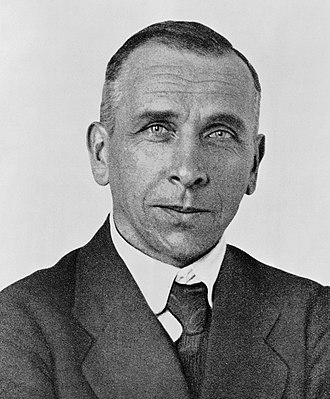
Achievements: Continental Drift theory
Born: November 1, 1880, Berlin, Germany
Died: November, 1930, Greenland. Aged about 50
Field & Discipline: Science; Geophysics; Meteorology
Language: German
Education: Kollnisches Gymnasium, Berlin; University of Heidelberg; University of Innsbruck; University of Berlin
Major Work:
"Die Entstehung der Kontinente und Ozeane” (The Origin of Continents and Oceans)
Life & Times:
In 1905 Wegener became technical aide at the Aeronautic Observatory in Lindenberg, Berlin. Within a year, he was invited to be official meteorologist on a pioneer Danish expedition to north-eastern Greenland, where, from 1906 to 1908, he flew kites and balloons as high as 10,000 feet to investigate polar air masses. He incorporated his findings in a paper that got him his first teaching post in meteorology at the University of Marburg. In 1911, he published a textbook on the thermodynamics of the atmosphere, which contained the beginnings of the modern theory of precipitation.
Wegener noticed that the shape of the east coast of South America corresponded to that of the west coast of Africa, and he wondered whether the two continents had been joined at one time, then drifted apart. He dismissed the idea as improbable, but soon after, he read that fossils (snails) from the same period had been found both in Africa and Brazil. He immediately began to study fossil evidence to prove his "continental drift" theory, and in 1912, presented his hypothesis in a lecture, "The Geophysical Basis of the Evolution of the Large-Scale Features of the Earth’s Crust (Continents and Oceans)"). He dismissed the popular idea that a land-bridge must have existed between the two continents, and proposed that the continents had actually drifted away from each other.
In 1912, accompanied by Captain J.P. Koch of Denmark, Wegener returned to Greenland to study glaciology and climatology. In the First World War, he served as a junior military officer and was wounded twice. While recovering, he wrote an extended account of his continental drift theory, which appeared as "Die Entstehung der Kontinente und Ozeane” (The Origin of Continents and Oceans) in 1915. He suggested that in the Late Paleozoic era (about 250 million years ago) all present-day continents were formed in a single large mass, or super-continent (which he called the Continent of Pangaea) which eventually broke into pieces.
Other scientists had proposed the same idea, but believed modern continents had come about after large portions of the supercontinent had sunk, leaving the Atlantic and Indian oceans. Wegener theorized that the super-continent's parts had broken off and had slowly begun to move: the Americas west from Europe and Africa, with the Atlantic Ocean forming in the rift; India moving east from Africa; and Australia breaking away from Antarctica and moving towards the equator. He called this movement "die Verschiebung der Kontinente", or "continental displacement", which gave way to the term "continental drift". Wegener's strongest argument was that some rocks, animals, and plants were similar on both sides of the Atlantic, and that some fossils of reptiles and flora were found only in Africa and South America.
The publication of "The Origin of Continents and Oceans" which first appeared in German in 1915 caused an uproar when it was translated into English in 1922. A 1928 meeting called to debate Wegener's theories ended in an impasse. Of the fourteen international geologists attending, seven opposed the idea, five supported it without reservation, and two supported it with reservations.
Wegener also did valuable work on the dynamics and thermodynamics of the atmosphere, atmospheric refraction and mirages, optical phenomena in clouds, acoustical waves, and the design of geophysical instruments. In 1924, he was appointed professor of meteorology and geophysics at the University of Graz, and five years later, led his third and fourth expeditions to Greenland.
The development of paleomagnetism in the early 1950s demonstrated that rocks in different continents had different directions of magnetization, as if they had drifted apart from each other. In 1960, American geologist Harry Hammon Hess proposed the theory of "seafloor spreading", which was proven a few years later, giving Wegener's theory further validity. By the end of the 1960’s, the continental drift theory was accepted by the world scientific community, and Wegener's hypothesis became the foundation for a revolution among geologists and a cornerstone for modern views on the earth's history.
Extra Connections: His work related to that of seismologist [work related to] Mohorovicic* and to explorer [work related to] Nansen*
Assessment: His theory of continental drift became the well-established foundation for plate tectonics theory.
Oneliner: Alfred Wegener, of Continental Drift theory
Father: Dr. Richard Wegener
Mother: Anna Schwarz
Siblings: Four, including Kurt
Spouse: Else Koppen
Children: 3 daughters
Bibliography:
- Dictionary of Scientific Biography.
- Encyclopedia Britannica.
- Witze, Alexandra, “Alfred Wegener", in Notable Twentieth-Century Scientists, ed. Emily J. McMurray, New York & London: Gale Research Inc., 1995.
Wikipedia (see node 2)
Multimedia:
CONNECTIONS III #8 Fire from the Sky