Museum
A museum (/mjuːˈziːəm/ mew-ZEE-əm) is an institution dedicated to displaying and preserving culturally significant objects. Many museums have exhibitions of these objects on public display, and some have private collections that are used by researchers and specialists. Compared to a library, a museum hosts a much wider ranges of objects and usually focus around a specific theme such as the arts, science, natural history, local history, and other topics.
Public museums that host exhibitions and interactive demonstrations are often considered to be tourist attractions, and many museums attract large numbers of visitors from outside their host country, with the most visited museums in the world regularly attracting millions of visitors annually.
Since the establishment of the earliest known museum in ancient times, museums have been associated with academia and the preservation of rare items. Museums originated as private collections of interesting items, and only much later did the emphasis on educating the public take root.
Etymology
The English word museum comes from Latin, and is pluralized as museums (or rarely, musea). It is originally from the Ancient Greek Μουσεῖον (mouseion), which denotes a place or temple dedicated to the muses (the patron divinities in Greek mythology of the arts), and hence was a building set apart for study and the arts,[1] especially the Musaeum (institute) for philosophy and research at Alexandria, built under Ptolemy I Soter about 280 BC.[2]
Purpose
Visitors examining fossils displayed at the National Museum of Iran in Tehran, Iran
The purpose of modern museums is to collect, preserve, interpret, and display objects of artistic, cultural, or scientific significance for the study and education of the public. To city leaders, an active museum community can be seen as a gauge of the cultural or economic health of a city, and a way to increase the sophistication of its inhabitants. To museum professionals, a museum might be seen as a way to educate the public about the museum's mission, such as civil rights or environmentalism. Museums are, above all, storehouses of knowledge.[citation ^needed] In 1829, James Smithson's bequest funding the Smithsonian Institution stated that he wanted to establish an institution "for the increase and diffusion of knowledge".[3]
Museums of natural history in the late 19th century exemplified the scientific desire for the classification of life and for interpretations of the world. Gathering all examples for each field of knowledge for research and display was the purpose. As American colleges grew in the 19th century, they developed their own natural history collections for the use of their students. By the last quarter of the 19th century, scientific research in universities was shifting toward biological research on a cellular level, and cutting-edge research moved from museums to university laboratories.[4]
While many large museums, such as the Smithsonian Institution, are still respected as research centers, research is no longer a main purpose of most museums. While there is an ongoing debate about the purposes of interpretation of a museum's collection, there has been a consistent mission to protect and preserve cultural artifacts for future generations. Much care, expertise, and expense is invested in preservation efforts to retard decomposition in aging documents, artifacts, artworks, and buildings. All museums display objects that are important to a culture. As historian Steven Conn writes, "To see the thing itself, with one's own eyes and in a public place, surrounded by other people having some version of the same experience, can be enchanting."[5]
...
History
Ancient
 One of the earlist known museum labels, from Ennigaldi-Nanna's museum in Ur, c. 530 BC.
One of the oldest museums known is Ennigaldi-Nanna's museum, built by Princess Ennigaldi in modern Iraq at the end of the Neo-Babylonian Empire. The site dates from c. 530 BC, and contained artifacts from earlier Mesopotamian civilizations. Notably, a clay drum label—written in three languages—was found at the site, referencing the history and discovery of a museum item.[13][14]
Ancient Greeks and Romans collected and displayed art and objects but perceived museums differently from modern day views. In the classical period the museums were the temples and their precincts which housed collections of votive offerings. Paintings and sculptures were displayed in gardens, forums, theaters, and bathhouses.[15] In the ancient past there was little differentiation between libraries and museums with both occupying the building and were frequently connected to a temple or royal palace. The Museum of Alexandria is believed to be one of the earliest museums in the world. While it connected to the Library of Alexandria it is not clear if the museum was in a different building from the library or was part of the library complex. While little was known about the museum it was an inspiration for museums during the early Renaissance period.[16] The royal palaces also functioned as a kind of museum outfitted with art and objects from conquered territories and gifts from ambassadors from other kingdoms allowing the ruler to display the amassed collections to guests and to visiting dignitaries.[17]
Also in Alexandria from the time of Ptolemy II Philadelphus (r. 285-246 BCE), was the first zoological park. At first used by Philadelphus in an attempt to domesticate African elephants for use in war, the elephants were also used for show along with a menagerie of other animals specimens including hartebeests, ostriches, zebras, leopards, giraffes, rhinoceros, and pythons.[16][18]
Early
See also: List of museums from the 18th century
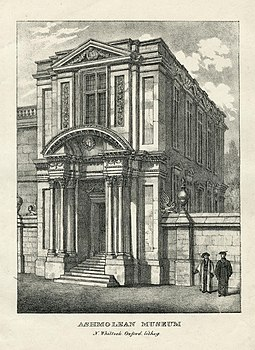
The old Ashmolean Museum building in Oxford, England
Early museums began as the private collections of wealthy individuals, families or institutions of art and rare or curious natural objects and artifacts. These were often displayed in so-called "wonder rooms" or cabinets of curiosities. These contemporary museums first emerged in western Europe, then spread into other parts of the world.[19]
Public access to these museums was often possible for the "respectable", especially to private art collections, but at the whim of the owner and his staff. One way that elite men during this time period gained a higher social status in the world of elites was by becoming a collector of these curious objects and displaying them. Many of the items in these collections were new discoveries and these collectors or naturalists, since many of these people held interest in natural sciences, were eager to obtain them. By putting their collections in a museum and on display, they not only got to show their fantastic finds but also used the museum as a way to sort and "manage the empirical explosion of materials that wider dissemination of ancient texts, increased travel, voyages of discovery, and more systematic forms of communication and exchange had produced".[20]
One of these naturalists and collectors was Ulisse Aldrovandi, whose collection policy of gathering as many objects and facts about them was "encyclopedic" in nature, reminiscent of that of Pliny, the Roman philosopher and naturalist.[21] The idea was to consume and collect as much knowledge as possible, to put everything they collected and everything they knew in these displays. In time, however, museum philosophy would change and the encyclopedic nature of information that was so enjoyed by Aldrovandi and his cohorts would be dismissed as well as "the museums that contained this knowledge". The 18th-century scholars of the Age of Enlightenment saw their ideas of the museum as superior and based their natural history museums on "organization and taxonomy" rather than displaying everything in any order after the style of Aldrovandi.[22]
The first "public" museums were often accessible only by the middle and upper classes. It could be difficult to gain entrance. When the British Museum opened to the public in 1759, it was a concern that large crowds could damage the artifacts. Prospective visitors to the British Museum had to apply in writing for admission, and small groups were allowed into the galleries each day.[23] The British Museum became increasingly popular during the 19th century, amongst all age groups and social classes who visited the British Museum, especially on public holidays.[24]
The Ashmolean Museum, however, founded in 1677 from the personal collection of Elias Ashmole, was set up in the University of Oxford to be open to the public and is considered by some to be the first modern public museum.[25] The collection included that of Elias Ashmole which he had collected himself, including objects he had acquired from the gardeners, travellers and collectors John Tradescant the elder and his son of the same name. The collection included antique coins, books, engravings, geological specimens, and zoological specimens—one of which was the stuffed body of the last dodo ever seen in Europe; but by 1755 the stuffed dodo was so moth-eaten that it was destroyed, except for its head and one claw. The museum opened on 24 May 1683, with naturalist Robert Plot as the first keeper. The first building, which became known as the Old Ashmolean, is sometimes attributed to Sir Christopher Wren or Thomas Wood.[26]
 The Louvre in 1853
In France, the first public museum was the Louvre in Paris,[27] opened in 1793 during the French Revolution, which enabled for the first time free access to the former French royal collections for people of all stations and status. The fabulous art treasures collected by the French monarchy over centuries were accessible to the public three days each "décade" (the 10-day unit which had replaced the week in the French Republican Calendar).
The Conservatoire du muséum national des Arts (National Museum of Arts's Conservatory) was charged with organizing the Louvre as a national public museum and the centerpiece of a planned national museum system. As Napoléon I conquered the great cities of Europe, confiscating art objects as he went, the collections grew and the organizational task became more and more complicated. After Napoleon was defeated in 1815, many of the treasures he had amassed were gradually returned to their owners (and many were not). His plan was never fully realized, but his concept of a museum as an agent of nationalistic fervor had a profound influence throughout Europe.
 The Nantong Museum, the first Chinese-sponsored museum
Chinese and Japanese visitors to Europe were fascinated by the museums they saw there, but had cultural difficulties in grasping their purpose and finding an equivalent Chinese or Japanese term for them. Chinese visitors in the early 19th century named these museums based on what they contained, so defined them as "bone amassing buildings" or "courtyards of treasures" or "painting pavilions" or "curio stores" or "halls of military feats" or "gardens of everything". Japan first encountered Western museum institutions when it participated in Europe's World's Fairs in the 1860s. The British Museum was described by one of their delegates as a 'hakubutsukan', a 'house of extensive things' – this would eventually become accepted as the equivalent word for 'museum' in Japan and China.[28]
Modern
American museums eventually joined European museums as the world's leading centers for the production of new knowledge in their fields of interest. A period of intense museum building, in both an intellectual and physical sense was realized in the late 19th and early 20th centuries (this is often called "The Museum Period" or "The Museum Age"). While many American museums, both natural history museums and art museums alike, were founded with the intention of focusing on the scientific discoveries and artistic developments in North America, many moved to emulate their European counterparts in certain ways (including the development of Classical collections from ancient Egypt, Greece, Mesopotamia, and Rome).
Drawing on Michel Foucault's concept of liberal government, Tony Bennett has suggested the development of more modern 19th-century museums was part of new strategies by Western governments to produce a citizenry that, rather than be directed by coercive or external forces, monitored and regulated its own conduct. To incorporate the masses in this strategy, the private space of museums that previously had been restricted and socially exclusive were made public. As such, objects and artifacts, particularly those related to high culture, became instruments for these "new tasks of social management".[29] Universities became the primary centers for innovative research in the United States well before the start of World War II. Nevertheless, museums to this day contribute new knowledge to their fields and continue to build collections that are useful for both research and display.[30]
An exhibition of the remains of Native Americans at the Royal Ontario Museum in 1908
The late twentieth century witnessed intense debate concerning the repatriation of religious, ethnic, and cultural artifacts housed in museum collections. In the United States, several Native American tribes and advocacy groups have lobbied extensively for the repatriation of sacred objects and the reburial of human remains.[31] In 1990, Congress passed the Native American Graves Protection and Repatriation Act (NAGPRA), which required federal agencies and federally funded institutions to repatriate Native American "cultural items" to culturally affiliate tribes and groups.[32] Similarly, many European museum collections often contain objects and cultural artifacts acquired through imperialism and colonization. Some historians and scholars have criticized the British Museum for its possession of rare antiquities from Egypt, Greece, and the Middle East.[33]
...