Double refraction
ALTERNATIVE NAME/S: Birefringence
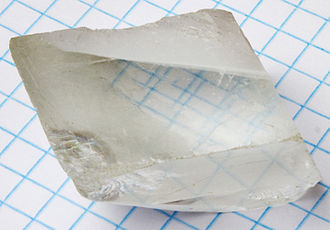
A calcite crystal laid upon a graph paper with blue lines showing the double refraction
DETAILS/DESCRIPTION:
In 1678 Christian Huyghens* published the results of his investigations into reflection and refraction. He undertook this work in an effort to understand the way in which light works.
In one of his experiments, Huyghens passed a ray of light through a calcite crystal and found that two rays were produced (this phenomenon is only produced by certain materials such as calcite or quartz crystals). Double refraction occurs when a light ray passing through the crystal splits into two rays, which travel through the crystal at different speeds. Their paths are bent at different angles, so we see a double image.
In the original, unrefracted light, the light wave vibrates in all the directions perpendicular to its line of propagation – in other words, a light wave travelling forward also vibrates up and down, from side to side, and in any intermediate direction.
But once it has undergone double refraction, both of the two rays that are produced vibrate in only one direction, and each ray vibrates in a direction perpendicular to the other. So, if one ray is now vibrating up and down, the other will be vibrating side to side. These rays are ‘polarized.’
ONELINER: Double refraction is the optical property of a material having a refractive index that depends on the polarization and propagation direction of light.
OTHER CONNECTIONS:
Birefringence is used in many optical devices. Liquid-crystal displays, the most common sort of flat-panel display.
Birefringence is utilized in medical diagnostics.
BIBLIOGRAPHY:
"Christian Huygens (1629-1695)." From W.W. Rouse Ball, A Short Account of the History of Mathematics, 4th edition, 1908. Transcribed by D.R. Wilkins, School of Mathematics, Trinity College, Dublin. http://www.maths.tcd.ie/pub/HistMath/People/Huygens/RouseBall/RB_Huygens.html Accessed September 16, 2004
"Polarization of light." The Columbia Encyclopedia, Sixth Edition, 2001. http://www.bartleby.com/65/po/polariza.html Accessed October 2, 2004.
"Biophysics." The Columbia Encyclopedia, Sixth Edition, 2001. http://www.bartleby.com/65/bi/biophysi.html Accessed October 2, 2004
"Rocks and Microscopes – Birefringence (Double Refraction)." Copyright © 1995-2004, Pearson Education, Inc., publishing as Pearson Prentice Hall. Picture of double refraction through a calcite crystal. http://wps.prenhall.com/esm_walker_physics_2/0,7966,804717-,00.utf8.html Accessed October 2, 2004
AUDIO/VISUAL:
"Rocks and Microscopes – Birefringence (Double Refraction)." Copyright © 1995-2004, Pearson Education, Inc., publishing as Pearson Prentice Hall. Picture of double refraction of the image of a word through a calcite crystal. http://wps.prenhall.com/esm_walker_physics_2/0,7966,804717-,00.utf8.html Accessed October 2, 2004.