El Cid
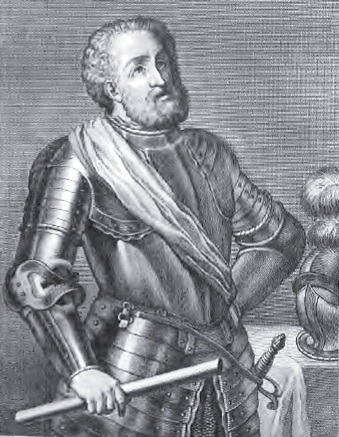
Nickname/Alias: born: Rodrigo (or Ruy) Diaz de Vivar; El Campeador ("the Champion")
Achievements: 11th century Castilian military leader, soldier of fortune and national hero who, after serving both Spaniards and Muslims, eventually became the ruler of Valencia (1093-94).
Born: c.1043; Vivar, near Burgos, Castile, Spain
Died: July 10, 1099; Valencia, Spain (Aged 56)
Field & Discipline: Military; Mercenary
Language: Spanish
Father: Diego Lainez
Mother: Unknown
Siblings: Unknown
Spouse: Jimena (m. 1074-75, d. 1116)
Children: Diego Rodriguez (d.1097); Cristina; Maria
Education: Unknown
Life & Times:
El Cid (his popular name was taken from the Spanish-Arabic as-sid, meaning "lord", and dates from his lifetime) was born Rodrigo Diaz around1043 at Vivar, near Burgos in Castile (Spain), the son of Diego Lainez.
His father was a member of the minor Castilian nobility and a distinguished soldier who, during the 1050s, defeated the Navarrese in battle and recovered Ubierna, Urbel and La Piedra for King Fernando I. Although nothing is known of his mother, Rodrigo's paternal grandfather was Rodrigo Alvarez, an aristocrat of note loyal to the ruling dynasty. As a result of these connections, at the age of around fourteen Rodrigo was placed in the household of King Fernando's eldest son Sancho, the heir to the throne of Castile.
After what was in all probability an intensive early training in horsemanship, hunting and military skills, Rodrigo was knighted by Sancho (c.1062), and in 1063 he served in his first significant military action, against the Aragonese at the Pyrenean town of Graus.
On Sancho's succession to the throne in 1065 as Sancho II of Castile, Rodrigo was nominated as the king's standard-bearer (armiger regis), or commander of the royal troops, and thus became one of the new king's principal military advisers. In this capacity, he accompanied Sancho in 1067 on a campaign against the important Moorish kingdom of Saragossa (Zaragoza) in northeastern Spain, and played an leading role in the negotiations that made its king, al-Muqtadir, a protectorate of Castile.
With the death of Fernando I's widow, Sancha, in late 1067, a period of strife was precipitated between her three sons, Sancho II, [served] Alfonso VI* of Leon, and Garcia of Galicia, amongst whom Fernando I had (unequally) divided his kingdom. A greater and more valuable part of Fernando's kingdom had gone to Alfonso, and in 1068 Sancho, wishing to annex Leon, attacked his brother's forces, defeating Alfonso at the battle of Llantada.
Rodrigo (El Cid) played a prominent part in these and ensuing campaigns, and in the peace treaty between Castile and Leon which resulted, three years later, in Sancho and Alfonso's joint attack upon the third brother, Garcia of Galicia, who they defeated in May 1071.
At first, Sancho and Alfonso ruled Galicia jointly, but this arrangement quickly broke down, hostilities again broke out, and early in January 1072 Alfonso was defeated and captured by Sancho at Golpejera, near Carrion. Sancho, now king of Castile, Leon and Galicia, had thus successfully reunited his father's kingdom, and his brothers went into exile.
Throughout this successful series of campaigns, El Cid had borne Sancho's royal standard and distinguished himself by his bravery and military prowess, and his position had therefore improved further with the king's. However, Sancho II's rule over Castile, Leon and Galicia lasted only nine months, for in October 1072 the childless king was murdered at Zamora, leaving the dethroned Alfonso as his heir.
As a result, El Cid was forced to transfer his allegiance to his former enemy, Alfonso, and although he lost the prestigious post of armiger regis to his rival, Count Garcia Ordonez (who would later become his bitter enemy), he was allowed to remain at court, and in July 1074 he married the king's niece Jimena, daughter of Count Diego of Oviedo, allying himself to the ancient royal dynasty of Leon. With Jimena, El Cid had one son, Diego Rodriguez, and two daughters, Cristina and Maria.
In 1079, while on a mission to the Moorish king al-Mutamid of Seville to collect tributes due to Alfonso, El Cid was drawn into the defence of Seville at Cabra against invading forces aiding 'Abd Allah of Granada; after a difficult battle, the far superior Granadan forces were defeated, and El Cid took a large number of prisoners, amongst whom were a number of Alfonso's knights - including Count Garcia Ordonez and his brother-in-law Lope Sanchez - who had been persuaded to support 'Abd Allah' campaign.
Although the knights were released after three days, El Cid made sure that they were publicly humiliated and deprived of their possessions and weaponry, and on his return to Alfonso's court he found himself more unpopular than ever.
He then sealed his fate in 1081 when, after a raid on Castile by bandits from the Moorish kingdom of Toledo, he amassed a private army and led an unauthorized retaliatory military raid into Toledo, which was ruled by al-Qmadir under Alfonso's protection. This action, which gained El Cid much wealth, greatly displeased Alfonso and his advisers as it seriously threatened the fragile equilibrium of the king's protectorate over Toledo, and consequently El Cid was banished from the kingdom, with the loss of his lands and possessions.
Leaving his wife and children at the monastery at Cardena, El Cid began searching for employment as a soldier of fortune, the only calling for which he was fitted. After rejection by the Count of Barcelona in Catalonia, he turned to Saragossa where, with a reputation as a general who had never been defeated, he was gladly accepted into the service of the Muslim king
al-Muqtadir.
He remained at Saragossa for the next five years, where he served al-Muqtadir's son, the new ruler al-Mu'tamin (and later his successor al-Musta'in II), as a field commander and military adviser, and led several successful military campaigns.
From 1090 El Cid set out to restore his finances by a series of raids on the Spanish Levante and Valencia, from the latter extracting large amount of money from the Moorish leader al-Qadir, which led him into direct conflict with these areas' "protectors", respectively Count
Berenguer of Barcelona and Alfonso VI. There followed a fierce battle between El Cid and Berenguer, which resulted in the former's victory at Tebar, near Teruel in May 1090, for which he received more wealth and lands.
Thus, by the end of 1090, El Cid had, entirely by his own efforts, become the arbiter of the Levante coast from the mouth of the Ebro to the Denia promontory, and had usurped Alfonso's position as protector of al-Qadir, and he now set his sights on securing Valencia as his own.
Allying himself closely with Pedro I of Aragon, El Cid chose to rule Valencia directly, acting as a ruthless chief magistrate of the Muslims as well as the Christians.
Although first making a pact with Ibn Jahhaf, he later arrested the former qadi and in 1095 ordered him to be burnt alive. The city's chief mosque was Christianized in 1098, and a French bishop, Jerome, was appointed to the new see, heralding a considerable influx of Christian colonists.
El Cid's daughters made prestigious marriages - the elder daughter, Cristina, to a prince of Aragon, Ramiro, lord of Monzón, and the younger daughter, María, to Ramón Berenguer III, count of Barcelona. He lost his son, Diego Rodriguez, during a battle against the Almoravides at Consuegra in 1097.
El Cid did not live long to enjoy his new realm, however, as in July 1099, at the age of 56, he fell ill and died in his bed, in all probability the most famous man in Spain, and soon afterwards there began a cult of personality surrounding him and his remarkable achievements, during which he became the national hero of Castile.
The legend was perpetuated and elaborated in Spain's earliest and greatest epic poem, 'Poema de Mio Cid' ('The Song of the Cid') written in the 12th century, in the Spanish chronicle of the 13th century, and later by the French dramatist [written about by] Corneille's* tragedy 'Le Cid' (1637).
Assessment: His deeds inspired Spain's earliest and greatest epic, the 12th-century 'Poema de Mio Cid', and in myth his character has been glorified into a type of knightly and Christian virtue and patriotic zeal.
Oneliner: El Cid, medieval Spanish hero
Bibliography:
- Encyclopedia Britannica.
- Fletcher, Richard, The Quest for El Cid, London: Hutchinson, 1989.
- Pidal, Ramón Menéndez, The Cid and His Spain, trans. H. Sutherland, London, 1934.