Global Warming
In common usage, climate change describes global warming—the ongoing increase in global average temperature—and its effects on Earth's climate system. Climate change in a broader sense also includes previous long-term changes to Earth's climate. The current rise in global average temperature is more rapid than previous changes, and is primarily caused by humans burning fossil fuels.[2][3] Fossil fuel use, deforestation, and some agricultural and industrial practices increase greenhouse gases, notably carbon dioxide and methane.[4] Greenhouse gases absorb some of the heat that the Earth radiates after it warms from sunlight. Larger amounts of these gases trap more heat in Earth's lower atmosphere, causing global warming.
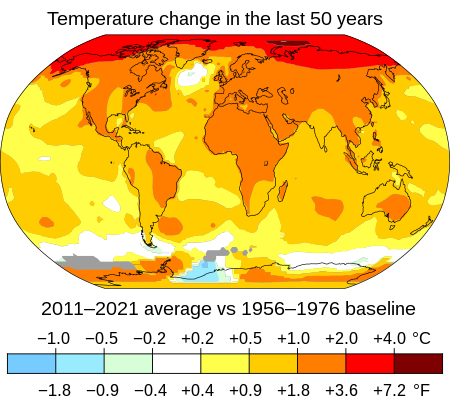
Due to climate change, deserts are expanding, while heat waves and wildfires are becoming more common.[5] Increased warming in the Arctic has contributed to melting permafrost, glacial retreat and sea ice loss.[6] Higher temperatures are also causing more intense storms, droughts, and other weather extremes.[7] Rapid environmental change in mountains, coral reefs, and the Arctic is forcing many species to relocate or become extinct.[8] Even if efforts to minimise future warming are successful, some effects will continue for centuries. These include ocean heating, ocean acidification and sea level rise.[9]
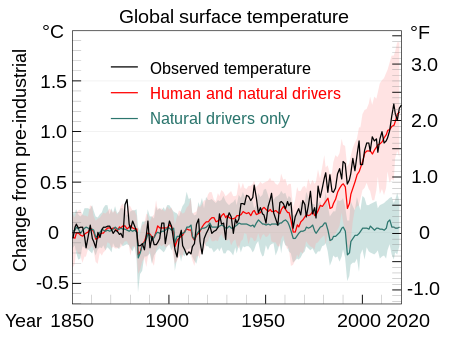
(Change in average surface air temperature since the Industrial Revolution, plus drivers for that change.)
Climate change threatens people with food and water scarcity, increased flooding, extreme heat, more disease, and economic loss. Human migration and conflict can also be a result.[10] The World Health Organization (WHO) calls climate change the greatest threat to global health in the 21st century.[11] Communities may adapt to climate change through efforts like coastline protection or expanding access to air conditioning, but some impacts are unavoidable. Poorer countries are responsible for a small share of global emissions, yet they have the least ability to adapt and are most vulnerable to climate change.
Many climate change impacts are already felt at the current 1.2 °C (2.2 °F) level of warming. Additional warming will increase these impacts and can trigger tipping points, such as the melting of the Greenland ice sheet.[12] Under the 2015 Paris Agreement, nations collectively agreed to keep warming "well under 2 °C". However, with pledges made under the Agreement, global warming would still reach about 2.7 °C (4.9 °F) by the end of the century.[13] Limiting warming to 1.5 °C will require halving emissions by 2030 and achieving net-zero emissions by 2050.[14]
[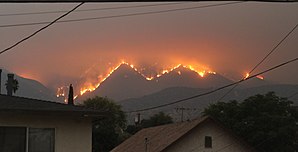 ](Los Angeles)
 Coral Bleaching caused by increased temperature and ocean acidification due to increased CO2. Marine coral are key to biodiversity.
 Droughts are effect of erratic rainfall and glaciers melting.
Some effects of climate change,(above) Wildfire intensified by heat and drought, worsening droughts compromising water supplies, and bleaching of coral caused by marine heatwaves.
Reducing emissions requires generating electricity from low-carbon sources rather than burning fossil fuels. This change includes phasing out coal and natural gas fired power plants, vastly increasing use of wind, solar, and other types of renewable energy, and reducing energy use. Electricity generated from non-carbon-emitting sources will need to replace fossil fuels for powering transportation, heating buildings, and operating industrial facilities.[16][17] Carbon can also be removed from the atmosphere, for instance by increasing forest cover and by farming with methods that capture carbon in soil.[18]
...
Greenhouse Gases
Main articles: Greenhouse gas, Greenhouse gas emissions, Greenhouse effect, and Carbon dioxide in Earth's atmosphere

(CO2 concentrations over the last 800,000 years as measured from ice cores[58][59][60][61] (blue/green) and directly[62] (black)
Greenhouse gases are transparent to sunlight, and thus allow it to pass through the atmosphere to heat the Earth's surface. The Earth radiates it as heat, and greenhouse gases absorb a portion of it. This absorption slows the rate at which heat escapes into space, trapping heat near the Earth's surface and warming it over time.[63] Before the Industrial Revolution, naturally-occurring amounts of greenhouse gases caused the air near the surface to be about 33 °C warmer than it would have been in their absence.[64][65] While water vapour (50%) and clouds (25%) are the biggest contributors to the greenhouse effect, they increase as a function of temperature and are therefore feedbacks. On the other hand, concentrations of gases such as CO2 (20%), tropospheric ozone,[66] CFCs and nitrous oxide are not temperature-dependent, and are therefore external forcings.[67]
Human activity since the Industrial Revolution, mainly extracting and burning fossil fuels (coal, oil, and natural gas),[68] has increased the amount of greenhouse gases in the atmosphere, resulting in a radiative imbalance. In 2019, the concentrations of CO~2 and methane had increased by about 48% and 160%, respectively, since 1750.[69] These CO2 levels are higher than they have been at any time during the last 2 million years. Concentrations of methane are far higher than they were over the last 800,000 years.[70]

The Global Carbon Project shows how additions to CO2 since 1880 have been caused by different sources ramping up one after another.
Global anthropogenic greenhouse gas emissions in 2019 were equivalent to 59 billion tonnes of CO2. Of these emissions, 75% was CO2, 18% was methane, 4% was nitrous oxide, and 2% was fluorinated gases.[71] CO2 emissions primarily come from burning fossil fuels to provide energy for transport, manufacturing, heating, and electricity.[4] Additional CO2 emissions come from deforestation and industrial processes, which include the CO2 released by the chemical reactions for making cement, steel, aluminum, and fertiliser.[72] Methane emissions come from livestock, manure, rice cultivation, landfills, wastewater, and coal mining, as well as oil and gas extraction.[73] Nitrous oxide emissions largely come from the microbial decomposition of fertiliser.[74]
Despite the contribution of deforestation to greenhouse gas emissions, the Earth's land surface, particularly its forests, remain a significant carbon sink for CO2. Land-surface sink processes, such as carbon fixation in the soil and photosynthesis, remove about 29% of annual global CO2 emissions.[75] The ocean also serves as a significant carbon sink via a two-step process. First, CO2 dissolves in the surface water. Afterwards, the ocean's overturning circulation distributes it deep into the ocean's interior, where it accumulates over time as part of the carbon cycle. Over the last two decades, the world's oceans have absorbed 20 to 30% of emitted CO2.[76]...
Climate Change Feedback
Main articles: Climate change feedback and Climate sensitivity
[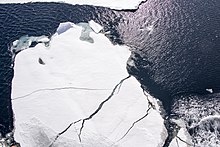 North Pole
Sea ice reflects 50% to 70% of incoming sunlight, while the ocean, being darker, reflects only 6%. As an area of sea ice melts and exposes more ocean, more heat is absorbed by the ocean, raising temperatures that melt still more ice. This process is a positive feedback.[102]
The response of the climate system to an initial forcing is modified by feedbacks: increased by "self-reinforcing" or "positive" feedbacks and reduced by "balancing" or "negative" feedbacks.[103] The main reinforcing feedbacks are the water-vapour feedback, the ice–albedo feedback, and the net effect of clouds.[104][105] The primary balancing mechanism is radiative cooling, as Earth's surface gives off more heat to space in response to rising temperature.[106] In addition to temperature feedbacks, there are feedbacks in the carbon cycle, such as the fertilizing effect of CO2 on plant growth.[107] Uncertainty over feedbacks is the major reason why different climate models project different magnitudes of warming for a given amount of emissions.[108]
As air warms, it can hold more moisture. Water vapour, as a potent greenhouse gas, holds heat in the atmosphere.[104] If cloud cover increases, more sunlight will be reflected back into space, cooling the planet. If clouds become higher and thinner, they act as an insulator, reflecting heat from below back downwards and warming the planet.[109] The effect of clouds is the largest source of feedback uncertainty.[110]
Another major feedback is the reduction of snow cover and sea ice in the Arctic, which reduces the reflectivity of the Earth's surface.[111] More of the Sun's energy is now absorbed in these regions, contributing to amplification of Arctic temperature changes.[112] Arctic amplification is also melting permafrost, which releases methane and CO2 into the atmosphere.[113] Climate change can also cause methane releases from wetlands, marine systems, and freshwater systems.[114] Overall, climate feedbacks are expected to become increasingly positive.[115]
Around half of human-caused CO2 emissions have been absorbed by land plants and by the oceans.[116] On land, elevated CO2 and an extended growing season have stimulated plant growth. Climate change increases droughts and heat waves that inhibit plant growth, which makes it uncertain whether this carbon sink will continue to grow in the future.[117] Soils contain large quantities of carbon and may release some when they heat up.[118] As more CO2 and heat are absorbed by the ocean, it acidifies, its circulation changes and phytoplankton takes up less carbon, decreasing the rate at which the ocean absorbs atmospheric carbon.[119] Overall, at higher CO2 concentrations the Earth will absorb a reduced fraction of our emissions.[120]
Modelling
Further information: Carbon budget, Climate model, and Climate change scenario

Projected global surface temperature changes relative to 1850–1900, based on CMIP6 multi-model mean changes
A climate model is a representation of the physical, chemical, and biological processes that affect the climate system.[121] Models also include natural processes like changes in the Earth's orbit, historical changes in the Sun's activity, and volcanic forcing.[122] Models are used to estimate the degree of warming future emissions will cause when accounting for the strength of climate feedbacks, [123][124] or reproduce and predict the circulation of the oceans, the annual cycle of the seasons, and the flows of carbon between the land surface and the atmosphere.[125]
The physical realism of models is tested by examining their ability to simulate contemporary or past climates.[126] Past models have underestimated the rate of Arctic shrinkage[127] and underestimated the rate of precipitation increase.[128] Sea level rise since 1990 was underestimated in older models, but more recent models agree well with observations.[129] The 2017 United States-published National Climate Assessment notes that "climate models may still be underestimating or missing relevant feedback processes".[130]
A subset of climate models add societal factors to a simple physical climate model. These models simulate how population, economic growth, and energy use affect – and interact with – the physical climate. With this information, these models can produce scenarios of future greenhouse gas emissions. This is then used as input for physical climate models and carbon cycle models to predict how atmospheric concentrations of greenhouse gases might change in the future.[131][132] Depending on the socioeconomic scenario and the mitigation scenario, models produce atmospheric CO2 concentrations that range widely between 380 and 1400 ppm.[133]
The IPCC Sixth Assessment Report projects that:{ global warming is very likely to reach 1.0 °C to 1.8 °C by the late 21st century under the [very low GHG emissions scenario]).
In an intermediate scenario global warming would reach 2.1 °C to 3.5 °C, and 3.3 °C to 5.7 °C under the very high GHG emissions scenario.[134] These projections are based on climate models in combination with observations.[135] A 2023 article in Nature demonstrated that the models developed by Exxon in the early 1980’s based on CO2 data from their tankers turned out to be astonishingly accurate.
The remaining carbon budget is determined by modelling the carbon cycle and the climate sensitivity to greenhouse gases.[136] According to the IPCC, global warming can be kept below 1.5 °C with a two-thirds chance if emissions after 2018 do not exceed 420 or 570 gigatonnes of CO2. This corresponds to 10 to 13 years of current emissions. There are high uncertainties about the budget. For instance, it may be 100 gigatonnes of CO2 smaller due to methane release from permafrost and wetlands.[137] However, it is clear that fossil fuel resources are too abundant for shortages to be relied on to limit carbon emissions in the 21st century.[138]
Impacts
Main article: Effects of climate change