Carburetor
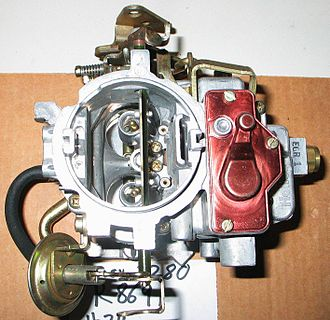
Details:
The carburetor (invented by German automotive engineer [invented by] Maybach*) is a mechanism for providing a spark-ignition engine with a mixture of air and gasoline.
Key to the process is the Venturi “waisted” tube through which incoming air enters the engine cylinder.
The waist (a narrowing) in the tube causes a drop in air-pressure (to near vacuum). In the waist, the near-vacuum draws in fuel through a pinhole-size opening in the tube wall.
When the incoming fuel meets the air in the low-pressure environment, the fuel breaks up into a fine spray, and then enters the cylinder.
Control of the ratio of air to fuel determines how much of a bang will happen when the spark plug ignites the fuel-air spray in the engine cylinder, driving down the piston. The more bang, the greater the pressure of the burning-and-expanding fuel-air mix, the harder the piston is pushed, and the faster the engine goes.
In this way, the carburetor controls the air-fuel mixture and therefore the speed of the engine.
Oneliner: Carburetor
Bibliography:
- Encyclopedia Britannica.
- How Stuff Works, www.howstuffworks.com.