Da Gama
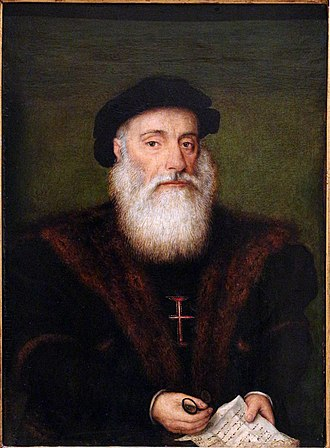
Name: Vasco da Gama
Achievements: Opened a sea route between Europe and Asia.
Born: c 1460; Sines, Portugal.
Died: December 24, 1524; Cochin, India (Aged about 64)
Field & Discipline: Exploration; Navigator
Language: Portuguese
Father: Estevao da Gama
Mother: Isobel Sodre
Siblings: Paulo; Ayres; Theresa
Spouse: Catherina de Athayde
Children: Francisco; Estevao (became governor of India); Paulo; Christavao; Pedro da Silva; Alavar de Athayde; Isabella de Athayde
Education: Unknown
Life & Times:
Da Gama was born in the same year the Portuguese Prince [influenced by] Henry the Navigator* died. At that time, da Gama's father was the Civil Governor of Sines, a small port on the coast of Portugal. Little is known about his education but, due to his father’s influence, he became a good navigator.
Bartolomeu Dias had discovered the Cape of Good Hope in 1487, and John II of Portugal was eager to establish trade in lands that were said to lie to the East. John II ordered Da Gama's father to head an expedition to open up a sea route to Asia but both men died before the journey could be attempted.
In 1496, Manuel I came to the throne and plans were put back into action, with Vasco da Gama his brother Paulo in charge. The two ships Sao Rafael and Sao Gabriel sailed from Lisbon on 8th July 1497, carrying provisions for three years, stone pillars to mark their discovered territories, and Arab-speaking interpreters. Bartolomeu Dias accompanied them in a third ship as far as the Cape Verde Islands, where he turned toward the West African Gold Coast.
The other two ships continued through the South Atlantic and landed on the western tip of what is now South Africa, ninety-six days later. Da Gama named the land St Helena, sailed around the dangerous Cape of Good Hope and landed at what is now the Bay of Mossel to a friendly native welcome. Here, da Gama exchanged goods for ivory before setting sail again on 8th December. On Christmas Day, they anchored on the East African coast, which Da Gama named “Natal.” At the end of January 1498, they were forced by an outbreak of scurvy to stop for a month at the mouth of the Quilimane River.
When the scurvy cleared up, they moved on to Mozambique and found white stone houses, cultivated gardens, palm groves and the ocean-going ships of Arabs trading in gold, silver, cloves, pepper, ginger and precious jewels. The Portuguese then discovered that the Muslims there and in Mombasa were plotting to seize their ships, so they left port after an unsuccessful Muslim attack.
The next place they came to was Malindi, where Da Gama exchanged gifts with the local Rajah before moving on. It took twenty-three days to cross the Indian Ocean and on on 20th May they reached Calicut, on the Indian coast, where they were welcomed by the Hindu ruler, the Zamorin. Da Gama stayed for three months, trying to negotiate a trade treaty, but eventually left at the end of August with only a letter for the King, asking for gold, silver and corals.
On the return voyage to Portugal, many men, including Paulo da Gama, died from scurvy and, in September 1499, only fifty-five of the original hundred and seventy men sailed back into Lisbon. Da Gama was rewarded with a title, an estate and a pension for his efforts. [succeeded by] Cabral* was sent to Calicut to follow up Da Gama's work and to establish Portuguese presence in the East.
Manuel then promoted Da Gama to Admiral, in command of a fleet of fifty ships. His mission was to secure Portuguese dominance in the Indian Ocean, and the fleet left Portugal in February 1502. Da Gama anchored off Calicut and sent word demanding that the Zamorin banish all Muslims from the port.
The Zamorin took too long to respond, so da Gama murdered Hindu traders who had sailed out to barter with his crews. After sending their bodies back to Calicut, Da Gama returned home, arriving in Portugal in October 1502. Five ships were left in India to intercept Arab merchant cargoes and guard the trading posts set up in Cannanore and Cochin. This was the first permanent European naval presence in the Orient.
Da Gama then married and settled down for the next twenty-one years, raising a large family in Evora, Portugal. In 1519, he was made Count of Vidigueira and in 1524, at the age of sixty-five, became Viceroy in India. His job was to reform the corrupt administration of Portuguese settlements. In the middle of the reforms, he fell ill and died in Cochin
Extra Connections: His exploits are commemorated in an epic poem by [commemorated by] Camoes*.
[route followed by] Linschoten* followed Da Gama’s route.
His work influenced [influenced] Vespucci*
One of his captains’ brothers took [work related to] Noronha* to Brazil
Assessment: Vasco da Gama achieved the first European trading stations on the Indian sub-continent.
Oneliner: Vasca da Gama, early Portuguese explorer
Bibliography:
- Jayne, K G, Vasco da Gama and His Successors, Methuen & Co. Ltd., London, 1970.
- Subrahmanyam, Sanjay, The Career and Legend of Vasco da Gama, Cambridge University Press, 1997.