Wright Bros
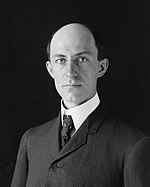

ACHIEVEMENT(S): Powered flight
DATE/PLACE OF BIRTH: Wilbur: 16 April 1867, near Millville, IN.
Orville: 19 August 1871, at Dayton, OH
DATE/PLACE/AGE AT DEATH: Wilbur: 30 May 1912, in Dayton, OH. Aged 45.
Orville: 30 January 1948, in Dayton, OH. Aged 76
DISCIPLINE: Inventors and aviators FIELD: Aeronautics
LANGUAGE: English
PARENTS: Milton Wright and Susan Catharine Koerner (d. 1889), married 1859
SIBLINGS: Reuchlin (1861-1920), Lorin (1862-1939) and Katharine (1874-1929)
- plus twins Otis and Ida (born and died 1870)
SPOUSE: None
CHILDREN: None
EDUCATION: Dayton Central High School
MAJOR WORK: "Our Aeroplane Tests at Kitty Hawk", 1908 (in 'Scientific American', 29.2.1908)
LIFE AND TIMES: In 1892, when cycling had become a national obsession, the brothers opened a bicycle sales and repair shop, while continuing with the printing business. Within four years the Wright Cycle Company had begun the small-scale manufacture and sale of bicycles, and during the late 1890s the brothers introduced several innovations (including their own self-oiling bicycle wheel hub) and had installed light machine tools in the shop.
The Wrights’interest in aviation was awakened in August 1896 by news accounts of the death of the German gliding pioneer Otto Lilienthal. The first thing they did was to examine all the current information on flight, and in 1899 Wilbur wrote to the Smithsonian for suggestions as to further reading in aeronautics. The following year he wrote to the American aviator Octave Chanute, who became an important adviser to the brothers between 1900 and 1905.
From their reading, the Wrights decided that the construction of a powered airplane involved complex problems in aerodynamics, propulsion and control, and they decided to master the art of flying in an un-powered machine first.
Earlier experimenters had designed wings capable of flight and engines with enough power to propel a craft through the air, so the brothers concentrated on developing a system for controlling a plane in pitch, roll and yaw instead of relying on the usual pilot-weight-shifting control. Watching the flight of buzzards and noticed the twisting or warping of their wings as they flew, the brothers quickly realized that wing-warping was a fundamental aspect of flight. This idea became the forerunner of the later idea of ailerons. This realization led to the development, in August 1899, of a small biplane kite, with a wingspan of about 5 feet and controls for warping the wings to control direction and stability.
In 1900 came a larger kite, of 17 foot wingspan, to carry a pilot, using Lilienthal's data to calculate the amount of wing surface area needed. After taking advice from the U.S. Weather Bureau the Wrights decided on the fishing village of Kitty Hawk in North Carolina - with its high steady winds, tall dunes from which to glide, and soft sands for landing - to test their machine, and in October 1900 Wilbur (who did all the flying up to 1902) achieved a few seconds of piloted flight.
The following July-August they returned to Kitty Hawk, to the foot of Kill Devil Hills, where they assembled a much larger glider with a hand-operated forward elevator attached to the tail-plane for pitch control. Although they again achieved encouraging results from their 50-100 flights, particularly after further alterations to the wing camber (during which the centre of gravity of the machine was shifted back one foot), they still met many problems with stability and control.
Back in Dayton, careful analysis of their results led the Wrights to the conclusion that the Lilienthal lift tables were wrong, even though they were considered gospel by the flying world of the time. During the winter of 1901-02, the brothers decided on a home-made laboratory to test the performance of different wing shapes at different wind angles, so they built a wind tunnel 18 inches long, with balances mounted inside to measure the forces [as described mathematically by the laws of fluid mechanics developed by British engineer and physicist Osborne Reynolds* ] - operating on small model airfoils. After tests of between 100 and 200 wing designs in their wind tunnel, they wrote the first accurate tables of lift and drag.
The Wrights returned to Kitty Hawk in September 1902 with their third full-scale glider, with longer, narrower wings, a 32-foot wingspan, a shallower wing curvature, and a double vertical fin tail mounted behind the wings. Turning was still difficult, and the tail was converted to a single moveable rudder operated by the wing-warping controls. This innovation was so successful they decided to try powered flight the following summer.
The Wrights returned to Kill Devil Hills in September 1903, where over the next two months they assembled their first powered machine, with a wingspan of 40 foot. After some early trouble with propeller shafts, on 17 December 1903 the Wright Biplane took to the air and Orville made a successful flight of 120 feet in 12 seconds. They flew several times more that day, each flight covering a longer distance, and in the last flight Wilbur stayed in the air for 59 seconds, travelling 856 feet at just under 10 mph relative to the ground. For the first time in history, and witnessed by five local citizens, a heavier-than-air machine had demonstrated powered and sustained flight under the complete control of the pilot. The airplane* was born.
The brothers spent 1904 building and refining a new machine, which they called Flyer II, since the first flyer had been hopelessly damaged during the 1903 tests. In this new machine, in which they incorporated a 16hp engine and separated the wing-warping and rudder controls, they flew in the more confined spaces of Dayton, and on 20 September Wilbur flew the first complete circle, setting a new distance record of 3/4 mile in one minute 35.4 seconds.
Continuing to improve the design, and gaining in skill and confidence in the air, in June 1905 they launched Flyer III, which on 5 October flew 24.2 miles in just over 38 minutes, landing only because it was out of fuel. In late 1905, now able to remain aloft for up to 39 minutes at a time and to Fly circles and other maneuvers, the Wrights were sufficiently confident of their design to offer it to the United States War Department, but were turned down. The following year they patented their control system of elevator, rudder and wing-warping, and spent the next two years attempting to find a buyer. Finally, in February 1908, the Wrights signed a contract with the US Army to build a plane according to army specifications - capable of flying for at least one hour, and of carrying a pilot and passenger, at a speed of at least 40 mph (65 km/ph) - for $25,000, and the following month they negotiated a second agreement with a group of French investors interested in building and selling Wright machines under license.
In May 1908 they travelled to Outer Banks, North Carolina where they made 22 flights with their 1905 machine, modified with upright seating and new hand controls. Wilbur then sailed to France, where he made his first public flight at a racetrack near Le Mans on 8 August, and overnight became the toast of Europe. The European rich and famous (including the future aircraft and helicopter pioneer Sikorsky*) saw him fly at Le Mans and Pau in France, and at Centocelle near Rome.
Meanwhile, in September 1908 during the US Army trials at Fort Myer, VA, Orville made the first one-hour flight. Nine days later he was flying with Lieutenant Thomas E. Selfridge, when a propeller split. Orville survived the crash with a broken leg, four broken ribs and a multi-fractured hip, but Selfridge became the first person to die in the crash of a powered aircraft. During the course of his recovery, Orville and his sister Katharine visited Wilbur in Europe, and together they returned to Fort Myer in 1909 to complete the Army trials, and completed the sale of the first airplane to the US Army. Having exceeded the required speed of 40 miles per hour, the Wrights earned a bonus of $5,000 beyond the $25,000 contract price.
Increasingly, Wilbur focused on business and legal activities, including a series of patent suits against rival aircraft builders in the US and Europe, in November 1909 becoming president of the new Wright Company, with offices in New York City, a factory in Dayton and a flying field and flight school at Huffman Prairie. Orville was vice-president and chief flight instructor, and over the following years he selected and trained the members of the Wright Exhibition Company flying team, whose aerial performances in 1910-11 thrilled millions of spectators across the nation.
Exhausted by business and legal concerns and suffering from typhoid fever, Wilbur died at Dayton, at the age of 45, in May 1912. Orville assumed leadership of the Wright Company, also founding the Wright Aeronautical Corporation, later becoming director of the Wright Aeronautical Laboratory in Dayton. Between 1909 and 1919 he was primarily responsible for designing new types of Wright aircraft. In 1915 he sold his share in the Wright Company to a group of financiers, and during World War I worked for the US government as a consultant aeronautical engineer.
After the war Orville retired from active involvement in the aircraft industry, but remained a celebrated figure in American life for the next half century.
ASSESSMENT: They solved massive technical problems and made great intellectual advances in aeronautics.
EXTRA CONNECTIONS: Influenced aerodynamicist Prandtl*
Were nearly beaten to the punch by flying piano-maker Kress*
ONELINER: The Wright Brothers, first fliers
BIBLIOGRAPHY:
EB,Biographical Dictionary of Engineers and Inventors,
ANB
Howard, Fred,Wilbur and Orville: A Biography of the Wright Brothers, London: Robert Hale, 1987
Kolmer, Susan E., “Wilbur and Orville Wright", in Notable Twentieth Century Scientists.