Logarithms
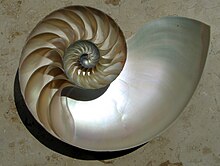
A nautilus displaying a logarithmic spiral
Details:
Logarithms were invented by [invented by] John Napier* who published his system in 1614. Logarithms are basically a set of numbers which are used in place of other numbers. Napier supplied tables of logarithms and anti-logarithms which allow the simpler process of adding to substitute for the more complicated one of multiplication, and of subtraction for division.
Adding two logarithms together provides a reference number for an instant answer in multiplication. Subtracting one logarithm from another provides a reference number in division. A simplified version of Napier’s system demonstrating its use follows below:
The numbers 0 to 10 are printed horizontally in one line in numerical order. These numbers are the logarithms and they increase along the line arithmetically by adding a common number - in this case, the number 1.
On a line underneath are a set of numbers, beginning with the number 1, which each correspond to the logarithm above it on the page. These numbers, sometimes called anti-logarithms, increase geometrically by multiplying the preceding number by a common number - in this case, the number 2.
The logarithm of 1 is O, so therefore the logarithm of 2 is 1, the logarithm of 4 is 2, the logarithm of 8 is 3, and so on. To multiply 8 by 32, therefore, all that is necessary is to look up the logarithm of 8, which is 3, and the logarithm of 32, which is 5, and add them together. The answer (the logarithm 8) corresponds to the number 256 (ie, 8 x 32).
To divide any number by another, all that is necessary is to subtract one logarithm from another.
For example, to divide 128 by 16, subtract the logarithm of 16 (4) from the logarithm of 128 (7) to get the logarithm number 3 which corresponds to the number 8, the correct answer to the calculation.
To find the square of a number, double its logarithm. For example, the logarithm of 8 is 3, three doubled equals 6, the anti-logarithm of 6 is 64 - the square of 8. To find the square root of a number, halve its logarithm.
To find the cube of a number, multiply its logarithm by 3. To find the cube root, divide its logarithm by 3.
Logarithms occur in definitions of the dimension of fractals. They also are useful in entropy, information theory and psychology.
Oneliner: Logarithms
Bibliography:
- Motz, Lloyd and Weaver, Jefferson Hane,The Story of Mathematics,Plenum Press, New York and London, 1993.
- Shennan, Francis,Flesh and Bones, The Life, Passions and Legacies of John Napier, Napier Polytechnic of Edinburgh, 1989.