De Bary, A
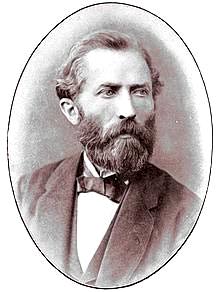
Achievements: Founded the study of fungus
Born: January 26,1831; Frankfurt, Germany
Died: January 19, 1888; Strasbourg, Germany (now France) (Aged 57)
Field & Discipline: Science; Botany; Mycology
Language: German
Education: High School, Frankfurt; Heidelberg University; Marburg University; Berlin University
Major Work: "Researches Concerning Fungal Blights" (1853)
Life & Times:
At Berlin University De Bary was taught by [taught by] Ehrenberg* and [taught by] Muller*. In 1853, De Bary received his medical degree and in the same year published a book on the types of fungi which caused rust and smut disease in plants. The origin of plant diseases was highly topical at that time because grain crops were frequently ruined through fungal disease and the potato blight had had serious economic and social consequences.
De Bary put forward his view that the fungal rust patches in rust-infected plants were plants in their own right and were not produced by the host plants or by secretions from diseased host plants. This implied that the rust fungi were the cause, not the effect, of the disease. He proposed that the development of the fungi should be studied to find out how they infected the plants.
He began practising medicine in Frankfurt but soon gave up to become a tutor in botany at Tubingen University where he also acted as assistant to the plant anatomist, Hugo von Mohl. In 1855 De Bary was appointed professor of botany at Frieburg im Breisgau where he succeeded [succeeded] Naegeli*. At Frieburg, De Bary established the first laboratory of botany that was also a teaching centre. He worked on the development of the Myxomycetes, which include the slime molds, and decided that their correct classification was among the lower animals, naming them the Mycetozoa. He noted that at one stage of their development they were virtually formless, mobile masses of a substance called plasmodium, and that the amoeboid swarm spores produced by the Myxomycetes were made of protoplasm. His research was important evidence of the protoplasmic substratum of life.
He also demonstrated the sexuality of fungi and set up procedures for sowing spores and monitoring their development. In 1861 he published his first writings on the Peronospora infestans, the potato fungus which causes potato blight. Two years later he published a paper on his research into the development of fungal parasites in which he rejected the theory of spontaneous generation. Through observation and experiment he was able to describe how spores of the potato fungus, sown onto healthy potato leaves, penetrated the leaf and then developed. He also described sowing the fungus on to potato stalks and tubers and watering the spores into the soil to infect healthy tubers below ground. He concluded that plants became diseased because of the germs of parasites which developed when conditions were favourable for invasion of the host plant.
In 1865 he demonstrated that the development of the organism causing rust in wheat depended on two host plants: wheat and barberry. The elimination of barberry near wheat fields had long been an accepted practice but De Bary was the first to prove how the process worked. He knew that the rust organisms developed summer spores which were reddish in colour and winter spores which were dark. He examined the reproductive organs of these spores and he inoculated plants with the spores a technique earlier developed by the Italian bacteriologist [used technique of] Bassi* . His results proved that the rust parasite needed two hosts to develop and he classified these parasites as heteroecious (in contrast to autoecious species, which require only one host).
In 1867 De Bary moved to Halle University where he again established a botanical laboratory and became co-editor of the "Botanische Zeitung". After Prussia annexed French Alsace-Lorraine in 1871 he was appointed professor of botany and rector at the re-chartered Strasbourg University where [succeeded] Millardet* had worked before the German takeover. He attracted many students from both Europe and the United States and had a world-wide reputation in his field. He was asked by the Royal Agricultural Society of England to carry out further research on the potato blight. In 1876 he announced that he could produce the disease in healthy plants by inoculation, although he had not been able to find out how the fungus reproduced sexually.
Among other major advances, De Bary described how lichen is formed through the combined developments of the fungus and alga. He also described the different ways in which parasites developed and survived and how they adapted to drought and winter conditions. He coined the word 'symbiosis' in 1879 to describe the "living together of unlike organisms.” In 1885 he published his lectures on bacteria which were highly relevant to the developing science of bacteriology. His books on morphology contained detailed descriptions and illustrations of slimes, molds and yeasts which provided a valuable teaching and reference tool, and he published over a hundred papers on different botanical subjects, from ferns to insect-killing plants. De Bary remained at Strasbourg until his death.
Assessment: De Bary is recognised as the founder of the science of mycology and plant pathology.
Oneliner: Anton de Bary, first fungus expert
Bibliography:
- Dictionary of Scientific Biography.
- Encyclopedia Britannica.
Father: August Theodor De Bary
Mother: Emilie Meyer
Siblings: 9
Spouse: Antonie Einert
Children: 4