Airbrake
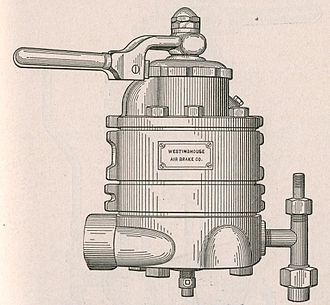
DATE INVENTED/BEGAN: 1869
PLACE INVENTED/BEGAN: USA
DATE ENDED: 1869
PLACE ENDED: USA
DISCIPLINE: Transportation
FIELD: Braking system
SHORT DESCRIPTION/ASSESSMENT: A braking system activated by differences in air pressure
DETAILS/DESCRIPTION:
George Westinghouse G* invented the first successful air brake for which he received a patent in 1869. His air brake was developed for use on the railroads and it had a major impact on rail travel in the United States, enabling trains to travel at higher speeds and saving hundreds of lives a year. Some of the very early locomotives did not actually have any brakes, others were manually operated, and there had been experiments with brakes powered by steam power. There had also been failed attempts to use compressed air for brakes.
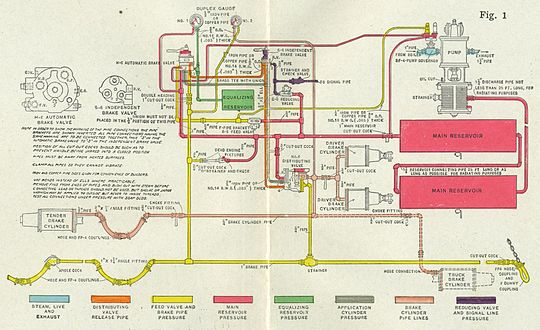
Westinghouse’s device was a mechanical brake operated by compressed air acting on a piston. The piston rod exerted force on the braking device. It was a continuous braking system in which the air pressure was applied to brake cylinders throughout the train. A reciprocating steam pump on the locomotive delivered compressed air to a tank in the cab of the engine. On the opening of a valve, the compressed air was transmitted through a pipe to all the coaches, with flexible hoses between them. From the pipe, the air went into cylinders which were attached to the brake rigging.
Westinghouse developed his system and made it safer, taking out a new patents in the 1870’s which involved an independent air apparatus for coaches, with an auxiliary tank and control valve under each one. If the train broke up the brakes would automatically go into emergency stop mode. In 1872-3 he perfected the air-actuated brake which worked in an opposite way to his old system. The brakes were activated by discharging rather than charging the train pipeline.
For this, Westinghouse invented the pressure-sensitive triple valve which had three functions: to admit air from the train pipeline into the carriage’s reserve tank, to re-admit air from the same tank to the brake cylinder, to exhaust the air and so release the brake. Each coach had a triple valve. As a result, braking was more uniform because full pressure was available to each coach; and it acted as a fail-safe because any reduction of pressure in the train line caused the triple valve to open.
Nowadays, a more sensitive control valve is used but the modern air brake is still based on Westinghouse’s 1873 blueprint. With an air brake, a slight effort by the operator can quickly apply full braking force. Today, the air brake is used in buses, heavy road vehicles and off-road equipment. It is required by law on locomotive and railroad cars.
In motor vehicles, an engine-driven compressor takes in air and compresses it. The compressor is controlled by a governor that maintains air compression within a pre-selected range. The compressed air is stored in reservoirs, and safety valves allow air to escape if its pressure is too high. The compressed air is transmitted from the reservoirs to the brake chambers of the vehicle. In the brake chambers, the air pressure is converted into a mechanical force to apply to the brakes.
The amount of braking is regulated according to how much the foot pedal is depressed. When the driver releases the brake valves, the compressed air is released from the brake chambers. If air pressure is lost to the front brakes, the rear brake system will continue to operate. Loss of air pressure in the rear brake system makes front brake system responsible for stopping the vehicle.

EXTRA CONNECTIONS: None
ONELINER: Airbrake
BIBLIOGRAPHY:
White, John H, The American Railroad Passenger Car, John Hopkins University Press, Baltimore and London, 1978
Multimedia:
Connections II #5 Something for Nothing