Bosch, Hieronymous
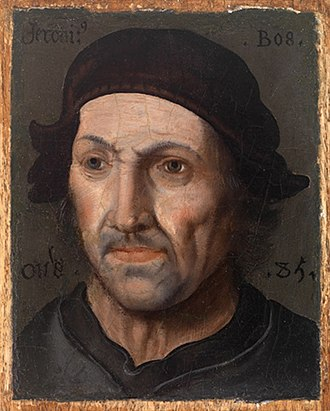
ACHIEVEMENTS: Paintings
NAME: Van Aeken, Jerome
DATE AND PLACE OF BIRTH: c.1450, Hertogenbosch, Netherlands
DATE/PLACE OF DEATH/AGE AT DEATH: August 9, 1516, Hertogenbosch, Netherlands. Aged in his 50s
DISCIPLINE: Painter
FIELD: Art
LANGUAGE: Dutch

The Garden of Earthly Delights in the Museo del Prado in Madrid
PARENTS: Anthonis van Aeken; Mother unknown
SIBLINGS: Brother, Goosen Aeken
SPOUSE: Aleyt van Meervenne
CHILDREN: Unknown
EDUCATION: Unknown
MAJOR WORK: "Garden of Earthly Delights"; "Carrying of the Cross"
LIFE AND TIMES:
Bosch was born into a wealthy family of painters who had been active and respected in their district for about two centuries. Both his grandfather and father did religious paintings on commission for the local gentry. Bosch's older brother, Goosen, also a painter, inherited their father's workshop. Bosch lived either in Hertogenbosch, where he was born, or in the nearby village of Oorschot, where he acquired property in his wife's dowry.
Not much is known about Bosch's life. He is believed to have been an active member of the Catholic Church, and after 1546 his name appears frequently in the archives of the Brotherhood of Our Lady as a painter who was commissioned to produce religious paintings. Records show that in 1504 Philip the Fair, the ruler of the Netherlands, commissioned him to paint a huge altarpiece of the Last Judgment, which no longer exists.Bosch's famous painting, "The Garden of Earthly Delights", was probably commissioned by Hendrik III, Prince of Nassau.
Bosch is considered the most innovative Dutch painter after Jan van Eyck, whose style has been called "microscopic realism." Bosch's work was so original and his symbols so unusual that it has been thought he was using a cryptic language, linked to the occult, or to a secret society. The dominant theme of Bosch's work was the human condition and his morality was rigid. His work reflects the fear of witchcraft and deviltry that obsessed the decades immediately preceding the Reformation.
He was the first to set down the violence and brutality of life in the Middle Ages and the terror people felt about the unknown, particularly the fate that religion described for the sinner.
What made Bosch's paintings particularly compelling and disturbing was that the cruelty he depicted was happening on earth, not in some abstract hell. Since his scenes were of everyday life, they gave an immediacy to the idea of sin and retribution.
Bosch painted standard religious subjects such as Christ carrying the Cross and the Last Judgment with a personal bent. In "The Wedding Feast at Cana", at which Christ turns water into wine, a swan expels smoke, an old woman plays the bagpipes, there is a sorcerer's altar. In his painting of the "Seven Deadly Sins", each vice is illustrated by a domestic scene.
He used familiar Dutch proverbs to show that it is humans who make evil. In "Cure of Folly" (or the "Stone Operation",) a man has allowed a doctor to cut the stone of stupidity from his head. In the "Garden of Earthly Delights", Bosch depicts quack doctors, fortune tellers and gaming boards. In "Death and the Miser", the dying man and the man who is going through his strongbox are the same person. Monsters are everywhere in the picture.
As Bosch matured, his paintings became more complex and more subtly executed. His most famous painting, "The Garden of Earthly Delights", portrays the story of Adam and Eve and the fall from grace. The three panels, all with a fantastical air, are crammed with exquisitely painted animals and symbols.
When Bosch painted the temptations of the saints, he chose to paint those saints who were hermits, so he could paint landscapes, which were growing in popularity. Bosch was an innovator in landscape painting, executing the foreground, middle-ground and far distance each less colored as they receded.
In "The Temptation of St. Anthony", believed to be among Bosch's last paintings, the saint appears to be meditating with his eyes fixed on the middle distance, and although fiends and fantasy figures appear, they are few and almost lost in the peaceful landscape. Still the realist and the moralist, Bosch sees St. Anthony rising above temptation.
ASSESSMENT: Bosch was a unique painter whose works appear to anticipate studies of the unconscious.
EXTRA CONNECTIONS: Influenced Pieter Breughel*
He was a great favorite of Philip II of Spain*
ONELINER: Hieronymous Bosch, medieval Dutch painter
BIBLIOGRAPHY:
Linfert, Carl, Hieronymus Bosch, Thames & Hudson, London, Harry N Abrams, Inc., New York, 1989.