Garrison, Wm Lloyd
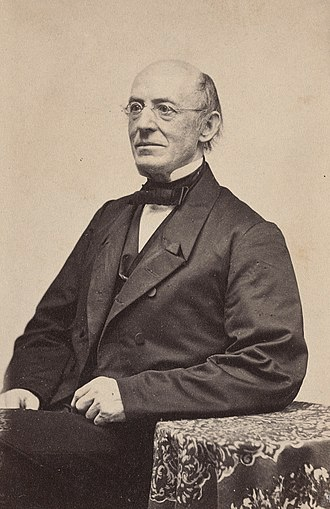
William Lloyd Garrison (December 12, 1805 – May 24, 1879) was a prominent American abolitionist, journalist,suffragist, and social reformer. He is best known as the editor of the abolitionist newspaper The Liberator, which he founded with Isaac Knapp in 1831 and published in Massachusetts until slavery was abolished by Constitutional amendment after the American Civil War. He was one of the founders of the American Anti-Slavery Society. He promoted "immediate emancipation" of slaves in the United States. In the 1870s, Garrison became a prominent voice for the woman suffrage movement.
- 1Early life and education
- 2Career
- 3Later life and death
- 4Legacy
- 5See also
- 6Works online
- 7References
- 8Bibliography
- 9External links
Early life and education

Garrison was born on December 12, 1805, inNewburyport, Massachusetts,[1] the son of immigrants from the British colony of New Brunswick, in present-day Canada. Under An Act for the relief of sick and disabled seamen, Abijah Garrison, a merchant sailing pilot and master, had obtained American papers and moved his family to Newburyport in 1806. The U.S. Embargo Act of 1807, intended to injure Great Britain, caused a decline in American commercial shipping. The elder Garrison became unemployed and deserted the family in 1808. Garrison's mother was Frances Maria Lloyd, reported to have been tall, charming, and of a strong religious character. She started referring to their son William as Lloyd, his middle name, to preserve her family name. She died in 1823, in the town ofSpringfield, Massachusetts.
Garrison sold home-made lemonade and candy as a youth, and also delivered wood to help support the family. In 1818, at 13, Garrison began working as an apprentice compositor for the Newburyport Herald. He soon began writing articles, often under the pseudonymAristides. Aristides was an Athenian statesman and general nicknamed "the Just." After his apprenticeship ended, Garrison and a young printer named Isaac Knapp bought their own newspaper in 1826, the short-lived Free Press. One of their regular contributors was poet and abolitionist John Greenleaf Whittier. In this early work as a small town newspaper writer, Garrison acquired skills he would later use as a nationally known writer, speaker and newspaper publisher. In 1828, he was appointed editor of the National Philanthropistin Boston, Massachusetts, the first American journal to promote legally-mandated temperance.
Career
Reformer
At the age of 25, Garrison joined the anti-slavery movement, later crediting the 1826 book of Presbyterian Reverend John Rankin, Letters on Slavery, for attracting him to the cause.[2] For a brief time he became associated with the American Colonization Society, an organization that promoted the resettlement of free blacks to a territory (now known as Liberia) on the west coast of Africa. Although some members of the society encouraged granting freedom to slaves, others considered relocation a means to reduce the number of already free blacks in the United States. Southern members thought reducing the threat of free blacks in society would help preserve the institution of slavery. By late 1829–1830, "Garrison rejected colonization, publicly apologized for his error, and then, as was typical of him, he censured all who were committed to it."[3]
...
Genius of Universal Emancipation
Garrison began writing for and became co-editor with Benjamin Lundy of theQuaker newspaper Genius of Universal Emancipation in Baltimore, Maryland. With his experience as a printer and newspaper editor, Garrison changed the layout of the paper and handled other operation issues. Lundy was freed to spend more time touring as an anti-slavery speaker. Garrison initially shared Lundy's gradualist views, but while working for the Genius, he became convinced of the need to demand immediate and complete emancipation. Lundy and Garrison continued to work together on the paper in spite of their differing views. Each signed his own editorials.
Garrison introduced "The Black List," a column devoted to printing short reports of "the barbarities of slavery—kidnappings, whippings, murders."[4] For instance, Garrison reported that Francis Todd, a shipper from Garrison's home town of Newburyport, Massachusetts, was involved in the domestic slave trade, and that he had recently had slaves shipped from Baltimore to New Orleans in the coastwise trade on his ship the Francis. (This was thoroughly legal, although the US had in 1807 prohibited the international slave trade from Africa.)
Todd filed a suit for libel in Maryland against both Garrison and Lundy; he thought to gain support from pro-slavery courts. The state of Maryland also brought criminal charges against Garrison, quickly finding him guilty and ordering him to pay a fine of $50 and court costs. (Charges against Lundy were dropped on the grounds that he had been traveling when the story was printed.) Garrison refused to pay the fine and was sentenced to a jail term of six months.[5] He was released after seven weeks when the anti-slavery philanthropist Arthur Tappan donated the money for the fine. Garrison decided to leave Baltimore, and he and Lundy amicably agreed to part ways.
The Liberator
In 1831, Garrison returned to New England, where he co-founded a weekly anti-slavery newspaper, The Liberator, with his friend Isaac Knapp.[6] In the first issue, Garrison stated:
I am aware that many object to the severity of my language; but is there not cause for severity? I will be as harsh as truth, and as uncompromising as justice. On this subject, I do not wish to think, or speak, or write, with moderation. No! No! Tell a man whose house is on fire to give a moderate alarm; tell him to moderately rescue his wife from the hands of the ravisher; tell the mother to gradually extricate her babe from the fire into which it has fallen;—but urge me not to use moderation in a cause like the present. I am in earnest—I will not equivocate—I will not excuse—I will not retreat a single inch—AND I WILL BE HEARD. The apathy of the people is enough to make every statue leap from its pedestal, and to hasten the resurrection of the dead.[7]
Paid subscription to The Liberator was always smaller than its circulation. In 1834 it had two thousand subscribers, three-fourths of whom were blacks. Benefactors paid to have the newspaper distributed to influential statesmen and public officials. Although Garrison rejected physical force as a means for ending slavery, his critics took his demand for immediate emancipation literally. Some believed he advocated the sudden and total freeing of all slaves, and considered him a dangerous fanatic. Nat Turner's slave rebellion in Virginia just seven months after The Liberator started publication fueled the outcry against Garrison in the South. A North Carolina grand jury indicted him for distributing incendiary material, and the Georgia Legislature offered a $5,000 reward for his capture and conveyance to the state for trial.
Among the anti-slavery essays and poems which Garrison published in The Liberator was an article in 1856 by a 14-year-old Anna Dickinson.
The Liberator gradually gained a large following in the northern states. By 1861 it had subscribers across the North, as well as in England, Scotland, and Canada. It was received in state legislatures, governor's mansions, Congress, and the White House. After the end of the Civil War and the abolition of slavery by the Thirteenth Amendment, Garrison published the last issue (number 1,820) on December 29, 1865, writing a "Valedictory" column. After reviewing his long career in journalism and the cause of abolitionism, he wrote:
The object for which the Liberator was commenced—the extermination of chattel slavery—having been gloriously consummated, it seems to me specially appropriate to let its existence cover the historic period of the great struggle; leaving what remains to be done to complete the work of emancipation to other instrumentalities, (of which I hope to avail myself,) under new auspices, with more abundant means, and with millions instead of hundreds for allies.[8]
In addition to publishing The Liberator, Garrison spearheaded the organization of a new movement to demand the total abolition of slavery in the United States. By January 1832, he had attracted enough followers to organize the New-England Anti-Slavery Societywhich, by the following summer, had dozens of affiliates and several thousand members. In December 1833, abolitionists from ten states founded the American Anti-Slavery Society (AAS). Although the New England society reorganized in 1835 as the Massachusetts Anti-Slavery Society, enabling state societies to form in the other New England states, it remained the hub of anti-slavery agitation throughout the antebellum period. Many affiliates were organized by women who responded to Garrison's appeals for women to take active part in the abolition movement. The largest of these was the Boston Female Anti-Slavery Society, which raised funds to support The Liberator, publish anti-slavery pamphlets, and conduct anti-slavery petition drives.
Organization and reaction
The purpose of the American Anti-Slavery Society was the conversion of all Americans to the philosophy that "Slaveholding is a heinous crime in the sight of God" and that "duty, safety, and best interests of all concerned, require its immediate abandonment without expatriation."[9]
Meanwhile, on September 4, 1834, Garrison married Helen Eliza Benson (1811–1876), the daughter of a retired abolitionist merchant. The couple had five sons and two daughters, of whom a son and a daughter died as children.

William Lloyd Garrison, engraving from 1879 newspaper
The threat posed by anti-slavery organizations and their activity drew violent reaction from slave interests in both the Southern and Northern states, with mobs breaking up anti-slavery meetings, assaulting lecturers, ransacking anti-slavery offices, burning postal sacks of anti-slavery pamphlets, and destroying anti-slavery presses. Healthy bounties were offered in Southern states for the capture of Garrison, "dead or alive".
In the fall of 1835, a mob of several thousand surrounded the building housing Boston's anti-slavery offices, where Garrison had agreed to address a meeting of the Boston Female Anti-Slavery Society after the fiery British abolitionist George Thompson was unable to keep his engagement with them. The mayor and police persuaded the women to leave the building, but when the mob learned that Thompson was not within, it began yelling for Garrison with cries for his lynching or tar and feathering. The mayor managed to sneak Garrison and an assistant out a window, but the mob pursued, captured him, tied a rope around his waist, and dragged him through the streets of Boston. The sheriff rescued Garrison from lynching by arresting him and taking him to the Leverett Street Jail for his own protection.
The woman question and division
Garrison's appeal for women's mass petitioning against slavery sparked a controversy over women's right to a political voice. In 1837, women abolitionists from seven states convened in New York to expand their petitioning efforts and repudiate the social mores that proscribed their participation in public affairs. That summer, sisters Angelina Grimké and Sarah Grimké responded to the controversy roused by their public speaking with treatises on woman's rights – Angelina's "Letters to Catherine E. Beecher"[11] and Sarah's "Letters on the Equality of the Sexes and Condition of Woman"[12] – and Garrison published them first in The Liberator and then in book form. Instead of surrendering to appeals for him to retreat on the "woman question," Garrison announced in December 1837 that The Liberator would support "the rights of woman to their utmost extent." The Massachusetts Anti-Slavery Society appointed women to leadership positions and hired Abby Kelley as the first of several female field agents.
In 1840, Garrison's promotion of woman's rights within the anti-slavery movement was one of the issues that caused some abolitionists, including New York brothersArthur Tappan and Lewis Tappan, to leave the AAS and form the American and Foreign Anti-Slavery Society, which did not admit women. In June of that same year, when the World Anti-Slavery Convention meeting in London refused to seat America's women delegates: Garrison, Charles Lenox Remond, Nathaniel P. Rogers and William Adams[13] refused to take their seat as delegates as well, and joined the women in the spectator's gallery. The controversy introduced the woman's rights question not only to England, but also to future woman's rights leader Elizabeth Cady Stanton, who attended the convention as a spectator accompanying her delegate-husband, Henry B. Stanton.
Although Henry Stanton had cooperated in the Tappans' failed attempt to wrest leadership of the AAS from Garrison, he was part of another group of abolitionists unhappy with Garrison's influence—those who disagreed with Garrison's insistence that because the U.S. Constitution was a pro-slavery document, abolitionists should not participate in politics and government. A growing number of abolitionists—including Stanton, Gerrit Smith, Charles Turner Torrey, and Amos Phelps—wanted to form an anti-slavery political party and seek a political solution to slavery. They withdrew from the AAS in 1840, formed the Liberty Party, and nominated James G. Birney for president. By the end of 1840, Garrison announced the formation of a third new organization, the Friends of Universal Reform, with sponsors and founding members including prominent reformers Maria Chapman, Abby Kelley Foster, Oliver Johnson, and Bronson Alcott (father of Louisa May Alcott).[14]
Although some members of the Liberty Party supported woman's rights, including woman suffrage, Garrison's Liberator continued to be the leading advocate of woman's rights throughout the 1840s, publishing editorials, speeches, legislative reports and other developments concerning the subject.
In February 1849, Garrison's name headed the woman suffrage petition sent to the Massachusetts legislature, the first such petition sent to any American legislature, and he supported the subsequent annual suffrage petition campaigns organized by Lucy Stone and Wendell Phillips. Garrison took a leading role in the May 30, 1850, meeting that called the first National Woman's Rights Convention, saying in his address to that meeting that the new movement should make securing the ballot to women its primary goal.[15]At the national convention held in Worcester the following October, Garrison was appointed to the National Woman's Rights Central Committee, which served as the movement's executive committee, charged with carrying out programs adopted by the conventions, raising funds, printing proceedings and tracts, and organizing annual conventions.[16]
Controversy
In 1849, Garrison became involved in one of Boston's most notable trials of the time. Washington Goode, a black seaman had been sentenced to death for the murder of a fellow black mariner, Thomas Harding. In The Liberator Garrison argued that the verdict relied on "circumstantial evidence of the most flimsy character ..." and feared that the determination of the government to uphold its decision to execute Goode was based on race. As all other death sentences since 1836 in Boston had been commuted, Garrison concluded that Goode would be the last person executed in Boston for a capital offense writing, "Let it not be said that the last man Massachusetts bore to hang was a colored man!" Despite the efforts of Garrison and many other prominent figures of the time, Goode was hanged on May 25, 1849.
Garrison became famous as one of the most articulate, as well as most radical, opponents of slavery. His approach to emancipation stressed "moral suasion," non-violence, and passive resistance. While some other abolitionists of the time favored gradual emancipation, Garrison argued for "immediate and complete emancipation of all slaves." On July 4, 1854, he publicly burned a copy of the Constitution, condemning it as "a Covenant with Death, an Agreement with Hell," referring to the compromise that had written slavery into the Constitution.[17] In 1855, his eight-year alliance with Frederick Douglass disintegrated when Douglass converted to political abolitionists' view that the document could be interpreted as being anti-slavery.
Garrison's outspoken anti-slavery views repeatedly put him in danger. Besides his imprisonment in Baltimore and the price placed on his head by the State of Georgia, he was the object of vituperation and frequent death threats. On the eve of the Civil War, a sermon preached in a Universalist chapel in Brooklyn, New York, denounced "the blood thirsty sentiments of Garrison and his school; and did not wonder that the feeling of the South was exasperated, taking as they did, the insane and bloody ravings of the Garrisonian traitors for the fairly expressed opinions of the North."...