Horse
The horse (Equus ferus caballus)[2][3] is a domesticated, one-toed, hoofed mammal. It belongs to the taxonomic family Equidae and is one of two extant subspecies of *Equus ferus*. The horse has evolved over the past 45 to 55 million years from a small multi-toed creature, close to Eohippus, into the large, single-toed animal of today. Humans began domesticating horses around 4000 BCE, and their domestication is believed to have been widespread by 3000 BCE. Horses in the subspecies caballus are domesticated, although some domesticated populations live in the wild as feral horses. These feral populations are not true wild horses, which are horses that never have been domesticated. There is an extensive, specialized vocabulary used to describe equine-related concepts, covering everything from anatomy to life stages, size, colors, markings, breeds, locomotion, and behavior.
Horses are adapted to run, allowing them to quickly escape predators, and possess an excellent sense of balance and a strong fight-or-flight response. Related to this need to flee from predators in the wild is an unusual trait: horses are able to sleep both standing up and lying down, with younger horses tending to sleep significantly more than adults.[4] Female horses, called mares, carry their young for approximately 11 months and a young horse, called a foal, can stand and run shortly following birth. Most domesticated horses begin training under a saddle or in a harness between the ages of two and four. They reach full adult development by age five, and have an average lifespan of between 25 and 30 years.
Horse breeds are loosely divided into three categories based on general temperament: spirited "hot bloods" with speed and endurance; "cold bloods", such as draft horses and some ponies, suitable for slow, heavy work; and "warmbloods", developed from crosses between hot bloods and cold bloods, often focusing on creating breeds for specific riding purposes, particularly in Europe. There are more than 300 breeds of horse in the world today, developed for many different uses.
Horses and humans interact in a wide variety of sport competitions and non-competitive recreational pursuits as well as in working activities such as police work, agriculture, entertainment, and therapy. Horses were historically used in warfare, from which a wide variety of riding and driving techniques developed, using many different styles of equipment and methods of control. Many products are derived from horses, including meat, milk, hide, hair, bone, and pharmaceuticals extracted from the urine of pregnant mares. Humans provide domesticated horses with food, water, and shelter, as well as attention from specialists such as veterinarians and farriers.
Biology
Main article: Equine anatomy
 Points of a horse[5][6]
Specific terms and specialized language are used to describe equine anatomy, different life stages, colors, and breeds.
Lifespan and life stages
Depending on breed, management and environment, the modern domestic horse has a life expectancy of 25 to 30 years.[7] Uncommonly, a few animals live into their 40s and, occasionally, beyond.[8] The oldest verifiable record was "Old Billy", a 19th-century horse that lived to the age of 62.[7] In modern times, Sugar Puff, who had been listed in Guinness World Records as the world's oldest living pony, died in 2007 at age 56.[9]
...
Taxonomy and evolution
 Diagram of evolution in horses showing size development, biometrical changes in the cranium and reduction of toes (left forefoot)
Main articles: Evolution of the horse, Equus (genus), and Equidae
The horse adapted to survive in areas of wide-open terrain with sparse vegetation, surviving in an ecosystem where other large grazing animals, especially ruminants, could not.[122] Horses and other equids are odd-toed ungulates of the order Perissodactyla, a group of mammals dominant during the Tertiary period. In the past, this order contained 14 families, but only three—Equidae (the horse and related species), Tapiridae (the tapir), and Rhinocerotidae (the rhinoceroses)—have survived to the present day.[123]
The earliest known member of the family Equidae was the Hyracotherium, which lived between 45 and 55 million years ago, during the Eocene period. It had 4 toes on each front foot, and 3 toes on each back foot.[124] The extra toe on the front feet soon disappeared with the Mesohippus, which lived 32 to 37 million years ago.[125] Over time, the extra side toes shrank in size until they vanished. All that remains of them in modern horses is a set of small vestigial bones on the leg below the knee,[126] known informally as splint bones.[127] Their legs also lengthened as their toes disappeared until they were a hooved animal capable of running at great speed.[126] By about 5 million years ago, the modern Equus had evolved.[128] Equid teeth also evolved from browsing on soft, tropical plants to adapt to browsing of drier plant material, then to grazing of tougher plains grasses. Thus proto-horses changed from leaf-eating forest-dwellers to grass-eating inhabitants of semi-arid regions worldwide, including the steppes of Eurasia and the Great Plains of North America.
By about 15,000 years ago, Equus ferus was a widespread holarctic species. Horse bones from this time period, the late Pleistocene, are found in Europe, Eurasia, Beringia, and North America.[129] Yet between 10,000 and 7,600 years ago, the horse became extinct in North America.[130][131][132] The reasons for this extinction are not fully known, but one theory notes that extinction in North America paralleled human arrival.[133] Another theory points to climate change, noting that approximately 12,500 years ago, the grasses characteristic of a steppe ecosystem gave way to shrub tundra, which was covered with unpalatable plants.[134]
Wild species surviving into modern times
 A small herd of Przewalski's Horses
Main article: Wild horse
A truly wild horse is a species or subspecies with no ancestors that were ever successfully domesticated. Therefore, most "wild" horses today are actually feral horses, animals that escaped or were turned loose from domestic herds and the descendants of those animals.[135] Only two wild subspecies, the tarpan and the Przewalski's horse, survived into recorded history and only the latter survives today.
The Przewalski's horse (Equus ferus przewalskii), named after the Russian explorer Nikolai Przhevalsky, is a rare Asian animal. It is also known as the Mongolian wild horse; Mongolian people know it as the taki, and the Kyrgyz people call it a kirtag. The subspecies was presumed extinct in the wild between 1969 and 1992, while a small breeding population survived in zoos around the world. In 1992, it was reestablished in the wild by the conservation efforts of numerous zoos.[136] Today, a small wild breeding population exists in Mongolia.[137][138] There are additional animals still maintained at zoos throughout the world.
The question of whether the Przewalski's horse was ever domesticated was challenged in 2018 when DNA studies of horses found at Botai culture sites revealed captured animals with DNA markers of an ancestor to the Przewalski's horse. The study concluded that the Botai animals appear to have been an independent domestication attempt and apparently unsuccessful, as these genetic markers do not appear in modern domesticated horses. However, the question of whether all Przewalski's horses descend from this population is also unresolved, as only one of seven modern Przewalski's horses in the study shared this ancestry.[139][140][141]
The tarpan or European wild horse (Equus ferus ferus) was found in Europe and much of Asia. It survived into the historical era, but became extinct in 1909, when the last captive died in a Russian zoo.[142] Thus, the genetic line was lost. Attempts have been made to recreate the tarpan,[142][143][144] which resulted in horses with outward physical similarities, but nonetheless descended from domesticated ancestors and not true wild horses.
Periodically, populations of horses in isolated areas are speculated to be relict populations of wild horses, but generally have been proven to be feral or domestic. For example, the Riwoche horse of Tibet was proposed as such,[138] but testing did not reveal genetic differences from domesticated horses.[145] Similarly, the Sorraia of Portugal was proposed as a direct descendant of the Tarpan on the basis of shared characteristics,[146][147] but genetic studies have shown that the Sorraia is more closely related to other horse breeds, and that the outward similarity is an unreliable measure of relatedness.[146][148]
Other modern equids
Main article: Equus (genus)
Besides the horse, there are six other species of genus Equus in the Equidae family. These are the ass or donkey, Equus asinus; the mountain zebra, Equus zebra; plains zebra, Equus quagga; Grévy's Zebra, Equus grevyi; the kiang, Equus kiang; and the onager, Equus hemionus.[149]
Horses can crossbreed with other members of their genus. The most common hybrid is the mule, a cross between a "jack" (male donkey) and a mare. A related hybrid, a hinny, is a cross between a stallion and a "jenny" (female donkey).[150] Other hybrids include the zorse, a cross between a zebra and a horse.[151] With rare exceptions, most hybrids are sterile and cannot reproduce.[152]
Domestication and history
Main articles: History of horse domestication theories and Domestication of the horse
 Bhimbetka rock painting showing a man riding on a horse, India
Domestication of the horse most likely took place in central Asia prior to 3500 BCE. Two major sources of information are used to determine where and when the horse was first domesticated and how the domesticated horse spread around the world. The first source is based on palaeological and archaeological discoveries; the second source is a comparison of DNA obtained from modern horses to that from bones and teeth of ancient horse remains.
The earliest archaeological evidence for the domestication of the horse comes from sites in Ukraine and Kazakhstan, dating to approximately 4000–3500 BCE.[153][154][155] By 3000 BCE, the horse was completely domesticated and by 2000 BCE there was a sharp increase in the number of horse bones found in human settlements in northwestern Europe, indicating the spread of domesticated horses throughout the continent.[156] The most recent, but most irrefutable evidence of domestication comes from sites where horse remains were interred with chariots in graves of the Sintashta and Petrovka cultures c. 2100 BCE.[157]
A 2021 genetic study suggested that most modern domestic horses descend from the lower Volga-Don region. Ancient horse genomes indicate that these populations influenced almost all local populations as they expanded rapidly throughout Eurasia, beginning about 4,200 years ago. It also shows that certain adaptations were strongly selected due to riding, and that equestrian material culture, including Sintashta spoke-wheeled chariots spread with the horse itself.[158][159]
Domestication is also studied by using the genetic material of present-day horses and comparing it with the genetic material present in the bones and teeth of horse remains found in archaeological and palaeological excavations. The variation in the genetic material shows that very few wild stallions contributed to the domestic horse,[160][161] while many mares were part of early domesticated herds.[148][162][163] This is reflected in the difference in genetic variation between the DNA that is passed on along the paternal, or sire line (Y-chromosome) versus that passed on along the maternal, or dam line (mitochondrial DNA). There are very low levels of Y-chromosome variability,[160][161] but a great deal of genetic variation in mitochondrial DNA.[148][162][163] There is also regional variation in mitochondrial DNA due to the inclusion of wild mares in domestic herds.[148][162][163][164] Another characteristic of domestication is an increase in coat color variation.[165] In horses, this increased dramatically between 5000 and 3000 BCE.[166]
Before the availability of DNA techniques to resolve the questions related to the domestication of the horse, various hypotheses were proposed. One classification was based on body types and conformation, suggesting the presence of four basic prototypes that had adapted to their environment prior to domestication.[111] Another hypothesis held that the four prototypes originated from a single wild species and that all different body types were entirely a result of selective breeding after domestication.[167] However, the lack of a detectable substructure in the horse has resulted in a rejection of both hypotheses.
...
Interaction with humans
 Finnhorse pulling a heavy wagon.
Worldwide, horses play a role within human cultures and have done so for millennia. Horses are used for leisure activities, sports, and working purposes. The Food and Agriculture Organization (FAO) estimates that in 2008, there were almost 59,000,000 horses in the world, with around 33,500,000 in the Americas, 13,800,000 in Asia and 6,300,000 in Europe and smaller portions in Africa and Oceania. There are estimated to be 9,500,000 horses in the United States alone.[183] The American Horse Council estimates that horse-related activities have a direct impact on the economy of the United States of over $39 billion, and when indirect spending is considered, the impact is over $102 billion.[184] In a 2004 "poll" conducted by Animal Planet, more than 50,000 viewers from 73 countries voted for the horse as the world's 4th favorite animal.[185]
Communication between human and horse is paramount in any equestrian activity;[186] to aid this process horses are usually ridden with a saddle on their backs to assist the rider with balance and positioning, and a bridle or related headgear to assist the rider in maintaining control.[187] Sometimes horses are ridden without a saddle,[188] and occasionally, horses are trained to perform without a bridle or other headgear.[189] Many horses are also driven, which requires a harness, bridle, and some type of vehicle.[190]
Sport
 A horse and rider in dressage competition at the Olympics
Main articles: Equestrianism, Horse racing, Horse training, and Horse tack
Historically, equestrians honed their skills through games and races. Equestrian sports provided entertainment for crowds and honed the excellent horsemanship that was needed in battle. Many sports, such as dressage, eventing, and show jumping, have origins in military training, which were focused on control and balance of both horse and rider. Other sports, such as rodeo, developed from practical skills such as those needed on working ranches and stations. Sport hunting from horseback evolved from earlier practical hunting techniques.[186]
^ Horse racing of all types evolved from impromptu competitions between riders or drivers. All forms of competition, requiring demanding and specialized skills from both horse and rider, resulted in the systematic development of specialized breeds and equipment for each sport. The popularity of equestrian sports through the centuries has resulted in the preservation of skills that would otherwise have disappeared after horses stopped being used in combat.[186]
Horses are trained to be ridden or driven in a variety of sporting competitions. Examples include show jumping, dressage, three-day eventing, competitive driving, endurance riding, gymkhana, rodeos, and fox hunting.[191] Horse shows, which have their origins in medieval European fairs, are held around the world. They host a huge range of classes, covering all of the mounted and harness disciplines, as well as "In-hand" classes where the horses are led, rather than ridden, to be evaluated on their conformation.
The method of judging varies with the discipline, but winning usually depends on style and ability of both horse and rider.[192] Sports such as polo do not judge the horse itself, but rather use the horse as a partner for human competitors as a necessary part of the game. Although the horse requires specialized training to participate, the details of its performance are not judged, only the result of the rider's actions—be it getting a ball through a goal or some other task.[193] Examples of these sports of partnership between human and horse include jousting, in which the main goal is for one rider to unseat the other,[194] and buzkashi, a team game played throughout Central Asia, the aim being to capture a goat carcass while on horseback.[193]
Horse racing is an equestrian sport and major international industry, watched in almost every nation of the world. There are three types: "flat" racing; steeplechasing, i.e. racing over jumps; and harness racing, where horses trot or pace while pulling a driver in a small, light cart known as a sulky.[195] A major part of horse racing's economic importance lies in the gambling associated with it.[196]
Work
[ ](https://en.wikipedia.org/wiki/File:Tanga_%28carriage%29_at_Darbhanga_Bihar.jpg)
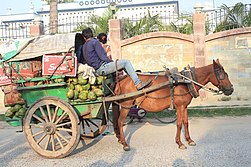
Horse pulling a cart

A mounted police officer in Poland
There are certain jobs that horses do very well, and no technology has yet developed to fully replace them. For example, mounted police horses are still effective for certain types of patrol duties and crowd control.[197] Cattle ranches still require riders on horseback to round up cattle that are scattered across remote, rugged terrain.[198] Search and rescue organizations in some countries depend upon mounted teams to locate people, particularly hikers and children, and to provide disaster relief assistance.[199]
Horses can also be used in areas where it is necessary to avoid vehicular disruption to delicate soil, such as nature reserves. They may also be the only form of transport allowed in wilderness areas. Horses are quieter than motorized vehicles. Law enforcement officers such as park rangers or game wardens may use horses for patrols, and horses or mules may also be used for clearing trails or other work in areas of rough terrain where vehicles are less effective.[200]
Although machinery has replaced horses in many parts of the world, an estimated 100 million horses, donkeys and mules are still used for agriculture and transportation in less developed areas. This number includes around 27 million working animals in Africa alone.[201] Some land management practices such as cultivating and logging can be efficiently performed with horses. In agriculture, less fossil fuel is used and increased environmental conservation occurs over time with the use of draft animals such as horses.[202][203] Logging with horses can result in reduced damage to soil structure and less damage to trees due to more selective logging.[204]
Warfare
Main article: Horses in warfare
[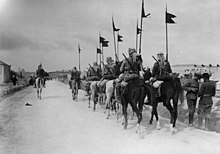 ](https://en.wikipedia.org/wiki/File:Bundesarchiv_Bild_146-1970-073-17,_T%C3%BCrkische_Kavallerie_s%C3%BCdlich_von_Jerusalem.jpg)Ottoman cavalry, 1917
Horses have been used in warfare for most of recorded history. The first archaeological evidence of horses used in warfare dates to between 4000 and 3000 BCE,[205] and the use of horses in warfare was widespread by the end of the Bronze Age.[206][207]
Although mechanization has largely replaced the horse as a weapon of war, horses are still seen today in limited military uses, mostly for ceremonial purposes, or for reconnaissance and transport activities in areas of rough terrain where motorized vehicles are ineffective. Horses have been used in the 21st century by the Janjaweed militias in the War in Darfur.[208]
Entertainment and culture
 The horse-headed deity in Hinduism, Hayagriva
See also: Horse symbolism, Horses in art, and Horse worship
Modern horses are often used to reenact many of their historical work purposes. Horses are used, complete with equipment that is authentic or a meticulously recreated replica, in various live action historical reenactments of specific periods of history, especially recreations of famous battles.[209]
Horses are also used to preserve cultural traditions and for ceremonial purposes. Countries such as the United Kingdom still use horse-drawn carriages to convey royalty and other VIPs to and from certain culturally significant events.[210] Public exhibitions are another example, such as the Budweiser Clydesdales, seen in parades and other public settings, a team of draft horses that pull a beer wagon similar to that used before the invention of the modern motorized truck.[211]
Horses are frequently used in television, films and literature. They are sometimes featured as a major character in films about particular animals, but also used as visual elements that assure the accuracy of historical stories.[212] Both live horses and iconic images of horses are used in advertising to promote a variety of products.[213]
The horse frequently appears in coats of arms in heraldry, in a variety of poses and equipment.[214] The mythologies of many cultures, including Greco-Roman, Hindu, Islamic, and Germanic, include references to both normal horses and those with wings or additional limbs, and multiple myths also call upon the horse to draw the chariots of the Moon and Sun.[215] The horse also appears in the 12-year cycle of animals in the Chinese zodiac related to the Chinese calendar.[216]
Horses serve as the inspiration for many modern automobile names and logos, including the Ford Pinto, Ford Bronco, Ford Mustang, Hyundai Equus, Hyundai Pony, Mitsubishi Starion, Subaru Brumby, Mitsubishi Colt/Dodge Colt, Pinzgauer, Steyr-Puch Haflinger, Pegaso, Porsche, Rolls-Royce Camargue, Ferrari, Carlsson, Kamaz, Corre La Licorne, Iran Khodro, Eicher, and Baojun.[217][218][219] Indian TVS Motor Company also uses a horse on their motorcycles & scooters.
Therapeutic use
See also: Equine-assisted therapy and Therapeutic horseback riding
...