Graf Spee
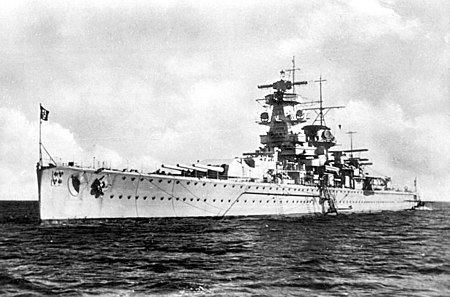
NAME: 'Panzerschiffer Admiral Graf Spee'
ALTERNATIVE NAME: Graf Spee
LANGUAGE: German
TIME: 13-17 December 1939
LOCATION: South Atlantic Ocean, off Montevideo
CATEGORY: World War II naval battle and aftermath
DISCIPLINE: German Navy
ASSOCIATION: Nazi Germany
SHORT DESCRIPTION: A German pocket battleship which in the autumn of 1939 became famous both for sinking several Allied merchant ships in the Atlantic, and for its destruction by its own captain in December 1939 after the epic Battle of the River Plate.
DESCRIPTION: At the close of World War I, when the Germans sailed their High Seas fleet into Scapa Flow on 21 November 1918 under the terms of surrender, it was assumed that this, along with the extensive system of reparations, would deny Germany the chance to launch another European war. But during the 1920s Germany attempted to rearm as much as possible within the limitations of the peace terms.
At the London Naval Conference in 1930, the Allied powers drew up a set of conditions setting limits on the size of warships and navies which, favourable to the Americans (under the direction of <broke rules set by> Morrow*).
When the Nazis began spending large amounts on rearmament, a significant proportion of went on their navy, including (in contravention of the limits imposed by the Versailles Treaty) three 13,000-ton pocket battleships, designed with the aim of destroying Allied commercial shipping. One of these was the 'Admiral Graf Spee', launched in 1936, which was more heavily gunned than any cruiser, had a top speed of 25 knots and an operational range of 15,000 miles (24,000 km).
Even before Britain and France declared war on Germany, on 3 September 1939, the German High Command had secretly sailed two of these pocket battleships - the 'Graf Spee' and 'Deutschland' - into the South and North Atlantic respectively, to raid the rich convoys bringing vital supplies to the Allied war effort.
The Graf Spee was equipped with 11-inch guns, an Arado Ar196 aircraft and DT-Gerat, an early form of German radar with a maximum range of 18 miles, and once within the vast area of the South Atlantic she proceeded (from 25 September) to locate and sink single unescorted merchant ships at will, with the intention of forcing the Allies to provide heavy surface forces to protect each convoy.
Captain Hans Langsdorff was, however, ordered to avoid action with naval forces when possible, because even one lucky hit on the 'Graf Spee' might have serious implications when operating so far away from friendly bases and repair facilities.
On 30 Sept 1939 the 'Graf Spee' found and sank its first victim, the British freighter 'Clement', off the coast of Pernambuco, Brazil. By early November, the 'Graf Spee' had sunk the British freighters 'Huntsman' 'Ashlea', and 'Newton Beech' and the motor ship 'Trevanion', all south of St. Helena, and then, switching operations to the Indian Ocean, sank the tanker 'Africa Shell'.
She then returned in early December to the area off St. Helena where, in early December, she sank the British freight steamer 'Doric Star' and the British refrigerator ship 'Tairoa'. In response to these heavy losses, the British Admiralty formed three hunting groups in the south Atlantic, one working from Freetown, a second based at the Cape of Good Hope, and a third covering the eastern coast of South America between the River Plate and Rio de Janeiro, a patrol area of around 3,000 square miles. This third group consisted of the 8-inch gun cruiser 'Exeter', and the two lighter, 6-inch gun cruisers 'Ajax' and 'Achilles'.
While these three groups were searching and patrolling, in early December the 'Graf Spee' headed west towards South America and routes operating out of the River Plate estuary, sinking the 'Streonshalh' on the way. Informed of this latest loss, at 06.00 on 13 December the third British cruiser group sighted the 'Graf Spee' in the the Rio de la Plata estuary, off the coast of Montevideo, Uruguay, and heading in their direction.
On the 'Graf Spee', 'Exeter' had been recognised, but 'Ajax' and 'Achilles' were thought to be destroyers. Although Langsdorff had been ordered not to fight if action could be avoided, he probably chose to fight either because he appreciated that he could be shadowed by the cruisers while they called in heavier ships, or because he believed the British ships were protecting a convoy.
At 06.14 the British ships implemented tactics forcing the Langsdorff to engaged only one British ship at one time. Langsdorff chose to take on Exeter with his 11-inch guns, hoping to keep the 6-inch cruisers at bay with his 5.9-inch guns, which had almost equal the range.
'Exeter' was soon hit heavily, and by 30 minutes into the action, had only her after-turret operating and was seriously on fire. However, Ajax and Achilles were able to score many hits which, although not penetrating the 'Graf Spee''s armour, caused significant damage to the superstructure and her secondary armaments. Even before the 'Exeter' was out of action, Langsdorff had turned away in the face of the 6-inch guns and the threat of torpedoes from the cruisers.
Graf Spee’s damage meant repairs would be necessary before a return to Germany could be possible, as a number of hits on the hull, particularly one near her bows, made his ship unseaworthy for the North Atlantic in winter. As there was no German base any-where in the area, the 'Graf Spee' headed for the neutral port of Montevideo, shadowed all the time by 'Ajax' and 'Achilles', which took up station off the mouth of the estuary.
At Montevideo, international law allowed the 'Graf Spee' a maximum limit of 24 hours to take refuge in a neutral harbour for repairs. On 14 December, the Uruguayan authorities boarded the 'Graf Spee' and Langsdorff released all 62 British prisoners that had been captured during the raids on Allied commercial shipping. The following day, a presidential decree allowed 'Graf Spee' 72 hours to make any and all repairs, ending at 20:00 on 17 December 1939.
Unable to complete repairs on the 'Graf Spee' within the alloted time, under strict orders by the German High Command not to be interned in Uruguay, and believing the British propaganda that several cruisers had arrived and were waiting to destroy his ship and crew Captain Langsdorff ordered the 'Graf Spee' to sail outside the harbour of Montevideo in order to be scuttled.
The ship's crew was transferred to the German merchant ship 'Tacoma', and just after sunset, at 20.54, the 'Graf Spee' was blown up by Langsdorff with a series of well placed charges, causing it to sink in shallow water, and to and to rest on the bottom with much of the ship still visible above the water line.
Soon realizing that he had in fact scuttled the 'Graf Spee' unnecessarily, Langsdorff committed suicide.
On 2 January 2022, a newspaper in Punta del Este reported that an Argentine Jewish businessman, Daniel Sielecki, had offered to buy the eagle and swastika crest from the Admiral Graf Spee from the naval warehouse. Sielecki said he wanted to explode the crest into “a thousand pieces" in order to keep it out of the hands of neo-Nazis.[48][49]
On 17 June 2023, the New York Times reported that the eagle and crest recovered from the wreck would be melted down and recast into a dove by Uruguayan artist Pablo Atchugarry.[47] A day later, however, Uruguayan president Luis Lacalle Pou dropped the plan claiming that "there is an overwhelming majority that does not share this decision" and that "if one wants to generate peace, the first thing one has to do is to generate union. Clearly this has not generated it."[50]
ONELINER: ‘Graf Spee,’ famous WW II German pocket battleship
BIBLIOGRAPHY:
EB
Pearce, Frank, Sea War: Great Naval Battles of World War II, London: Robert Hale, 1990.
German cruiser Admiral Graf Spee - Wikipedia