Time Ball
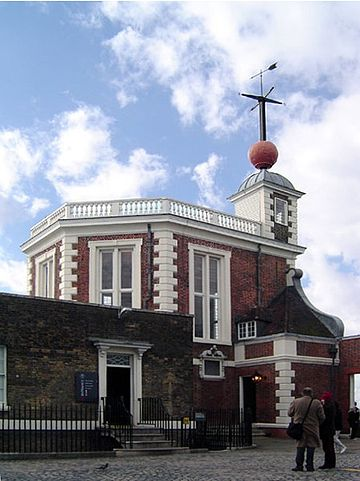
Royal Observatory, Greenwich, London. Installed in 1833, a time ball sits atop the Octagon Room
A time ball or timeball is a time-signalling device. It consists of a large, painted wooden or metal ball that is dropped at a predetermined time, principally to enable navigators aboard ships offshore to verify the setting of their marine chronometers. Accurate timekeeping is essential to the determination of longitude at sea.
Although time balls have since been replaced by electronic time signals, some time balls have remained operational as historical tourist attractions.
History
The fall of a little ball was in antiquity a way to show to people the time. Ancient Greek clocks had this system in the main square of a city, as in the city of Gaza in the post-Alexander era, and as described by Procopius in his book on Edifices. Time ball stations set their clocks according to transit observations of the positions of the sun and stars. Originally they either had to be stationed at the observatory, or had to keep a very accurate clock at the station which was set manually to observatory time. Following the introduction of the electric telegraph around 1850, time balls could be located at a distance from their source of mean time and operated remotely.

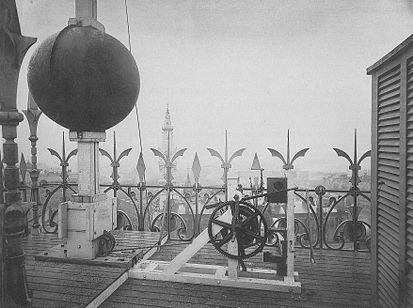
The Boston Time Ball (1881)
The first time ball was erected at Portsmouth, England, in 1829 by its inventor Robert Wauchope, a captain in the Royal Navy.[1] Others followed in the major ports of the United Kingdom (including Liverpool) and around the maritime world.[1] One was installed in 1833 at the Greenwich Observatory in London by the Astronomer Royal, John Pond, originally to enable tall ships in the Thames to set their marine chronometers,[2] and the time ball has dropped at 1 p.m. every day since then.[3] Wauchope submitted his scheme to American and French ambassadors when they visited England.[1] The United States Naval Observatory was established in Washington, D.C., and the first American time ball went into service in 1845.[1]
Time balls were usually dropped at 1 p.m. (although in the United States they were dropped at noon). They were raised half way about 5 minutes earlier to alert the ships, then with 2–3 minutes to go they were raised the whole way. The time was recorded when the ball began descending, not when it reached the bottom.[3] With the commencement of radio time signals (in Britain from 1924), time balls gradually became obsolete and many were demolished in the 1920s.[4]
A contemporary version of the concept has been used since 31 December 1907 at New York City's Times Square as part of its New Year's Eve celebrations; at 11:59 p.m., a lit ball is lowered down a pole on the roof of One Times Square over the course of the sixty seconds ending at midnight.[5][6]
Around the World
Over sixty time balls remain standing, though many are no longer operational. Existing time balls include:...
Extra Connections:
In 1845, the US Naval Observatory, then located at 23rd and E streets, Northwest, installed the first American time ball using a Gumelastic composition” supplied by Charles Goodyear, the inventor of vulcanized rubber. The ball dropped every day at 12 PM Eastern Standard Time. “Time may be made known every day to the inhabitants of the city of Washington,” Navy Secretary John Y. Mason said at the time.
Mason’s praise for the new device bore out.Former President John Quincy Adams reportedly made it a habit to walk over to the Observatory to see the time ball fall.New Yorker reported in 2013,we know the exact time President Abraham Lincoln was shot thanks to a meticulous stage carpenter who set the clock in the Ford’s Theatre vestibule according to the Observatory.