Pike Z
Name: Zebulon Montgomery Pike
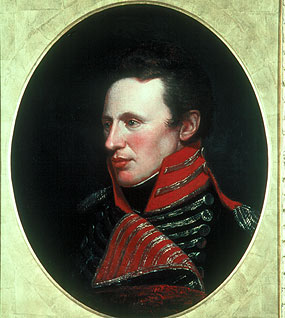
Achievements: Led an expedition to find the source of the Mississippi River. Led an expedition to find the sources of the Arkansas and Red rivers. Journeyed into the Rocky Mountains, where the mountain “Pike’s Peak” was later named after him.
Born: January 5, 1779; Lamberton (now Trenton), NJ.
Died: April 27, 1813; the American flagship “Madison” off the coast of York (now Toronto), Canada (Aged 34)
Field & Discipline: Exploration; Explorer
Language: English
Father: Major Zebulon Pike
Mother: Isabella Brown
Siblings: James; Maria Herriot; George Washington; four others died in infancy
Spouse: Clarissa Brown
Children: Clarissa
Education: No formal education
Life & Times:
An independent and adventurous man, Zebulon’s father abandoned his apprenticeship as a saddler and went to work on ships. He then returned to serve in the American Revolution. When his son was fourteen years old, Pike obtained a commission as captain and moved his family to Cincinnati, a Scotch-Irish frontier village.
Zebulon met General [a pal of] James Wilkinson*, a man with a penchant for scandal. The two became great friends, and Wilkinson would direct Zebulon’s military career.
In 1794, Zebulon enlisted in the army. Stationed first at Fort Washington near Cincinnati and then on the Ohio River at Fort Massoc, he oversaw the distribution of supplies to various military garrisons. Revealing an opportunistic eye and some entrepreneurial abilities, Pike supplemented his military income as an agent between private contractors and the American government. His role as agent and distributor afforded him ample opportunities to interact with people on the Ohio and Mississippi Rivers.
He often ate dinner with the family of Captain James Brown, his maternal uncle. He fell in love with the captain’s daughter (his cousin), Clarissa Brown, but was denied her hand in marriage. The two eloped and married in Cincinnati, much to the chagrin of Clarissa’s father, who steadfastly opposed the union.
In 1803, Pike was transferred west to Kaskaskia in the Illinois country. His work was routine and mundane, but on June 24, 1805 Wilkinson ordered him to St. Louis to prepare an expedition to explore the Mississippi River. Pike was instructed to collect geographical information and to learn about the natives, as well as attempting to offset any Spanish, French, or English influences among them.
It is generally agreed that this expedition (and Pike’s later expedition to explore the Arkansas and Red rivers) was developed by Wilkinson to meet his own personal ambitions. Pike’s supporters maintain that he was a dedicated and highly ethical man who wouldn’t question superior orders. His detractors believe he was aware of Wilkinson’s agenda, but feigned ignorance.
With twenty companions Pike set out on August 09, 1805. He returned to St. Louis on April 30, 1806. Pike did not achieve the objectives set by Wilkinson (the main one being to discover the source of the Mississippi River). Pike thought it was Leech Lake when it was actually Lake Itasca. However, he kept journals of the expedition, which, when published in 1810, awakened public interest in the Upper Mississippi.
He acquired valuable land for the government in a treaty he signed with the Sioux for 100,000 acres on either side of the Mississippi (much of present-day St. Paul and Minneapolis). Pike’s detailed reports made it possible to end illicit British trade in the region, and the U.S. was able to define the northern boundary of the newly-purchased Louisiana Territory.
In 1806, Wilkinson sent Pike on another expedition to find the source of the Arkansas and Red rivers. Wilkinson knew that this expedition would lead Pike into the lands of the Spanish. Most believe that Wilkinson arranged this expedition with the ulterior motive of opening up the way to Santa Fe, the Spanish capital of the New Mexico province.
In January of 1807, Aaron Burr, the ex-vice president of Thomas Jefferson, would be convicted on charges of treason. Wilkinson and Burr had spent a lot of time devising a plot to split off America’s western territory and ally it with Spain. While Pike was suspected too, the American government exonerated him. The Spanish government assumed he was a spy.
On January 05, 1807, Pike found the source of the Arkansas River (he had mistakenly thought it was the source of the Red River). On the 30th he reached the bank of the Rio Grande, which he again mistook as the Red but did not realize he was in Spanish territory. His men were building a stockade when Spanish dragoons arrived.
Pike was taken to Santa Fe and then south to Chihuahua where Governor Salcedo questioned him. During Pike’s “captivity”, he was treated with honor at the homes of great men and shared quarters with a former American officer who now worked for the Spanish. Salcedo was still convinced that Pike was a spy, but, unwilling to upset the American government, sent Pike back home.
When Pike returned on July 1, 1807, he found Burr on trial for treason, with Wilkinson the main witness.
Zebulon Pike is best remembered by Pike’s Peak, the mountain he spotted in November 1806 and later named after him. Abandoning all baggage and provisions, Pike and a contingent of his men set out to reach the peak. Pike thought he could climb the peak in an afternoon. Three days later, after a treacherous climb up Cheyenne mountain and a freezing night’s refuge in a cave, the men turned back.
Pike was promoted to captain while on the Arkansas expedition. Before the War of 1812 broke out with England, he was promoted to major and then to lieutenant colonel. On July 6, 1812, two weeks after the United States declared war on England, he was promoted to colonel, then brigadier general, and in March of 1813 Pike led his troops to York (now Toronto) in Canada for an attack. Pike was wounded on land when an abandoned British ammunition storehouse exploded.
He was taken offshore to the American flagship Madison, where he learned that his men had successfully taken over York, and then died.
Assessment: He is most remembered today for his discovery of Pike’s Peak on his Arkansas expedition.
Oneliner: Zebulon Pike, explorer and discoverer of Pike’s Peak
Bibliography:
- American National Biography”, pages 514-515, Oxford University Press, New York, 1999.
- Hollon, Eugene W., The Lost Pathfinder: Zebulon Montgomery Pike, University of Oklahoma Press, Norman, 1949.
- Sinnott, Susan, The World’s Great Explorer’s: Zebulon Pike, Children’s Press, Chicago, 1990.
Sandbox