Champollion
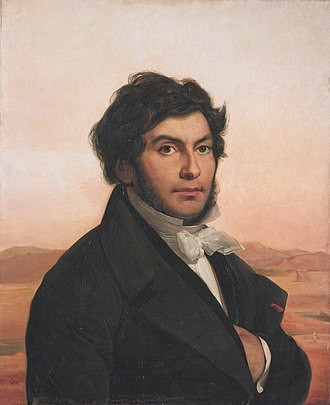
NAME: Champollion, Jean-Francois.
ACHIEVEMENT(S):
Made an important contribution to the deciphering of Egyptian hieroglyphics.
NICKNAME/ALIAS: None.
DATE/PLACE OF BIRTH: 23rd December 1790, in Figeac, France.
DATE/PLACE/AGE AT DEATH: 4th March 1832, in Paris, France. Aged 41.
DISCIPLINE: Historian and linguist.
FIELD: Egyptology.
LANGUAGE: French.
PARENTS: Jacques Champollion and Jeanne-Francoise Gualieu.
SIBLINGS: Three elder siblings: Jacques-Joseph Champollion-Figeac (1778--1867, French librarian and palaeographer), a sister and a brother.
SPOUSE: Rosine Blanc, married 1818.
CHILDREN: Five children.
EDUCATION:
Grenoble Lyceum, 1801-07; University of Paris, 1807-09.
MAJOR WORK:
'Precis du Systeme Hieroglyphique des Anciens Egyptiens'
('Primer of the Hieroglyphic System of the Ancient Egyptians'), 1824.
LIFE AND TIMES:
The son of a bookseller, Champollion was a very bright, talented child, who developed an early interest in Oriental languages, encouraged by his elder brother, Jacques-Joseph, who in 1798 was appointed professor of Greek at the University of Grenoble.
The same year, people who had travelled with Napoleon's Egyptian Expedition established the new science of Egyptology as well as a newspaper, 'Le Courier de l'Egypte'. A copy of the Courier turned up in Champollion's father's book shop in 1799 and was read by the young Jean-Francois.
The newspaper contained an article that fired the imagination of the nine year old. The article described the discovery, by the French artillery officer Bouchard, of the Rosetta stone, a slab of polished black basalt carrying a single text inscribed in three different languages, hieroglyphic, demotic and Greek. From this point, Champollion developed an interest in translating these mysterious symbols.
In 1801, Champollion won a government scholarship to the Lyceum at Grenoble, where he lived with his brother and sister-in-law. At the Lyceum, he proved himself particularly talented in languages, and learned Greek and Latin, Hebrew, Arabic, Syrian and Coptic.
While at Grenoble, he was introduced by his brother to the mathematician Fourier*, the Prefect of Grenoble, who had gone to Egypt with Napoleon in 1798 as a scholar and scientist, and who was deeply impressed by the abilities of the younger Champollion.
Through the influence of Fourier, who obtained texts for him otherwise unavailable in Grenoble, Champollion went on to study old Chinese, ancient Persian, East Indian religious writings and other rare texts.
He avidly read the first part of Conte*'s account of the Napoleonic expedition, 'La Description de l'Egypte' (1806-16), a work central to the foundation of Egyptology in France.
In September 1807, Champollion delivered a paper to the Academy of Grenoble in which he incorrectly asserted that Coptic was the ancient language of Egypt. He was immediately offered a professorship at the Lyceum.
In 1808 a new plaster copy of the inscription on the Rosetta stone arrived in Paris from London, and Champollion was given the chance to try to decipher it. To his great disappointment it proved to be far harder than he had hoped.
He went back to Grenoble in 1809, where he became a professor of history at Grenoble Lyceum (1809-16), and began work on a Coptic dictionary. In 1814, he published his first book, 'L'Egypte sous les Pharaohs', ('Egypt under the Pharaohs'), which launched him as the most brilliant Egyptologist in France.
In 1814, Napoleon escaped from Elba and Champollion’s brother, a devoted Bonapartist, became his secretary. As a result, Champollion met Napoleon*, who was very impressed with his book, and promised, at his reinstatement in Paris, to publish Champollion's Coptic dictionary.
The following year he began to decipher the hieroglyphics inscribed on the base of a red granite obelisk, or 'Cleopatra’s Needle'. The obelisk, with a single text in two languages, hieroglyphic and Greek, had been discovered in 1815 by J.W. Bankes, on the island of Philae.
At about the same time, the English physicist Thomas Young* began to publish his own papers on Egyptology, many concerning the translation of tablets written in hieroglyphics, which met with some success.
In 1822, Champollion was at last ready to present his findings to the academic world, and published his famous paper 'Lettre a M. Dacier' (the secretary to the Academy of Inscriptions in Paris).
The subject was the hieroglyphic and hieratic elements of the Rosetta Stone and the Philae obelisk, from which he established an entire list of hieroglyphic signs and their Greek equivalents.
The text on the Rosetta Stone recorded some benefits granted by Ptolemy V, who reigned from 205-182 BC, to the priesthood, the Greek name "Ptolemaios" being easy to recognize in hieroglyphics, because it was enclosed in the well-known royal cartouche, familiar to all those who had seen such monuments as the Egyptian obelisks.
The text on the Philae obelisk contained a petition to King Ptolemy, his wife Cleopatra, and his sister, also called Cleopatra. All these names were likewise enclosed in cartouches, and one of them, Ptolemy, was the same as that appearing on the Rosetta Stone.
In Greek, the names Ptolemy and Cleopatra have four letters in common, p, t, o and l, and in the hieroglyphic text these letters were found in the expected places, so the other signs were then easier to decipher. It was from Champollion's extensive knowledge of ancient languages, in particular his mastery of Coptic, a later Egyptian dialect, that he was finally able to establish and confirm the value of these other signs.
He found that Young had been correct 76 times out of 200, and thus became the first to recognize that some of the signs were alphabetic, some syllabic, and some determinative, standing for a whole idea or object previously expressed.
In 1824, Louis XVIII died, and his successor, Charles X, sent Champollion, now a French celebrity, on an scientific mission to Italy, where for the next two years he toured the museums at Turin, Leghorn, Rome and Naples, making copies of every Egyptian inscription available.
In Turin, within the Drovetti collection acquired by the Sardinian government, he made the sensational discovery of a book on Egyptian burial practices, 'The Book of the Dead', written in pure hieroglyphics. This treasure trove contained details of almost 200 Egyptian religious beliefs, including the doctrine of Osiris, funeral rituals, customs and beliefs concerning death and reincarnation.
In 1831 Champollion was appointed the first professor of Egyptology, a chair specially created for him at the College de France. Ill health overtook him, and he retired to Quercy, devoting the last months of his life to the completion and revision of his Egyptian grammar and dictionary.
ASSESSMENT: Jean-Francois Champollion is best known for his use of the Rosetta Stone to decipher Egyptian hieroglyphics (1822-24),and was the first to place the study of early Egyptian history and culture on a firm footing.
EXTRA CONNECTIONS:
Champollion's decipherment remained controversial even after his death. The brothers Alexander and Wilhelm von Humboldt famously championed his decipherment, as did Silvestre de Sacy, but others, such as Gustav Seyffarth, Julius Klaproth and Edmé-François Jomard sided with Young and refused to consider Champollion to be more than a talented imitator of Young even after the posthumous publication of his grammar.[115] In England, Sir George Lewis still maintained 40 years after the decipherment, that since the Egyptian language was extinct, it was a priori impossible to decipher the Hieroglyphs.
He also located the tomb of Ramesses the Great, but it was badly looted.
In Cairo, a street carries his name, leading to the Tahrir Square where the Egyptian Museum is located.[125]
Also named after him is the Champollion crater, a lunar crater on the far side of the Moon
ONELINER: J-F Champollion, who deciphered hieroglyphics
BIBLIOGRAPHY:
Honour, Alan Edward, The Man Who Could Read Stones: Champollion and the Rosetta Stone, Kingswood, Glos., World's Work, 1968.