Henry II
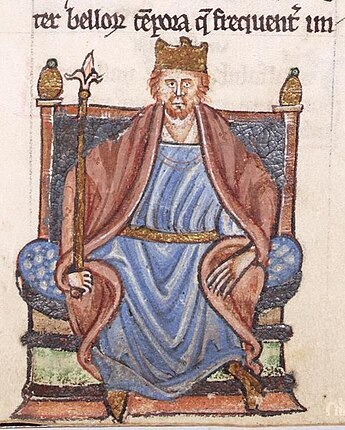
Henry II (5 March 1133 – 6 July 1189) was King of England from 1154 until his death in 1189. During his reign he controlled England, substantial parts of Wales and Ireland, and much of France (including Normandy, Aquitaine and Anjou), an area that altogether was later called the Angevin Empire, and also held power over Scotland and the Duchy of Brittany.
Henry became politically and militarily involved by the age of fourteen in the efforts of his mother, Matilda (daughter of Henry I of England), to claim the English throne, at that time held by Matilda's cousin Stephen of Blois. Henry's father, Geoffrey, made him Duke of Normandy in 1150, and upon Geoffrey's death in 1151, Henry inherited Anjou, Maine and Touraine. His marriage to Eleanor of Aquitaine brought him control of the Duchy of Aquitaine.
Thus, he controlled most of France. Henry's military expedition to England in 1153 resulted in King Stephen agreeing, by the Treaty of Wallingford, to leave England to Henry, and he inherited the kingdom at Stephen's death a year later. Henry was an energetic and ruthless ruler, driven by a desire to restore the royal lands and prerogatives of his grandfather Henry I. During the early years of his reign Henry restored the royal administration in England, which had almost collapsed during Stephen's reign, and re-established hegemony over Wales.
Henry's desire to control the English Church led to conflict with his former friend Thomas Becket, the Archbishop of Canterbury. This controversy lasted for much of the 1160s and resulted in Becket's murder in 1170. Soon after his accession Henry came into conflict with Louis VII of France, his feudal overlord, and the two rulers fought, over several decades, what has been termed a "cold war". Henry expanded his empire at Louis's expense, taking Brittany and pushing east into central France and south into Toulouse; despite numerous peace conferences and treaties, no lasting agreement was reached.
Henry and Eleanor had eight children. Three of their sons would rule as king, though Henry the Young King was named his father's nominal co-ruler rather than sole monarch. As his sons grew up, Henry struggled to find ways to satisfy their desires for land and immediate power, and tensions rose over the future inheritance of the empire, encouraged by Louis VII and his son Philip II, who ascended to the French throne in 1180. In 1173 Henry's heir apparent, "Young Henry", rebelled against his father; he was joined by his brothers Richard and Geoffrey and by their mother.
Several European states allied themselves with the rebels, and the Great Revolt was only defeated by Henry's vigorous military action and talented local commanders, many of them "new men" appointed for their loyalty and administrative skills. Young Henry and Geoffrey led another revolt in 1183, during which Young Henry died of dysentery. Geoffrey died in 1186. The Norman invasion of Ireland provided lands for Henry's youngest son, John. By 1189, Philip swayed Richard to his side, leading to a final rebellion. Decisively defeated by Philip and Richard and suffering from a bleeding ulcer, Henry retreated to Chinon Castle in Anjou. He died soon afterwards and was succeeded by his son Richard I.
Henry's empire quickly collapsed during the reign of his son John (who succeeded Richard in 1199), but many of the changes Henry introduced during his lengthy rule had long-term consequences. Henry's legal changes are generally considered to have laid the basis for the English Common Law, while his intervention in Brittany, Wales, Ireland, and Scotland shaped the development of their societies, histories, and governmental systems. Historical interpretations of Henry's reign have changed considerably over time. Contemporary chroniclers such as Gerald of Wales and William of Newburgh, though sometimes unfavourable, generally lauded his achievements.
In the 18th century, scholars argued that Henry was a driving force in the creation of a genuinely English monarchy and, ultimately, a unified Britain. During the Victorian expansion of the British Empire, historians were keenly interested in the formation of Henry's own empire, but they also criticised certain aspects of his private life and treatment of Becket. Late 20th-century historians have combined British and French historical accounts of Henry, challenging earlier Anglocentric interpretations of his reign.
Early years (1133–1149)
Main article: The Anarchy
 The great seal of Empress Matilda.
Henry was born in Maine at Le Mans on 5 March 1133, the eldest child of the Empress Matilda and her second husband, Geoffrey Plantagenet, Count of Anjou.[2] The French county of Anjou was formed in the 10th century and its Angevin rulers attempted for several centuries to extend their influence and power across France through careful marriages and political alliances.[3][4] In theory, the county answered to the French king, but royal power over Anjou weakened during the 11th century and the county became largely autonomous.[5]
Henry's mother was the legitimate daughter of Henry I, King of England and Duke of Normandy. She was born into a powerful ruling class of Normans, who traditionally owned extensive estates in both England and Normandy, and her first husband had been Holy Roman Emperor Henry V.[6] Henry I had during his own lifetime obtained pledges of fealty from his nobility, including from his nephew Stephen of Blois, promising to support Matilda's claim to the throne.[7]
After her father's death in 1135, Matilda hoped to claim the English throne, but instead, Stephen was crowned king and recognised as the Duke of Normandy, resulting in civil war between their rival supporters.[8] Geoffrey took advantage of the confusion to attack the Duchy of Normandy but played no direct role in the English conflict, leaving this to Matilda and her powerful illegitimate half-brother Robert, Earl of Gloucester.[9] The war, termed the Anarchy by historians, dragged on and degenerated into stalemate.[10]
Henry most likely spent part of his childhood in his mother's household. In the late 1130s he accompanied Matilda to Normandy, which would only be fully taken by Geoffrey around 1144.[11][12] Henry's later childhood, probably from the age of seven, was spent in Anjou, where he was educated by Peter of Saintes, a noted grammarian.[13][12] In late 1142, Geoffrey sent his nine-year-old son to Bristol, the centre of Angevin opposition to Stephen in the south-west of England, accompanied by Robert of Gloucester.[14]
Although having children educated in relatives' households was common among noblemen of the period, sending Henry to England also had political benefits, as Geoffrey was coming under criticism by Matilda's supporters for refusing to join the war in England.[14] For about a year, Henry lived alongside Roger of Worcester, one of Robert's sons, and was instructed by a magister, Master Matthew; Robert's household was known for its education and learning.[14][15] The canons of St Augustine's in Bristol also helped in Henry's education, and he remembered them with affection in later years.[16] Henry returned to Anjou in either 1143 or 1144, resuming his education under William of Conches, another famous academic.[17]
Henry returned to England in 1147, at the age of fourteen.[18] Taking his immediate household and a few mercenaries, he left Normandy and landed in England, striking into Wiltshire.[18] Despite initially causing considerable panic, the expedition had little success, and Henry found himself unable to pay his forces and therefore unable to return to Normandy.[18] Neither his mother nor his uncle was prepared to support him, implying that they had not approved of the expedition in the first place.[19]
Henry instead turned to King Stephen, who paid the outstanding wages and thereby allowed Henry to retire gracefully. Stephen's reasons for doing so are unclear. One potential explanation is his general courtesy to a member of his extended family; another is that he was starting to consider how to end the war peacefully, and saw this as a way of building a relationship with Henry.[20][21] Henry intervened once again in 1149, commencing what is often termed the Henrician phase of the civil war.[22]
This time, Henry planned to form a northern alliance with King David I of Scotland, his great-uncle, and Ranulf of Chester, a powerful regional leader who controlled most of the north-west of England.[23] Under this alliance, Henry and Ranulf agreed to attack York, probably with the help of Scots.[24] The planned attack disintegrated after Stephen marched north to York, and Henry returned to Normandy.[25][24][nb 2]
Appearance and personality
Henry was said by chroniclers to be good-looking, red-haired, freckled, with a large head; he had a short, stocky body and was bow-legged from riding.[26][27][28] Often he was scruffily dressed.[26] Henry was neither as reserved as his mother nor as charming as his father, but he was famous for his energy and drive.[29] He was ruthless but not vindictive.[30] He was also infamous for his piercing stare, bullying, bursts of temper, and, on occasion, his sullen refusal to speak at all.[31][32][33] Some of these outbursts may have been theatrical and for effect.[34][nb 3] Henry was said to have understood a wide range of languages, including English, but spoke only Latin and French.[35][36][nb 4]
In his youth Henry enjoyed active participation in warfare, hunting and other adventurous pursuits; as the years went by he put increasing energy into judicial and administrative affairs and became more cautious, but throughout his life he was energetic and frequently impulsive.[37] Despite his surges of anger, he was not normally fiery or overbearing; he was witty in conversation and eloquent in argument with an intellectual bent of mind and an astonishing memory, and much preferred the solitude of hunting or retiring to his chamber with a book than the entertainments of tournaments or troubadours.[38][39] He also had concern for ordinary people, ordaining early in his reign that those shipwrecked should be well-treated and prescribing heavy penalties for anyone who plundered their goods. The chronicler Ralph of Diceto records that when famine struck Anjou and Maine in 1176, Henry emptied his private stores to relieve distress among the poor.[40]
Henry had a passionate desire to rebuild his control of the territories that his grandfather Henry I had once governed.[41] He took back territories, regained estates and re-established influence over the smaller lords that had once provided what the historian John Gillingham describes as a "protective ring" around his core territories.[42] He was probably the first king of England to use a heraldic design: a signet ring with either a leopard or a lion engraved on it. The design would be altered in later generations to form the royal arms of England.[43]
Early reign (1150–1162)
Acquisition of Normandy, Anjou, and Aquitaine
 Northern France around the time of Henry's birth; red circles mark major urban centres.
By the late 1140s, the active phase of the civil war was over, barring the occasional outbreak of fighting.[21] Many of the barons were making individual peace agreements with each other to secure their war gains and it increasingly appeared as though the English church was considering promoting a peace treaty.[44][45]
On Louis VII's return from the Second Crusade in 1149, he became concerned about the growth of Geoffrey's power and the potential threat to his own possessions, especially if Henry could acquire the English crown.[46][47] In 1150, Geoffrey made Henry the Duke of Normandy and Louis responded by putting forward King Stephen's son Eustace as the rightful heir to the duchy and launching a military campaign to remove Henry from the province.[48][47][nb 5] Geoffrey advised Henry to come to terms with Louis and peace was made between them in August 1151 after mediation by Bernard of Clairvaux.[47] Under the settlement Henry did homage to Louis for Normandy, accepting Louis as his feudal lord, and gave him the disputed lands of the Norman Vexin; in return, Louis recognised him as duke.[47][39]
 The capture of Montsoreau Castle, next to the River Loire, in 1152 marked the end of the revolt organised by Geoffrey against his brother.
Geoffrey died in September 1151, and Henry postponed his plans to return to England, as he first needed to ensure that his succession, particularly in Anjou, was secure.[47] At around this time, he was also probably secretly planning his marriage to Eleanor, then still the wife of Louis.[47] Eleanor was the Duchess of Aquitaine, a land in the south of France, and was considered beautiful, lively and controversial, but had not borne Louis any sons.[51]
Louis had the marriage annulled on the grounds of consanguinity, and the nineteen year old Henry married Eleanor, who was eleven years his senior, eight weeks later on 18 May.[47][52][nb 6] The marriage instantly revived Henry's tensions with Louis: it was considered an insult and ran counter to feudal practice because Eleanor, a holder of a French fiefdom, married without Louis's consent, and the marriage between Henry and Eleanor was just as consanguineous as that of her and Louis. Henry's acquisition of Aquitaine also threatened the inheritance of Louis and Eleanor's two daughters, Marie and Alix, who might otherwise have had claims to Aquitaine on Eleanor's death. With his new lands, Henry now possessed a much larger proportion of France than Louis.[51][54]
Louis organised a coalition against Henry, including King Stephen; his son Eustace; Henry I, Count of Champagne; and Robert, Count of Perche.[55][39] Louis's alliance was joined by Henry's younger brother Geoffrey, who rose in revolt, claiming that Henry had dispossessed him of his inheritance.[56] Their father's plans for the inheritance of his lands had been ambiguous, making the veracity of Geoffrey's claims hard to assess.[57] Contemporaneous accounts suggest he left the main castles in Poitou to Geoffrey, implying that he may have intended Henry to retain Normandy and Anjou but not Poitou.[58][nb 7]
Fighting immediately broke out again along the Normandy borders, where Henry of Champagne and Robert captured the town of Neufmarché-sur-Epte.[56][55] Louis's forces moved to attack Aquitaine.[55] Stephen responded by placing Wallingford Castle, a key fortress loyal to Henry along the Thames Valley, under siege, possibly in an attempt to force a successful end to the English conflict while Henry was still fighting for his territories in France.[60][55] Henry moved quickly in response, avoiding open battle with Louis in Aquitaine and stabilising the Norman border, pillaging the Vexin and then striking south into Anjou against Geoffrey, capturing one of his main castles, Montsoreau.[61][55] Louis fell ill and withdrew from the campaign, and Geoffrey was forced to come to terms with Henry.[55]
Taking the English throne
 A political map of England, Wales and Scotland in 1153;
Under Henry's control
Stephen
Independent Welsh rulers
Ranulf of Chester and Robert of Leicester
David I of Scotland
In response to Stephen's siege, Henry returned to England again at the start of 1153.[62][63] Bringing only a small army of mercenaries, probably financed with borrowed money, Henry was supported in the north and east of England by the forces of Ranulf of Chester and Hugh Bigod, two local aristocrats, and had hopes of a military victory.[64][65][62] A delegation of senior English clergy met with Henry and his advisers at Stockbridge, Hampshire, shortly before Easter in April.[66] Details of their discussions are unclear, but it appears that the churchmen emphasised that while they supported Stephen as king, they sought a negotiated peace; Henry reaffirmed that he would avoid the English cathedrals and would not expect the bishops to attend his court.[67]
To draw Stephen's forces away from Wallingford, Henry besieged Stephen's castle at Malmesbury, and the King responded by marching west with an army to relieve it.[68][69] Henry successfully evaded Stephen's larger army along the River Avon, preventing Stephen from forcing a decisive battle.[68] In the face of the increasingly wintry weather, the two men agreed to a temporary truce, leaving Henry to travel north through the Midlands, where the powerful Robert de Beaumont, Earl of Leicester, announced his support for the cause.[68]
Henry was then free to turn his forces south against the besiegers at Wallingford.[69] Despite only modest military successes, he and his allies now controlled the south-west, the Midlands and much of the north of England.[70] Meanwhile, Henry was attempting to act the part of a legitimate king, witnessing marriages and settlements and holding court in a regal fashion.[71]
Stephen amassed troops over the following summer to renew the siege of Wallingford Castle in a final attempt to take the stronghold.[72][69] The fall of Wallingford seemed imminent and Henry marched south to relieve the siege, arriving with a small army and placing Stephen's besieging forces under siege themselves.[73] Upon news of this, Stephen returned with a large army, and the two sides confronted each other across the River Thames at Wallingford in July.[72] By this point in the war, the barons on both sides were eager to avoid an open battle,[72][74][75] so members of the clergy brokered a truce, to the annoyance of both Henry and Stephen.[72][74][75]
Henry and Stephen took the opportunity to speak together privately about a potential end to the war; conveniently for Henry, Stephen's son Eustace fell ill and died shortly afterwards.[76][75] This removed the most obvious other claimant to the throne, as while Stephen had another son, William, he was only a second son and appeared unenthusiastic about making a plausible claim on the throne.[77][78] Fighting continued after Wallingford, but in a rather half-hearted fashion, while the English Church attempted to broker a permanent peace between the two sides.[79][80]
In November the two leaders ratified the terms of a permanent peace.[81] Stephen announced the Treaty of Winchester in Winchester Cathedral: he recognised Henry as his adopted son and successor, in return for Henry paying homage to him; Stephen promised to listen to Henry's advice, but retained all his royal powers; Stephen's son William would pay homage to Henry and renounce his claim to the throne, in exchange for promises of the security of his lands; key royal castles would be held on Henry's behalf by guarantors whilst Stephen would have access to Henry's castles, and the numerous foreign mercenaries would be demobilised and sent home.[82][83][84]
Henry and Stephen sealed the treaty with a kiss of peace in the cathedral.[85] In early 1154 Stephen became more active. He attempted to exert his authority and started demolishing unauthorised castles. The peace remained precarious, and Stephen's son William remained a possible future rival to Henry.[86] Rumours of a plot to kill Henry were circulating and, possibly as a consequence, Henry returned to Normandy for a period.[86][nb 8] Stephen fell ill with a stomach disorder and died on 25 October 1154, allowing Henry to inherit the throne rather sooner than had been expected.[88]
Reconstruction of royal government
 12th-century depiction of Henry and Eleanor of Aquitaine holding court.
On landing in England on 8 December 1154, Henry quickly took oaths of loyalty from some of the barons and was then crowned alongside Eleanor at Westminster Abbey on 19 December.[89] At the coronation Henry wore one of the imperial crowns his mother brought back from Germany; they had once belonged to Emperor Henry V.[90] The royal court was gathered in April 1155, where the barons swore fealty to the King and his sons.[89] Several potential rivals still existed, including Stephen's son William and Henry's brothers Geoffrey and William, but they all died in the next few years, leaving Henry's position secure.[91]
Nonetheless, Henry inherited a difficult situation in England, as the kingdom had suffered extensively during the civil war.[nb 9] In many parts of the country the fighting had caused serious devastation, although some other areas remained largely unaffected.[93] Numerous "adulterine", or unauthorised, castles had been built as bases for local lords.[94][95] The authority of the royal forest law had collapsed in large parts of the country.[96] The King's income had declined seriously and royal control over the coin mints remained limited.[97]
Henry presented himself as the legitimate heir to Henry I and began rebuilding the kingdom in his image.[98] Although Stephen had tried to continue Henry I's method of government during his reign, the younger Henry's new government characterised those nineteen years as a chaotic and troubled period, with all these problems resulting from Stephen's usurpation of the throne.[99]
Henry was also careful to show that, unlike his mother the Empress, he would listen to the advice and counsel of others.[100] Various measures were immediately carried out although, since Henry spent six and a half years out of the first eight years of his reign in France, much work had to be done at a distance.[101] The process of demolishing the unauthorised castles from the war continued.[102][nb 10] Efforts were made to restore the system of royal justice and the royal finances. Henry also invested heavily in the construction and renovation of prestigious new royal buildings.[103][104]
The King of Scotland and local Welsh rulers had taken advantage of the long civil war in England to seize disputed lands; Henry set about reversing these losses.[105] In 1157 pressure from Henry resulted in the young King Malcolm of Scotland returning the lands in the north of England he had taken during the war; Henry promptly began to refortify the northern frontier.[103][106] Restoring Anglo-Norman supremacy in Wales proved harder, and Henry had to fight two campaigns in north and south Wales in 1157 and 1158 before the Welsh princes Owain Gwynedd and Rhys ap Gruffydd submitted to his rule, agreeing to the pre-civil war borders.[103][107][108]