Colt, Samuel
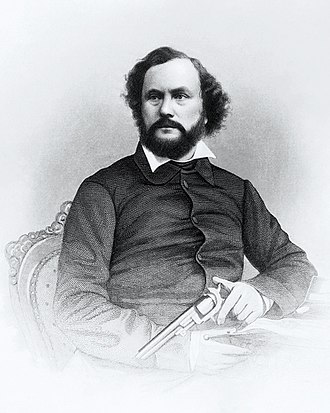
Samuel Colt
Nickname/Alias: The Colonel
Achievements: Colt revolver
Born: July 19, 1814; in [Hartford, Connecticut
Died: January 10, 1862; Hartford, Connecticut (Aged 47)
Field & Discipline: Business; Manufacturing
Education: Amherst Academy
Major Work: First practical revolver.
Life & Times:
On July 4, 1830, Colt first showed his interest in armaments when he set off a fireworks display near the local school to celebrate Independence Day. Unfortunately, one of the school buildings burned down and his father quickly decided to send him off to sea, so he set sail for Calcutta as a deckhand.
In his spare time during the year-long voyage, Colt is said to have carved a wooden model of a revolving multi-barrel pistol. The idea occurred to him of a much more efficient hand gun, using a static barrel and a revolving cylinder. He managed to make a crude device for automatically rotating and locking the cylinder in place after each shot.
When he got back to the US, Colt went to work at a bleaching plant in Ware, where he became very interested in chemical processes. After a year, travelled the Eastern seaboard under the name of Doctor Coult, giving public lectures in popular chemistry, the main attraction being his demonstration of laughing gas.
In 1831, Colt commissioned his first prototype revolver in Baltimore, and set up a small workshop three years later to make a pistol and a rifle, the first practical revolving firearms. He patented the Colt revolver in the US in 1836, but not before travelling to Europe to take out similar patents in Britain and France.
Within three months of filing the US patent, Colt set up The Patent Arms Manufacturing Company in Paterson, New Jersey and took his idea to the military. Both the army and the navy decided that the pistols were too complicated, so Colt closed the business and sold the patent.
The use of the revolvers during the fight for Texas independence, and in the Seminole War, brought good reports of the guns’ performance, but there was little need for revolvers outside Texas and Florida at the time.
Meanwhile Colt had been working on the development of an underwater firing battery for coastal defence, and successfully demonstrated a submarine mine to the navy in 1842. The government rejected the idea because Colt refused to hand over his designs. The explosives used in the mine were conventional, but the important thing was that Colt used an underwater electricity cable to ignite the gunpowder, a new development in submarine technology.
One important possibility for this new waterproof line was to carry the electric current needed for telegraphy. Colt approached [a pal of] Samuel Morse*, suggesting that Morse bury his cables underground, away from the weather and Colt, in anticipation of a growth in the cable market, began to produce large quantities of waterproof cable.
For $8,000, Colt bought the rights from Morse to set up a telegraph line linking Coney Island, New York, Brooklyn and Jersey. He then set up the New York and Offing Magnetic Telegraph Association in 1843 and supplied the wire, for which he was paid royalties.
For an annual fee of $10 subscribers to the service were informed of the approach of ships as soon as they were sighted from Coney Island, and, for a further fee the telegraph company would deliver messages to incoming ships.
In the Mexican War, Texas Rangers used Colt revolvers and proved to the army how efficient they were, so the army commissioned Captain Samuel Walker to buy more from Colt, but he found that they were no longer in production.
Walker and Colt then talked a larger weapon of heavier calibre, and the army gave Colt an order for a thousand of these bigger pistols (.45’s) in 1847, and he sub-contracted the work to [employed] Eli Whitney’s* armory.
More orders followed, so, in the same year, Colt set up his own factory in Whitneyville, CT. After a year, he moved the factory to Hartford, where he installed modern mechanical production methods like those used by Whitney, [used methods of] Simeon North* and others.
At the same time, he bought back his patent rights. In 1849, Colt went to Europe on business and came back with an order from the Turkish government for 5,000 revolvers. From this time on, he spent a lot of time in Europe promoting his guns and taking orders. To overcome British trading regulations and to supply the European market, Colt built a factory in London, where he introduced his modern manufacturing processes.
Within a year, Colt was the biggest firearms manufacturer in the world, and in 1852 he began the construction of a new factory with the most modern equipment. Hot-air ducting, gas lamps and engines were built into the framework of the buildings and there were washing facilities for the workers. When the new factory opened in 1856, Colt’s installation was so advanced for the period that he was able to cut production time to less than half of his competitors.
In 1858, Colt contracted inflammatory rheumatism which afflicted him until his death four years later.
Extra Connections:
Gave [gave guns to] Perry* arms for Japanese Emperor
His factory manufactured the portable steam engine designed by [manufactured steam engine by] William [Baxter(https://app.thebrain.com/brain/f3e16344-7cd9-4fa3-ae1d-59876e128474/fef3f07c-9b09-51d5-8683-919631f4913d)*
Hired nephew of Eli Whitney (both interested in interchangeable parts)
Assessment: Colt was one of the first to use standardized machine production, division of labour and the assembly line.
Oneliner: Sam Colt, inventor of the revolver
Language: English
Father: Christopher Colt
Mother: Sarah Caldwell
Siblings: Margaret; Sarah; John; Christopher; James
Spouse: Elizabeth H. Jarvis (married 1856)
Children: Samuel; Elizabeth; Henrietta; Caldwell Hart (Collie)
Bibliography:
- Jack Rohan, ‘Yankee Arms Maker: The Incredible Career of Samuel Colt’, Harper & Brothers Publishers, New York and London, 1935.
More info Wikipedia