Purkinje Cells
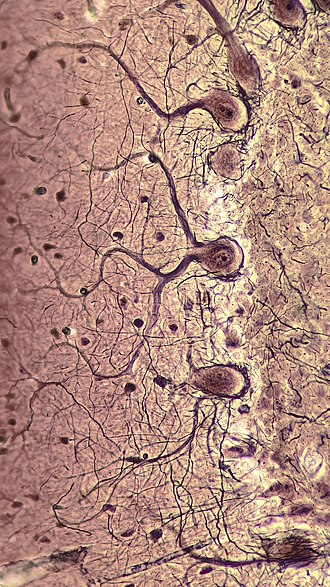
DETAILS/DESCRIPTION: Purkinje cells are found in the brain, specifically in the cerebral cortex, and are the best known discovery of Johannes Evangelista Purkinje* (1787-1869), a Czech physiologist.
Purkinje cells are the largest of the cell types in the cerebellum. They have their cell bodies packed together in a single layer while their axons (which send messages to other neurons) extend down through the granular layer into the white matter and their dendrites (which receive messages from other neurons) extend up through the molecular layer.
It is estimated that there are about 15 million Purkinje cells in the human cerebellum. Each Purkinje cell can receive input from many other neurons, with estimates of the number of neurons which can provide input to a given Purkinje cell ranging from 200,000 to 1,000,000.
One Purkinje cell function seems to be to organize or coordinate all of the background noise produced by the numerous neurons and neuronal fibers into some kind of coherent message. They are also thought to be involved in the timing and coordination of motor events and in memory storage.
ONELINER: Purkinje cells
OTHER CONNECTIONS: None
BIBLIOGRAPHY:
"Purkinje Cells and the Cerebellum." Buena Vista University, Storm Lake, Iowa, no date. http://web.bvu.edu/faculty/ferguson/BioPsych/Purkinje%20Summary.htm Access Feb 8/04.
Jan Evangelista Purkyne (Purkinje). Tiscali, c2004. http://home.tiscalinet.ch/biografien/biografien/purkinje.htm Accessed Februay 8, 2004.
NeuroPedia Index and Glossary - Copyright 1995 KnowledGeneticahttp://www.neuropedia.com/purkinje.html Accessed February 9, 2004.
"Cerebellar Model: Purkinje Cells." Detaq Science, Inc., c2003. http://www.detaq.com/biology1.html Accessed February 8, 2004.