Carter, Howard
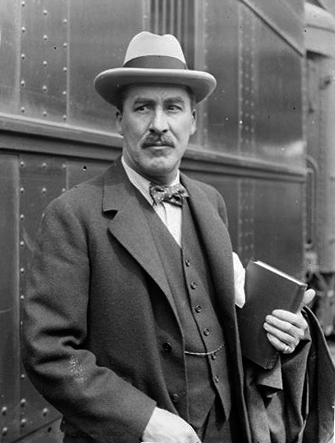
Howard Carter (9 May 1874 – 2 March 1939) was a British archaeologist and Egyptologist who became known for discovering the intact tomb of the 18th Dynasty Pharaoh Tutankhamun in November 1922, the best-preserved pharaonic tomb ever found in the Valley of the Kings.
Early life
Howard Carter was born in Kensington on 9 May 1874,[1] the youngest child (of eleven) of artist and illustrator Samuel John Carter and Martha Joyce Carter (née Sands). His father helped train and develop his artistic talents.[2]
Carter spent much of his childhood with relatives in the Norfolk market town of Swaffham, the birthplace of both his parents.[3][4] His father had previously relocated to London, but after three of the children had died young, Carter, who was a sickly child, was moved to Norfolk and raised for the most part by a nurse in Swaffham.[5]
Receiving only a limited formal education at Swaffham, he showed talent as an artist.
The nearby mansion of the Amherst family, Didlington Hall, contained a sizable collection of Egyptian antiques, which sparked Carter's interest in that subject. Lady Amherst was impressed by his artistic skills, and in 1891 she prompted the Egypt Exploration Fund (EEF) to send Carter to assist an Amherst family friend, Percy Newberry, in the excavation and recording of Middle Kingdom tombs at Beni Hasan.[6]
Although only 17, Carter was innovative in improving the methods of copying tomb decoration. In 1892, he worked under the tutelage of Flinders Petrie for one season at Amarna, the capital founded by the pharaoh Akhenaten. From 1894 to 1899, he worked with Édouard Naville at Deir el-Bahari, where he recorded the wall reliefs in the temple of Hatshepsut.[7]
In 1899, Carter was appointed Inspector of Monuments for Upper Egypt in the Egyptian Antiquities Service (EAS) on the personal recommendation of Gaston Maspero.[8] Based at Luxor, he oversaw several excavations and restorations at nearby Thebes, while in the Valley of the Kings he supervised the systematic exploration of the valley by the American archaeologist Theodore Davis.[7]
In early 1902, Carter began searching the Valley of the Kings on his own. He initially aimed at the southeast rocky wall of the valley basin, despite it being an inaccessible area. Within three days, he found what he was looking for: stone steps, a sepulchral entrance, a corridor, and a sarcophagus chamber. In short, he had found the last home of the fourth Thutmose, carefully stripped (except for a few furnishings and a cart). While digging to find Thutmose IV's final resting place, Carter unearthed an alabaster cup and a small blue scarab with Queen Hatshepsut's name on it.[9]
In February 1903, 60 metres (200 ft) north of the tomb of Thutmose IV, Carter found a stone bearing the ring with the name of Hatshepsut.[9]
In 1904, after a dispute with local people over tomb thefts, he was transferred to the Inspectorate of Lower Egypt.[10] Carter was praised for his improvements in the protection of, and accessibility to, existing excavation sites,[11] and his development of a grid-block system for searching for tombs. The Antiquities Service also provided funding for Carter to head his own excavation projects.
Carter resigned from the Antiquities Service in 1905 after a formal inquiry into what became known as the Saqqara Affair, a violent confrontation that took place on 8 January 1905 between Egyptian site guards and a group of French tourists. Carter sided with the Egyptian personnel, refusing to apologise when the French authorities made an official complaint.[12] Moving back to Luxor, Carter was without formal employment for nearly three years. He made a living by painting and selling watercolours to tourists and, in 1906, acting as a freelance draughtsman for Theodore Davis.[13]
Tutankhamun's tomb
Main article: Discovery of the tomb of Tutankhamun

Tomb of Tutankhamun
In 1907, Carter began work for Lord Carnarvon, who employed him to supervise the excavation of nobles' tombs in Deir el-Bahari, near Thebes.[14] Gaston Maspero, head of the Egyptian Antiquities Service, had recommended Carter to Carnarvon as he knew he would apply modern archaeological methods and systems of recording.[15] Carter soon developed a good working relationship with his patron, with Lady Burghclere, Carnarvon's sister, observing that "for the next sixteen years the two men worked together with varying fortune, yet ever united not more by their common aim than by their mutual regard and affection".[16]

KV62 in the Valley of the Kings.
In 1914, Lord Carnarvon received the concession to dig in the Valley of the Kings.[17] Carter led the work, undertaking a systematic search for any tombs missed by previous expeditions, in particular that of the Pharaoh Tutankhamun. However, excavations were soon interrupted by the First World War, Carter spending the war years working for the British Government as a diplomatic courier and translator. He enthusiastically resumed his excavation work towards the end of 1917.[17]
By 1922, Lord Carnarvon had become dissatisfied with the lack of results after several years of finding little. After considering withdrawing his funding, Carnarvon agreed, after a discussion with Carter, that he would fund one more season of work in the Valley of the Kings.[18]
Carter returned to the Valley of Kings and investigated a line of huts that he had abandoned a few seasons earlier. The crew cleared the huts and rock debris beneath. On 4 November 1922, a worker uncovered a step in the rock. According to Carter's published account, the workmen discovered the step while digging beneath the remains of the huts; other accounts attribute the discovery to a boy digging outside the assigned work area.[19][Note 1] Carter had the steps partially dug out until the top of a mud-plastered doorway was found. The doorway was stamped with indistinct cartouches (oval seals with hieroglyphic writing). Carter ordered the staircase to be refilled, and sent a telegram to Carnarvon, who arrived from England two and a half weeks later on 23 November, accompanied by his daughter Lady Evelyn Herbert.[23]

A painted, wooden figure of Tutankhamun found in his royal tomb.
On 24 November 1922, the full extent of the stairway was cleared, and a seal containing Tutankhamun's cartouche was found on the outer doorway. This door was removed and the rubble-filled corridor behind cleared, revealing the door of the tomb itself.[24] On 26 November, Carter, with Carnarvon, Lady Evelyn, and assistant Arthur Callender in attendance, made a "tiny breach in the top left-hand corner" of the doorway, using a chisel that his grandmother had given him for his 17th birthday. He was able to peer in by the light of a candle and see that many of the gold and ebony treasures were still in place. He did not yet know whether it was "a tomb or merely an old cache", but he did see a promising sealed doorway between two sentinel statues.
Carnarvon asked, "Can you see anything?" Carter replied: "Yes, wonderful things!"[25] (though in his own journal entry of the day Carter recorded what was said as "Yes, it is wonderful")[26] Carter had, in fact, discovered Tutankhamun's tomb (subsequently designated KV62).[27] The tomb was then secured, to be entered in the presence of an official of the Egyptian Department of Antiquities the next day.[28] However, that night, Carter, Carnarvon, Lady Evelyn, and Callender allegedly made an unauthorised visit, becoming the first people in modern times to enter the tomb.[29][30][31] Some sources suggest that the group also entered the inner burial chamber.[32] In this account, a small hole was found in the chamber's sealed doorway, and Carter, Carnarvon, and Lady Evelyn crawled through.[31]
The next morning, 27 November, saw an inspection of the tomb in the presence of an Egyptian official. Callender rigged up electric lighting, illuminating a vast hoard of items, including gilded couches, chests, thrones, and shrines. They also saw evidence of two further chambers, including the sealed doorway to the inner burial chamber, guarded by two life-size statues of Tutankhamun.[33] Despite evidence of break-ins in ancient times, the tomb was virtually intact, and would ultimately be found to contain over 5,000 items.
On 29 November, the tomb was officially opened in the presence of several invited dignitaries and Egyptian officials.[34]

Carter's house in the Theban Necropolis, in 2009.
Realising the size and scope of the task ahead, Carter sought help from Albert Lythgoe of the Metropolitan Museum's excavation team, working nearby, who readily agreed to lend a number of his staff, including Arthur Mace and archaeological photographer Harry Burton,[35] while the Egyptian government loaned analytical chemist Alfred Lucas.[36] The next several months were spent cataloguing and conserving the contents of the antechamber under the "often stressful" supervision of Pierre Lacau, director general of the Department of Antiquities.[37]
On 16 February 1923, Carter opened the sealed doorway and confirmed it led to a burial chamber, containing the sarcophagus of Tutankhamun. The tomb was considered the best preserved and most intact pharaonic tomb ever found in the Valley of the Kings, and the discovery was eagerly covered by the world's press. However, much to the annoyance of other newspapers, Lord Carnarvon sold exclusive reporting rights to The Times.
Only Arthur Merton of that paper was allowed on the scene, and his vivid descriptions helped to establish Carter's reputation with the British public.[38]
Towards the end of February 1923, a rift between Lord Carnarvon and Carter, probably caused by a disagreement on how to manage the supervising Egyptian authorities, temporarily halted the excavation. Work recommenced in early March after Lord Carnarvon apologised to Carter.[39] Later that month, Lord Carnarvon contracted blood poisoning while staying in Luxor near the tomb site. He died in Cairo on 5 April 1923.[40] Lady Carnarvon retained her late husband's concession in the Valley of the Kings, allowing Carter to continue his work.
Carter's meticulous assessing and cataloguing of the thousands of objects in the tomb took nearly ten years, most being moved to the Egyptian Museum in Cairo. There were several breaks in the work, including one lasting nearly a year in 1924–25, caused by a dispute over what Carter saw as excessive control of the excavation by the Egyptian Antiquities Service. The Egyptian authorities eventually agreed that Carter should complete the tomb's clearance.[41] This continued until 1929, with some final work lasting until February 1932.[42]
Despite the significance of his archaeological find, Carter received no honour from the British government. However, in 1926, he received the Order of the Nile, third class, from King Fuad I of Egypt.[43] He was also awarded an honorary degree of Doctor of Science by Yale University and honorary membership in the Real Academia de la Historia of Madrid, Spain.[44]
Carter wrote several books on Egyptology during his career, including Five Years' Exploration at Thebes, co-written with Lord Carnarvon in 1912, describing their early excavations,[45] and a three-volume popular account of the discovery and excavation of Tutankhamun's tomb.[46] He also delivered a series of illustrated lectures on the excavation, including a 1924 tour of Britain, France, Spain, and the United States.[47] Those in New York and other US cities were attended by large and enthusiastic audiences, sparking American Egyptomania,[48] with President Coolidge requesting a private lecture.[49]

Manuel Rosenberg autographed sketch of Howard Carter, 1924 for the Cincinnati Post
Personal life
Carter could be awkward in company, particularly with those of a higher social standing.[50] Often abrasive, he admitted to having a hot temper,[51] which often aggravated disputes, including the 1905 Saqqara Affair and the 1924–25 dispute with Egyptian authorities.
The suggestion that Carter had an affair with Lady Evelyn Herbert,[52] the daughter of the 5th Earl of Carnarvon, was later rejected by Lady Evelyn herself, who told her daughter Patricia that "at first I was in awe of him, later I was rather frightened of him", resenting Carter's "determination" to come between her and her father.[53] More recently, the 8th Earl dismissed the idea, describing Carter as a "stoical loner".[54]
Harold Plenderleith, a former associate of Carter's at the British Museum, was quoted as saying that he knew "something about Carter that was not fit to disclose", which some have interpreted as meaning that Plenderleith believed that Carter was homosexual.[55] An Egyptian guide who knew Carter claimed that his tastes extended to "both boys and the occasional 'dancing girl'".[56] There is, however, no evidence that Carter enjoyed any close relationships throughout his life,[57] and he never married nor had children.[48]

"King Tut as I know him" drawing by Howard Carter 1926 for Manuel Rosenberg
Later life

Carter's grave at Putney Vale Cemetery, London, in 2015
After the clearance of the tomb had been completed in 1932, Carter retired from excavation work. He continued to live in his house near Luxor in winter and retained a flat in London, but, as interest in Tutankhamun declined, he lived a fairly isolated existence with few close friends.[58]
He had acted as a part-time dealer for both collectors and museums for several years.[59] He continued in this role, including acting for the Cleveland Museum of Art and the Detroit Institute of Arts.
Death
Carter died from Hodgkin's disease aged 64 at his London flat at 49 Albert Court, next to the Royal Albert Hall, on 2 March 1939.[60][61][62][63] He was buried in Putney Vale Cemetery in London on 6 March, nine people attending his funeral.[64]
His love for Egypt remained strong; the epitaph on his gravestone reads: "May your spirit live, may you spend millions of years, you who love Thebes, sitting with your face to the north wind, your eyes beholding happiness", a quotation taken from the Wishing Cup of Tutankhamun,[65] and "O night, spread thy wings over me as the imperishable stars".[66]
Probate was granted on 5 July 1939 to Egyptologist Henry Burton and to publisher Bruce Sterling Ingram. Carter is described as Howard Carter of Luxor, Upper Egypt, Africa, and of 49 Albert Court, Kensington Grove, Kensington, London. His estate was valued at £2,002 (equivalent to £113,140 in 2025). The second grant of Probate was issued in Cairo on 1 September 1939.[67]
In his role as executor, Burton identified at least 18 items in Carter's antiquities collection that had been taken from Tutankhamun's tomb without authorization. As this was a sensitive matter that could affect Anglo-Egyptian relations, Burton sought wider advice, finally recommending that the items be discreetly presented or sold to the Metropolitan Museum of Art, with most eventually going either there or to the Egyptian Museum in Cairo.[68] The Metropolitan Museum items were later returned to Egypt.[69]

Blue plaque, 19 Collingham Gardens, Kensington, London
Selected publications
- The Discovery of the Tomb of Tutankhamen (1923) (written together with A. C. Mace)
- The Tomb of Tutankhamun: Volume I – Search, Discovery and Clearance of the Antechamber (1923) (written together with A. C. Mace)
- The Tomb of Tutankhamun: Volume II – Burial Chamber & Mummy (1927)
- The Tomb of Tutankhamun: Volume III – Treasury & Annex (1933)
Legacy
Carter's discovery of Tutankhamun's tomb revived popular interest in Ancient Egypt – 'Egyptomania' – and created "Tutmania", which influenced popular song and fashion.[70] Carter used this heightened interest to promote his books on the discovery and his lecture tours in Britain, America, and Europe.[47] While interest had waned by the mid-1930s,[71] from the early 1970s touring exhibitions of the tomb's artefacts led to a sustained rise in popularity. This has been reflected in TV dramas, films, and books, with Carter's quest and discovery of the tomb portrayed with varying levels of accuracy.[72]
One common element in popular representations of the excavation is the idea of a 'curse'. Carter consistently dismissed the suggestion as 'tommy-rot', commenting that "the sentiment of the Egyptologist ... is not one of fear, but of respect and awe ... entirely opposed to foolish superstitions."[73]
In 2022, a 1934 letter to Carter from Alan Gardiner came to light, accusing him of stealing from Tutankhamun's tomb. Carter had given Gardiner an amulet and assured him it had not come from the tomb, but Reginald Engelbach, director of the Egyptian Museum, later confirmed its match with other samples originating in the tomb. Egyptologist Bob Brier said the letter proved previous rumours, and the contemporary suspicions of Egyptian authorities, that Carter had been siphoning treasures for himself.[74] In a 2025 article, Eleanor Dobson felt that Carter's treatment of Tutankhamun's remains "challenge narratives of archaeological triumph and to look back on the past with a more critical view".[75]
Dramas
Carter has been portrayed or referred to in many films, television, and radio productions:[76]
- In George Lucas's TV films Young Indiana Jones and the Curse of the Jackal (1992) and Young Indiana Jones and the Treasure of the Peacock's Eye (1995), he is portrayed by Pip Torrens.
- He was portrayed in the 2008 Big Finish Radio Drama Forty-five, a title in the Doctor Who range, voiced by Benedict Cumberbatch.[78]
- A paraphrased extract from Carter's diary of 26 November 1922 is used as the plaintext for Part 3 of the encrypted Kryptos sculpture at the CIA Headquarters in Langley, Virginia.[89]
Highclere Castle (designed by Barry) was used as the setting for Downton Abbey. The castle became home to Egyptian artefacts after the 5th Earl, an enthusiastic amateur Egyptologist, sponsored the excavation of nobles' tombs in Deir el-Bahari (Thebes) in 1907,[31] and employed archaeologist Howard Carter in the search for the tomb of Tutankhamun.[30]
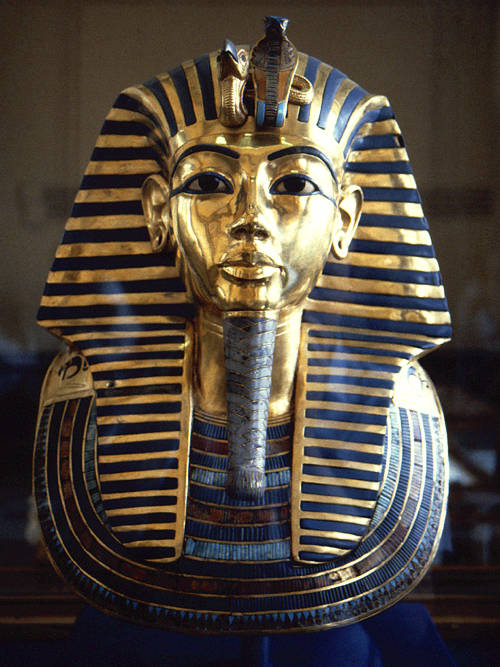
The 1922 discovery of the undamaged tomb of Pharaoh Tutankhamun revived public interest in ancient Egypt; the treasures of "King Tut" influenced popular fashion and design, particularly Art Deco.[15] The discovery also led to sensational claims, promoted by the tabloid press, of a 'curse' that killed the discoverers. These claims were dismissed by Howard Carter.[16]
Agatha Christie's 1924 short story "The Adventure of the Egyptian Tomb" from her collection Poirot Investigates features mysterious deaths that occur during an archaeological excavation.[17] A popular "curse of the mummy" myth developed out the tabloid reporting on Tutankhamun's excavators, which in turn inspired the 1932 horror film The Mummy with Boris Karloff. Cinema, and later television (see below), has proven to be one of the most powerful and enduring forms of imagining and re-imagining ancient Egypt since the medium's invention.
In 1993 Las Vegas's Luxor Hotel opened with its replica tomb of Tutankhamun.
In 1978, American comedian Steve Martin recorded the novelty song "King Tut". A 1986 hit song and music video by American rock band The Bangles called "Walk Like an Egyptian" evoked poses from the mural art of ancient Egypt.
HOWARD CARTER:
Howard Carter was born in Kensington, London on 9 May 1874, the youngest of
11 children of Samuel John Carter, an animal painter and illustrator for
'The Illustrated London News' and his wife Martha Joyce Sands. Much of his
youth spent at Carter family home at Swaffham, Norfolk, and his formal
education minimal - fact of which he was always painfully aware, and
partially explains his habitually abrupt and defensive manner. However, he
inherited considerable artistic gift and was trained by his father to be a
draughtsman: progressed so well that in summer 1891, aged 17, he was
recommended by future Lady Amherst of nearby Didlington to the young Percy
Newberry, an Egyptologist working at that time for the Egypt Exploration
Fund (EEF) - British sponsored archaeological survey of Egypt. Impressed by
Carter's talent, Newberry employed him to help ink-in tracings of tomb
scenes at Beni Hasan, an Egyptian Middle Kingdom archaeological site on the
eastern bank of the Nile - and in October 1891 Carter visited Egypt to work
as a junior artist at Beni Hasan and later at Deir el-Bersha. From there, in
February 1892, on the recommendation of William Amhurst Tyssen-Amherst
(later first Baron Amherst of Hackney), he then moved on to el-Amarna, where
he worked under the archaeologist W.M. Flinders Petrie, serving a
four-months apprenticeship as an excavator. However, Petrie was not
particularly impressed by Carter as an excavator, and advised that he stick
to drawing.
Carter returned to GB in mid-1892, filled with enthusiasm for archaeology,
and the following year he gladly returned to Egypt as a draughtsman for the
EEF. Accompanying the EEF Archaeological Survey to Thebes, he spent the next
six years there (1893-99) with Edouard Naville, copying the scenes and
inscriptions of the magnificent mortuary temple of the 18th-dynasty
woman-pharoah Hatshepsut at Deir el-Bahri. Was during these yrs that
Carter's potential was recognized by French Egyptologist Gaston Maspero, who
had recently been re-appointed head of the Egyptian Antiquities Service. One
of his first acts, in 1899, was to appoint Carter to the newly established
post of Inspector-General of Antiquities for Upper Egypt - Carter took up
post in January 1900, and from this time began to take an active and
increasing interest in the vast Theban necropolis. Was almost immediately
introduced to the Valley of the Kings, with the rearrangement and partial
removal to the Giza Museum of the royal mummies found in the tomb of
Amenophis II in 1898, which was about to be opened to the public. Over the
following years, Carter undertook the clearance of several new but plundered
tombs, not only for the Antiquities Service but also for Theodore Davis -
retired American lawyer who during these years would discover 2 new private
sepulchres and one royal one, belonging to Tuthmosis IV - Carter published
account of this latter discovery in 1904.
Carter did his job extremely well, and as a result in 1904 he was
transferred to the more prestigious post at Saqqara in the north (was
succeeded as Inspector-General by Arthur Weigall). However, within months he
had resigned - shocked everyone, and move cost him government career: affair
v. trivial - group of 14 French tourists visiting Saqqara on 8 Jan 1905,
several of which were drunk: fracas ensued with Carter's staff, and French
were refused a refund by Carter and told to leave. French lodged a formal
complaint and Carter hauled before Lord Cromer, British Consul-General and
asked to make formal apology - he refused on principal and given choice
between apologizing or resigning, he resigned. Typical of Carter - Maspero
much distressed by affair and wrote to several of Carter's friends asking
them to persuade him to reconsider, as did no want to lose him from
Antiquities Dept. but Carter adamant.
Result was that Carter spent next few years (1905-08) eking out meagre and
unsatisfactory living as a tourist guide, antiquities dealer and
watercolourist - did get few Egyptological commissions from Theodore Davis,
but was generally considered a failure by his colleagues. Big break came in
1908 with an introduction - engineered by his old boss Gaston Maspero - to
the fifth Earl of Carnarvon. Carnarvon had been devotee of infant sport of
motoring and was several times brought before magistrates for speeding;
inevitable serious accident came in Germany in 1903, from which Carn. left
incredibly weak (weighed only 8 stone 12 lb and cdn't put on anymore weight)
and vulnerable to cold and damp of English climate; result was that had to
spend winter months abroad, and in winter 1903 visited Egypt for the first
time - climate suited him well, but found Cairo dull. This why he took to
Egyptology, as way of passing time, but soon became dominating passion of
his life; first got permission to dig at Thebes from Maspero - via Sir
William Garstin, influential British adviser to the Public Works Ministry -
in 1906, but after 6 weeks' excavation only found "a large mummified cat in
its case" which he gave to the Cairo Museum. Carnarvan realized that he
needed expert help, and Maspero suggested Carter. Although v. different and
hugely different backgrounds, Carter and Carnarvon were both loners and took
to each other at once.
Pair began work in 1908, concentrated much of their efforts on Thebes.
Results of first excavation at Gurneh were immensely successful - Carter
discovering not only the decorated tomb of Tetiky (early 18th-dynasty mayor
of Thebes) but a further tomb containing 2 wooden tablets: one with moral
precepts of Ptahhotep, and other with part of text recording first steps in
the expulsion of the Hyksos by the 17th-dynasty King Kamose. Following years
brought equally successful results, Carter bringing to light a whole series
of important private tombs dating from the end of the Middle Kingdom to the
start of the New, and two 'lost' temples of Queen Hatshepsut and Ramesses
IV. In 1912 the report of the first seasons' work was published lavishly as
'Five Years' Explorations at Thebes, a record of work done 1907-1911'.
Volume received wide acclaim, and Carnarvon-Carter team now had
international recognition.
In 1912, while continuing to dig at Thebes, C & C decided to try their luck
at Sakha (ancient Xois) in the Delta: however, the team were forced to
abandon place after only 2 weeks "on account of the number of cobras and
cerastes [horned vipers] that infested the whole area". Two more
disappointments - at Dahshur and then Tell el-Balamun - followed, with
uninspiring yields, and after discovery of a hoard of Graeco-Roman silver
jewellry, work was abandoned and Lord Carnarvon returned home, while Carter
continued in Egypt, digging in tomb of Amenophis I. What they really wanted
was concession to work in the Valley of the Kings, but this still held by
Theodore Davis. Finally, in early 1915 Davis gave up the concession,
convinced that there was nothing left of worth in Valley, and C & C pounced
- on 8 February 1915 Carter began work at the tomb of Amenophis III in
western annexe of Valley of the Kings (the West Valley), which despite
having been dismantled during C10th BC yielded whole range of funerary
objects left behind.
However, Egyptian war now having effect on excavations: Carnarvon stuck in
England and Carter having to work more and more as diplomatic courier for
war effort. By 1917, Carter able to start work on Valley of Kings proper,
and over the following years, with brief interruptions, he proceeded to
clear the Valley down to bedrock in systematic search for a single tomb as
yet undiscovered - that of Tutankhamun. However, five years later, in 1922,
Carnarvon still had little to show for his money, and enthusiasm was
beginning to flag; summoned Carter to Highclere to tell him he was
withdrawing funding - Carter expecting this, and instead proposed to fund
one more season himself, clearing last triangle of ground which he felt
might yield results, and said that if find were made, it would belong to
Carnarvon as holder of the concession. Impressed by Carter's commitment,
Carnarvon relented and agreed to a final season - plus said that he would
foot the bill.
Work on final season began on 1 November 1922 - only three days later tomb
first came to light: story goes that on 4 Nov Carter's water-boy, struggling
to set up the communal 'zeer' (water jar) for the workmen, noticed a
straight edge cut into the rock. This, on further investigation, proved to
be the top of a step - which was followed by a second, and then a third,
until by 4 pm 5 November 12 steps and a tomb doorway had been uncovered,
plastered over its entire surface, stamped with large oval seals, but also
displaying - in top left-hand corner - evidence of 2 illicit entries and
subsequent reclosures (would later be revealed that ancient robbers had
stolen about 60 percent of the Treasury jewellery and some precious-metal
vessels, but not much else). At time of discovery Carnarvon was in England
and so Carter, with huge self-control, refilled the staircase and posted
guards. He then dashed off famous telegram to Highclere Castle - "At last
have made wonderful discovery in the Valley. A magnificent tomb with seals
intact. Congratulations". Was further 2 and half weeks before Carnarvon and
his daughter, Lady Evelyn Herbert, arrived at site on 24 November and
excavation could recommence. Piece by piece blocking was removed, showing
door with Tut.ankh.Amen written on it several times - door then removed,
revealing little by little a descending corridor, filled to ceiling with
packed limestone chip, through which a tunnel had been dug and anciently
refilled. By 4 pm on 26 Nov corridor was empty, and before them was a second
door, again faced with plaster and stamped with oval seals, and again
reclosed at top left-hand corner.
Not knowing what to expect - possibly a second staircase - Carter made small
hole in the sealed doorway and looked in: "At first I could see nothing, the
hot air escaping from the chamber causing the candle flame to flicker, but
presently, as my eyes grew accustomed to the light, details of the room
within emerged slowly from the mist, strange animals, statues, and gold -
everywhere the glint of gold." Pair enlarged whole and scrambled in to
Antechamber - knew now that had found something absolutely unique and
unprecedented. Over next 2 days they explored also the Annexe, Burial
Chamber and Treasury - although new royal tomb was one of smallest ever to
have been found in the Valley, was absolutely full of treasure - was now
certain that was Tutankhamun's tomb and that, despite ancient break-ins, was
virtually intact.
As euphoria settled, became obvious that find was an immense responsibility:
was huge amount of work to be done clearing the tomb - Carter immensely
conscientious and systematic, meant that everything carefully drawn and
described as it was removed - requiring skills of number of specialists.
Through yrs of dealing, Carter had established v. good working relationship
with Metropolitan Museum of Art in New York (had secured for it number of
important pieces), and was able to strike deal for loan of tow of their key
Egyptian Expedition staff members - Englishmen photographer Harry Burton and
Associate Curator Arthur C. Mace, expert in handling fragile ancient
materials. Carter also hired Alfred Lucas, the Egyptian Govt chemist, to
preserve finds.
While Carter dealt with archaeology, Carnarvon organized business side of
discovery - crucial decision was to channel results of daily work on dig
through 'The Times', for fee of £5,000, and 75 percent royalty on sales of
story to other newspapers (9 Jan). This financially shrewd, as paid for dig,
plus was also meant to avoid having hundreds of journalists on site -
however had v. bad political repercussions, plus 'Times's competitors
furious - meant excavators had to deal with on-going guerilla warfare from
journalists from the 'Times's' competitors and much mischief made as result.
(Main combatant was Carter's old rival Arthur Weigall - now employed by
'Daily Mail' who was constant thorn in side: oddly enough, was also him who
said, on observing Carnarvon's good humour at the opening of the Burial
Chamber doorway, "If he goes down in that spirit, I give him six weeks to
live" - Carn. died just over 6 weeks later: see 'Mummy's curse' below).
Effect was immense hostility from the press, and great anger in particular
from Egyptian press which obviously wanted to report on discovery - through
this, became a nationalist and therefore political issue: Egyptian
nationalists used whole thing as stick to beat English 'colonists' who they
wanted out.
Official opening of Burial Chamber took place on Sunday 17 February 1923, in
presence of Elizabeth, Queen of the Belgians, and 39 Egyptian, European and
American VIPs. First season ended on 26 February and corridor and entrance
refilled -much to everyone's relief. Situation had become v. fraught, esp
over negotiations for division of the finds - with Carter against any
division on archaeological grounds, while Carnarvon in favour. Lot rested on
whether tomb could be regarded as 'intact' or not: if intact, everything
would have to pass to Cairo Museum; if not (why evidence of robbery so
important) then Carnarvon could carry off generous share of treasures his
contract allowed. Both C & C by now at end of their tethers - with the tomb
and its treasures, with politics, and with each other (apparently fell out
entirely on 23 February - some say over Carnarvon's discovery that his
beloved daughter Lady Evelyn Herbert had developed crush on Carter: pair
rowed bitterly, and Carter threw Carn. out of house). Then, on 5 April,
disaster struck with Carnarvon's death from pneumonia, following infection
from mosquito bite - leaving Carter - by nature wholly unsuited to task - to
deal with public-relations re the dig, which was now hugely more vulnerable
without its influential sponsor and figurehead.
'Curse of Osiris': Lord Carnarvon's death focused popular attention on a
warning made just 2 weeks before by the novelist Marie Corelli that "the
most dire punishment follows any rash intruder into a sealed tomb". Public
chose to ignore fact that Carnarvon's constitution had not been strong since
1903, and that his annual pilgrimmage to Egypt had been undertaken primarily
on health grounds - preferred instead to regard his sudden death as the
inevitable consequence of having disturbed a Pharaoh's rest.
Rumour in fact was rife before this: day tomb was opened, Carter's pet
canary was swallowed by a cobra - very serpent on Tut's brow which spits
fire at his enemies. Then, at precise moment of Carnarvon's death, was said
that the lights of Cairo inexplicably went out, while at the same time, in
England, his three-legged terrier bitch, Susie, howled and dropped dead.
Demise of anyone who had been even remotely connected with Carnarvon, Carter
or the discovery was immediately seized on as further evidence for efficacy
of Tut's revenge - Carnarvon's younger brother, Aubrey Herbert, died
suddenly in Sept 1922; an X-ray specialist died unexpectedly while en route
to Egypt to examine the king's mummy; the American railroad magnate Jay
Gould died of penumonia, result of a cold contracted during a visit to the
tomb; Egyptian Ali Kemel Fahmy Bey was shot by his wife in the London Savoy
some time after viewing the discovery; Arthur Mace, Carter's right-hand man,
suffered health break down and died before tomb had been fully cleared; etc
etc. Many people believed in this - e.g. Arthur Conan Doyle attributed
responsibility for Carnarvon's death to "elementals - not souls, not spirits
- created by Tutankhamen's priests to guard the tomb".
However, stats drawn up by American Egyptologist Herbert E. Winlock in 1934
paint different picture. Of 26 people who had been present at opening of the
tomb, six had died within a decade; of 22 who had witnessed the opening of
the sarcophagus, only 2 had died; while of the 10 who had been present at
the mummy's unwrapping, none had yet succumbed to the "curse". (Indeed,
Carter himself did not die until 1939, aged 64, while many others closely
involved lived til ripe age, several into their 80s). Carter's share of
curse was perhaps instead Carnarvon's politcal legacy: with Carnarvon still
alive, had been a chance that the ever-widening cracks could be papered
over. With his unexpected death, matters - in hands of ill-tempered,
inflexible and uncompromising Carter - would go from bad to worse.
During summer, Carter (with Mace) began writing what would eventually be
three-vol work of great importance on find, 'The Tomb of Tutankhamun'
(1922-33). Second season began in October 1923, with Carter keeping
ill-advised agreement with 'Times', made worse by Carter's clumsy attempt to
deflect criticism by taking on 'Times' journalist Arthur Merton as an
official member of the excavating team. He also enraged everyone by
insisting that there should be no disruption to work by constant stream of
visitors, official or otherwise, but viewings would only be permitted "when
convenient". Outcome of long series of battles, obstructions and exchanged
insults both with Pierre Lacau (Maspero's successor as Director-General of
the Antiquities Service) and then with Morcos Bey Hanna, the newly appointed
Egyptian Nationalist Minister of Public Works, was that Carter finally
snapped - physical exhaustion combined with awesome responsibility of
dismantling the fragile shrines, plus all political problems, meant that on
12 February 1924 he downed tools, leaving the heavy lid of Tutankhamun's
sarcophagus suspended perilously above the king's shrouded form. Was first
strike in archaeological history, and Carter's biggest mistake: meant that
he had played into Lacau's hands - contract for the Carnarvon concession
(which had been renewed after his death by his wife) was now deemed broken,
and it was duly revoked. Result was that, rather than being seen as the
victim of the situation - selfless scholar doing his job (this quite near
truth - didn't appear to want much financial gain from find), Carter thus
became villain of piece, putting treasures at risk to make his own point.
Meant that one by one his friends and supporters began to distance
themselves from his high-handedness, and in desperation he resorted to the
courts - where acceptable compromise almost reached before being blown by
Carter's lawyer, F.M. Maxwell, who described Egyptian govt in matter of
Tut.'s tomb as "acting like bandits". Egyptian govt then guided by
ultra-nationalist PM Saad Zaghlul; this comment came in court at time of
intense anti-British feeling in Egypt, and provoked rioting in streets.
British Govt now wanted Carter out, and situation made worse by - while
Carter in US on extensive lecture tour in March 1924 - discovery, during
official inspection of his original storeroom (the tomb of Ramesses XI)
brought to light a wonderful and undocumented head of Tutankhamun
deliberately hidden, so it appeared, in a Fortnum and Mason's wine crate.
Huge furore broke out over this - committee believed that Carter had hidden
it intentionally, and situation only saved by intervention of Herbert
Winlock, and scandal narrowly averted. While in US, meanwhile, Carter
enthralled audiences with his lecture on discovery, and completed his
74-page pamphlet, 'Tut.ankh.amen, the Politics of Discovery' (June 1924),
his apologia and justification for actions which recounts in minute detail
events leading up to suspension of work. Had limited distribution, but still
caused trouble (lost him also Winlock's support) until he was persuaded to
suppress it altogether and at last to withdraw from his confrontation with
Lacau and the Egyptian Govt.
Strangely enough, problems surrounding Tutankhamun finally resolved
themselves, rather anticlimactically. Carter agreed to renounce all personal
claim to the antiquities in the tomb, and Lady Carnarvon followed suit,
though the Carnarvon estate refused to drop its claim to some form of
compensation (would eventually, in 1930, receive £36,000). Then came
terrorist murder of the British Commander-in-Chief of the Egyptian Army, Sir
Lee Stack, on 19 Nov 1924, which resulted in drastic tightening of British
control over Egypt - installation of new, pro-British govt, and Zaghlul and
nationalists were out. Meant that Carter was allowed to return, though this
time on the Egyptians' terms - agreed not to renew 'Times' monopoly for
third season, an daccepted nominal govt supervision of his work in the form
of an Antiquities Service inspector, Rushdi Effendi. Carter received new
concession on 13 Jan 1925 and started new season on 25 Jan, able at last to
return to monumental task of clearing and recording the tomb. Hazardous task
of unnesting coffins successfully achieved, body of king unwrapped and
revealed, and in due course builk of treasures extracted, packed and
transported, with minimal loss, to Cairo Museum. Was huge triumph for Carter
- his character, which had brought him and dig so much trouble, made him
perfect for job: was totally dogged, meticulous and determined. Truth was,
it was a job no one else wanted - work continued for more than 7 years, and
study of its contents and preparations for publication would hang as burden
around Carter's neck for rest of his life.
Carter finally completed his work of conservation on the Tutankhamun objects
in spring 1932, four years after last chamber had been cleared and almost a
decade after the initial discovery. Third and final part of "the preliminary
narrative", 'The Tomb of Tutankhamen', appeared in 1933, and the next years
were occupied with the preparation of the definitive, six-volume work on the
discovery, which was to be entitled 'A Report Upon the Tomb of Tut'ankh
Amun'; however, progress was slow, and in the end appears task was too much
for him. He died in London on 2 March 1939, still a bachelor, having
received much fame and some fortune, but no public honour. He left bulk of
his estate to his niece, Phyllis Walker. A portion of his small, but choice,
collection of antiquities passed via King Farouk to the Cairo Museum; other
pieces were sold, through London dealers Spink, and objects from it are now
in half a dozen collections round the world.