Appleton, Edward
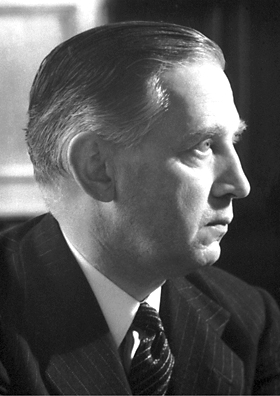
ACHIEVEMENTS:
Discovered ionosphere
DATE AND PLACE OF BIRTH:
6 September 1892, Bradford, Yorkshire, England
DATE AND PLACE OF DEATH AND AGE AT DEATH:
21 April 1965, Edinburgh, Scotland. Aged 73
DISCIPLINE:
Physicist
FIELD:
Physics
EDUCATION:
Hanson School, Bradford
University College School, London
St John's College, Cambridge University
MAJOR WORK:
None
LIFE AND TIMES:
Appleton was a brilliant student who as a postgraduate began working on crystallography. His career was interrupted by World War I (1914-18), during which he served as a signals officer and became interested in radio. He returned to Cambridge University after the war and worked on vacuum tubes before beginning to investigate why and how radio waves faded (in particular why Cambridge reception from a broadcasting station in London faded in and out).
In 1924 he was appointed professor of physics at London University and during his first year experimentally verified the theory put forward (separately) in 1902 by Heaviside* and Kennelly* of an ionized layer in the upper atmosphere that reflected radio waves back to Earth.
He used the new British Broadcasting Company's transmitter at Bournemouth on the south coast of England, varying a signal at a constant rate so that interference between the direct waves from the ground and the reflected waves from the sky produced the regular fading in and out of the radio waves.
Having proved that the Kennelly-Heaviside layer of ionization really existed, Appleton continued to work on electromagnetic waves and what happened to them in the ionosphere. He and his team were able to measure the height of the reflecting ionized layer and they discovered two more layers: the so-called Appleton layer*, or F layer (at more than twice the height of the Kennelly-Heaviside, or E layer) and the D layer, below E. They also demonstrated that the reflected wave was elliptically polarized and were able to describe its daily and seasonal variations, and to supply data for mathematical analysis of reflection and density. These findings resulted in better long-range radio communication and also contributed to the development of radar.
Appleton returned to Cambridge University in 1936 as professor of natural philosophy and when World War II broke out in 1939 he was appointed secretary of the British government's Department of Scientific and Industrial Research. He was involved in work on radar and on the atomic bomb. In 1947 he won the Nobel Prize in physics.
ASSESSMENT: Made a significant contribution to the development of radar and improved long-range radio communications.
EXTRA CONNECTIONS: None
ONELINER: Edward Appleton, discoverer of the Appleton layer
BIBLIOGRAPHY:
DSB; EB
LANGUAGE:
English
PARENTS:
Father: Peter Appleton
Mother: Mary Wilcock
SPOUSE:
- Jessie Longson
- Helen Allison
CHILDREN:
By Longson:
2 daughters: Marjery, Rosalind