Haydn, Michael
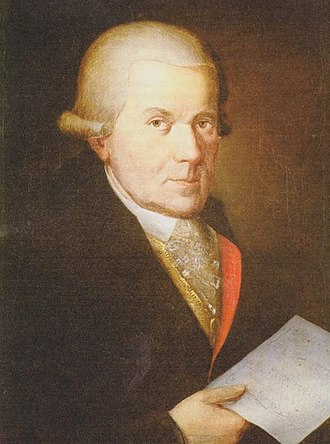
Name: Johann Michael Haydn
Achievements: Church music
Born: September 14, 1737; Rohrau, Austria
Died: August 10, 1806; Salzburg, Austria (Aged 68)
Field & Discipline: Music; Composer
Language: German
Father: Unknown
Mother: Unknown
Siblings: Franz Joseph Haydn
Spouse: Maria Magdalena Lipp
Children: Aloysia Josepha, died in infancy
Education: Choir School, St Stephen's Cathedral, Vienna
Major Work:
"Requiem in C Minor"
Life & Times:
At 20, Haydn was appointed Director of Music to the Bishop of Grosswardein in Hungary (now Oradea, Romania). During this period he composed several masses, a "Te Deum", symphonies and a concerto.
In 1762, Haydn was offered the post of court musician and Konzertmeister to Archbishop Sigismund Schrattenbach of Salzburg, and remained in Salzburg as concertmaster for the rest of his life.
The Salzburg court was renowned for its music. When Haydn arrived, there were about 100 musicians, who provided music for a great variety of functions, both in church and for secular occasions.
Haydn and music colleague Anton Cajetan Adlgasser, who had been first organist at St. Stephen's Cathedral and Dreifaltigkeitskirche, collaborated on a number of vocal works, the best known being the oratorio "Die Schuldigkeit des ersten Gebots" Haydn wrote the second act, Adlgasser the third and the first was written by the 11-year-old [collaborated with] Mozart*.
When Adlgasser died in 1777, Haydn became organist at the Dreifaltigkeitskirche, and Mozart was appointed cathedral organist at St. Stephen's. After Mozart's break with Archbishop Hieronymus Colloredo in 1781, Haydn took over the cathedral post as well.
One of Haydn's main tasks as cathedral organist was to teach keyboard and composition. He found teaching rewarding and among his famous chorister-pupils was [taught] Karl Maria von Weber*. Haydn wrote many famous compositions for his choristers, including the " Missa Sancta Aloysii" (1777), and the " Missa Sancta Leopoldi" (1805, his last completed work).
On the death of Archbishop Sigismund in 1771, Haydn wrote one of his most famous works, the "Requiem in C minor", which was also performed at the funeral of his brother, [brother was] Joseph Haydn*. There are striking similarities between this work and Mozart's Requiem, written 20 years later, which make it seem likely that Mozart knew Haydn's score.
Haydn's next important work was his "Missa Sancta Hieronymi" in 1771, a large and festive work with unusual scoring for oboes, bassoons and trombones rather than strings. Haydn and the Mozarts were friendly and Mozart wrote two duets for violin and viola for him in 1783, when Haydn was too ill to fulfil a commission.
The "Enlightened" church reforms of the late 18th century affected sacred music in Salzburg, as in Vienna. The reformers demanded a reduction in the number of religious services and simplification in those that remained. Edicts were also passed against instrumental music and florid, soloistic music in churches.
Archbishop Colloredo instructed Haydn to compose short choral settings of the Proper for each Sunday and festival to replace the purely instrumental settings, including trumpet and violin concertos, that had been played during Mass in Austrian and Italian churches.
Between 1783 and 1790, Haydn wrote some 100 Latin compositions, mostly to texts for the offertory and gradual during Mass. The reformers also demanded a return to congregational singing in German, and Haydn edited the hymnal that had been approved for the Salzburg province, simplifying some of the melodies and adding others.
His setting of the German Mass "Hier liegt vor deiner Majestat" became especially popular.
Probably through the recommendation of his brother, Haydn received a commission to write a mass for the Spanish court in 1786. His festive "Missa a due cori" (also known as "Missa Hispanica") for double choir, organ and large orchestra brought him much praise. Haydn revisited Vienna in 1798, chiefly to see his brother.
Haydn's "Missa sotto il titolo di Teresa", completed in 1801, was a mass written in honor of Empress Maria Theresa, wife of Franz I, who was an able singer and liked to participate in performances of sacred music. The mass dedicated to her was performed in Vienna in 1801, with Haydn conducting and the empress singing the soprano solos.
During the Napoleonic Wars, in 1801-02 Salzburg was occupied by the French and Haydn escaped to Vienna. During the last year of his life Haydn was frequently ill.
Assessment: During his lifetime he was considered a better composer of church music than his brother, Joseph
Oneliner: Michael Haydn, church music composer and brother of Joseph
Bibliography:
- Encyclopedia Britannica.
- Pauly, Reinhard G., "Haydn, Michael" in The New Grove Dictionary of Music and Musicians, ed. Stanley Sadie, London: Macmillan, 1960.